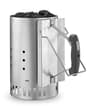
What a chimney starter actually does
It is a chimney, in the literal sense. Hot air from a small flame at the bottom rises through the tube, air is pulled in through the vents at the base to replace it, and that draft drives the fire upward through the charcoal far faster than an open pile would burn. There is no clever engineering to pay for: the tube, the holes and the grate that holds the coals above the flame are the whole design.
The reason it matters for barbecue specifically is what it replaces. Lighter fluid burns off in a couple of minutes on a hot grill, which is why it is tolerable for burgers. In a smoker you are running a low fire for six, ten, sometimes fourteen hours with the food in from the very start, so anything that tastes of solvent early gets a long time to settle into the meat. A chimney removes the question. It is also why our charcoal guide tells you to avoid self-lighting briquettes, which are pre-soaked in the same fluid.
The second thing it buys you is evenness. Coals lit in a chimney all catch at roughly the same time, so when you pour them in you are starting from a known state rather than a pile where half the briquettes are still black. For a cook that lives or dies on holding 225–275°F — the band the USDA gives for smoking — starting from evenly lit coals is most of what makes the first hour predictable.
What actually separates one chimney from another
Four things, in this order. Everything else is packaging.
- Published capacity. Not “large” — a number. Kingsford states that a standard chimney holds about 4 pounds of briquets, which is about 100 of them, and that is a useful benchmark to hold every other claim against. If a maker will not say, assume standard.
- What the body is made of. Aluminized steel (Weber) and stainless (Oklahoma Joe’s) are the two materials named on the pricier picks; the budget chimneys use galvanized, or zinc-coated, steel. All of them light charcoal identically on day one. The coating is a question about season three, not about tonight.
- The handle situation. You will be tipping several pounds of live coals, so the handle is the safety feature. Weber pairs a heat shield with a flip-up helper handle so you can use two hands; Oklahoma Joe’s states a cool-touch handle; Char-Griller uses an ABS plastic handle with a shield; the Amazon Basics states an insulated cool-touch handle and a large vent hole. Gloves are still the right call with any of them — Weber and Kingsford both say so on their own pages.
- How the coals come out. Almost every chimney pours sideways, which is fine over an open kettle and awkward over a smoker. A trigger-release base, like Char-Griller’s, drops the coals straight down instead, which is the one genuine design difference on this page.
What you cannot judge from a listing is lighting speed. Every maker claims fast; one claims twice as fast as everyone else. Those are marketing claims, we have not timed them, and we are not going to repeat them as if we had. In practice Kingsford’s own guidance — coals glowing through the vents at about 15 to 20 minutes — is the number to plan your cook around.
How much charcoal do you actually need to light?
This is where capacity stops being trivia. A chimney that holds less than your cooker needs means lighting two loads and waiting twice; a chimney far bigger than your cooker just gets filled halfway, which is harmless. When in doubt, size up.
| What you are lighting | Roughly how much | Notes |
|---|
| A long low-and-slow cook (minion method) | A partial chimney of lit coals | You light a small amount and pour it onto a full bed of unlit charcoal; the fire spreads slowly for hours |
| A 14-inch bullet smoker | Well under a full chimney to start | A small firebox needs a small fire; a full chimney of lit coals will overshoot your target temperature |
| An 18 to 22-inch bullet smoker | Part of a chimney, onto a full ring | The ring holds hours of fuel; you are only lighting the starter portion |
| An offset firebox | A chimney of coals, then wood splits | Charcoal establishes the coal bed; the splits do the cooking from there |
| Topping up a fading fire mid-cook | A partial chimney, lit separately | Always add lit coals to a running smoker — dumping raw briquettes in makes acrid smoke over your food |
| A 22-inch kettle for grilling | A full chimney | This is the load a standard chimney was designed around |
Notice how often the answer is “part of a chimney.” That is the single biggest difference between grilling and smoking, and the reason a big chimney is never a mistake while a small one can be. For how much fuel a whole cook needs rather than just the lighting stage, our guide to how much charcoal to use works through it by cooker and cook length.
How to use one, start to finish
- Set it somewhere fireproof. The grill grate, a concrete slab, a paving stone. Never on a wooden deck, plastic table or dry grass — the base gets hot enough to scorch, and embers do fall through.
- Fill the top. Charcoal in the upper chamber, on top of the grate. Do not pack it down; the draft needs gaps to pull through.
- Put the starter underneath. A lighter cube, a couple of sheets of loosely crumpled newspaper, or a paper bag — in the chamber below the grate, not stuffed in with the coals.
- Light it in two or three places and leave it alone. Poking at it interrupts the draft that is doing the work.
- Wait for the top layer to ash over. Kingsford puts this at about 15 to 20 minutes, when coals glow through the vents and flames flicker over the top. Gray ash on the top coals is the signal — not flames, which come earlier.
- Pour with gloves on, and with intent. Know where the coals are going before you lift it. Two hands if your chimney has a helper handle; a trigger release if you are aiming into a basket.
- Put it down somewhere safe and forget it for an hour. An empty chimney stays hot for a surprisingly long time.
The gloves are not optional politeness. Weber recommends them on its own product page, Kingsford says the same in its lighting guide, and the pour is the one moment in a barbecue day where a slip has real consequences. Long-cuff BBQ gloves protect your forearms, which is where a chimney radiates heat as you tip it.
What to light it with
Newspaper is free and works. Two or three sheets, crumpled loosely rather than balled tight, is genuinely all a chimney needs on a dry day. If you have paper in the house, start there and spend nothing.
Lighter cubes are the upgrade, and what they buy is reliability rather than results. One cube, one match, walk away — no relighting, no fishing for newsprint that has gone out under the grate, and it still works when the wind is up or the paper is damp. Weber describes its cubes as ash-free ignition that lights the charcoal without the smell or taste of lighter fluid reaching the food, which is exactly the property you are buying.
Two things to skip: lighter fluid, for every reason above, and self-lighting briquettes, which are the same fluid sold pre-absorbed into the charcoal. Neither belongs anywhere near a cook where the food sits in the smoke for hours. An electric loop lighter or a propane torch also works well if you already own one, and neither taints anything — but neither is worth buying before a chimney.
Do you need one at all?
Only if you burn charcoal. A pellet smoker lights its own fire with an igniter rod, an electric smoker has a heating element, and a propane smoker lights with a knob and a match. None of them has any use for a chimney, and it is worth knowing that before you add one to a starter-kit order out of habit.
If you own a charcoal smoker, a kettle, a kamado, a drum or an offset, then this is one of the few accessories we would call close to essential rather than nice to have. It costs a fraction of what the smoker did, it removes the single most common source of off-flavor in a beginner’s first cooks, and there is nothing about it to learn or maintain.
The mistakes that catch people out
- Pouring too early. Flames at the top mean the fire is traveling; gray ash on the top coals means it has arrived. Pour at flames and you will be chasing your temperature for an hour.
- Packing the charcoal tight. A chimney runs on draft. Fill it, do not compress it.
- Lighting a full chimney for a low-and-slow cook. Several pounds of fully lit coals into a small smoker overshoots 250°F badly, and bringing a smoker back down is much harder than bringing it up. Light less than you think.
- Adding unlit charcoal to a running cook. Raw briquettes smolder and put dirty smoke over your food. If the fire needs help, light the new coals in the chimney first — the reason a second cheap chimney is a genuinely good purchase.
- Setting it down on something that burns. Decking, plastic furniture, the lid of your cooler. The base is the hottest part.
- Leaving it out in the rain all season. Any steel tube left wet rusts through eventually. Under cover, upside down, and it lasts years.
None of these are hard to avoid, and none of them require gear. That is really the summary of this whole page: a chimney starter is a cheap, dumb, unbreakable object that fixes a real problem, which makes it one of the few genuinely worthwhile items in our smoker starter kit. Buy one, keep it dry, and put the money you did not spend on gadgets into better wood instead.