The four things that decide whether a smoker travels
- Does it need mains power? Pellet grills do. Electric cabinets do. Charcoal and gas do not. This is the first filter and it removes more cookers than anything else.
- Can one person lift it into a car?Not “is it compact” — a 14-inch bullet smoker is compact and comes apart into three awkward pieces. A tabletop kamado is small and dense and heavy. Both travel; they travel differently.
- Does it hold temperature in wind? A campsite or a car park has no fence and no house to shelter behind, and a thin-walled cooker loses heat to every gust. Insulated bodies and heavy ceramic do far better here than thin steel. Our cold-weather guide explains the same physics.
- Will the fuel fit in the car too? A pellet grill needs a bag of pellets and somewhere dry to keep it. Lump charcoal is bulky. Briquettes are heavy. Pack the fuel first and the cooker second, which is the opposite of what everybody does.
The picks against published figures
Only published numbers appear below. Where a maker does not publish a figure the cell says so — Weber publishes no cooking area for any Smokey Mountain and Pit Barrel publishes none for the Junior, and we are not going to invent one by measuring a photograph.
| Cooker | Fuel | Needs power? | Published cooking area | Published temperature range |
|---|
| Traeger Tailgater 20 | Wood pellets | Yes | 300 sq in | Not published |
| Char-Griller AKORN Jr. | Lump charcoal | No | 155 sq in | 200–700°F (Char-Griller) |
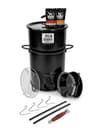
| Pit Barrel Junior 14 | Charcoal, hanging | No | Not published | Not published |
| Weber Smokey Mountain 14 | Charcoal | No | Not published | Not published |
Why the Tailgater wins if there is an outlet
Because it removes the hardest part of cooking away from home, which is fire management in conditions you cannot control. You set a temperature on the controller and the grill holds it whether you are on a patio or in a car park. The legs fold, 300 square inches is enough for a rack of ribs or a couple of chickens, and pellets are the one fuel you can buy almost anywhere.
The honest trade is the one in the spec table: 300 square inches is tight, a brisket will not fit, and the hopper is small enough that a long cook means carrying spare pellets and refilling. It also costs more than roomier pellet grills that stay at home, because you are paying for the folding legs.
Why the AKORN Jr. wins if there is not
A tabletop kamado is the best thing in this category at the job portability makes hardest: holding a low temperature with no help from a thermostat. The insulated double-wall body is doing what thick ceramic does in a full-size kamado, and Char-Griller publishes a 200–700°F range for it, which means the same cooker smokes at 225°F and then sears at the top end.
155 square inches is genuinely small — one chicken, or a rack of ribs cut in half. And it has short legs, so it needs a heat-safe surface rather than a camping table, which is worth planning for. NFPA’s grilling guidance is blunt about clearance from anything that burns, and a picnic bench is exactly the kind of surface it means.
A word on cooking away from a kitchen
Two practical things get overlooked on this kind of trip. The first is that USDA’s smoking guidance assumes two thermometers, one for the food and one for the chamber, and a travelling cooker gives you fewer clues than the one in your garden does — no familiar lid thermometer reading to compare against. A wireless leave-in thermometer matters more here, not less.
The second is cooling. USDA guidance is to refrigerate within two hours, and a cooler full of melted ice is not a refrigerator. Plan what happens to the leftovers before you cook twice what you will eat, which is also an argument for the smaller cookers on this page rather than against them.
If you do not actually need to travel — if the real constraint is a small patio or a balcony — read the small-spaces page instead, which has different picks for a good reason. And if you have not decided on a fuel yet, how to choose your first smoker is the right place to start.