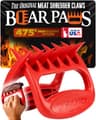
Nylon or steel? This is the whole decision
Everything else about meat claws is cosmetic. The tines are either a hard plastic or a metal, and the two behave differently in ways that matter.
Nylon tines are blunter. On a pork shoulder that has been cooked properly that costs you almost nothing, because the meat is already surrendering. What nylon buys you is everywhere it touches: it will not scratch a nonstick pan, will not score a wooden board, and does not conduct heat up into your fingers the way a metal tine does. If you shred in the foil pan the meat came out in, or in a slow cooker, nylon is the right answer and it is not close.
Stainless steel tines are sharper and narrower, so they go into a tight, slightly underdone shoulder in fewer passes. They also do not soften, flex or melt — which matters because no maker on this page publishes a heat rating for anything. The cost is real: steel will scratch nonstick and will mark wood, and the LOPE & NG set pairs steel tines with wooden handles, which means hand washing.
Our read, for a beginner: buy nylon. The surfaces in most kitchens are nonstick or wood, and the case for steel is strongest on exactly the cook you should not be having — a shoulder that came off too early. If that is happening, the fix is in our pulled pork guide rather than in the cutlery drawer.
The four sets on published figures
| Claws | Tine material | Heat rating | Origin | Safe on nonstick? |
|---|
| Bear Paws | Nylon | Not published | USA made (listing) | Yes |
| Alpha Grillers | Not published | Not published | Not published | Unknown — no material stated |
| LOPE & NG | Stainless steel | Not published | Not published | No |
| Cave Tools | Not published | Not published | Not published | Unknown — no material stated |
Two of those rows say “not published” for the one spec that decides the purchase, and we would rather print that than invent it. It is also the clearest argument for the Bear Paws: at a few dollars more, you know what you are holding.
How to actually use them, which is not obvious
Most people pick up claws and start stabbing. There are three distinct moves and only one of them is shredding.
- The lift. Drive both sets of tines in from opposite sides, low and under the widest part of the shoulder, and lift with your palms rather than your fingers. The weight sits on the claw bodies, not on the tines. This is the move that justifies the purchase.
- The pull. Anchor one claw in the meat and pull the other through it along the grain, like combing. Short strokes. If you are having to work at it, the meat is not done — see below.
- The toss. Once it is all shredded, use the claws upside down as a pair of giant salad hands to fold the meat through its own juices. This is the step that keeps pulled pork from drying out in the pan, and it is far easier with claws than with tongs.
One safety point that is easy to skip: claws are a raw-and-cooked crossover tool. USDA warns that bacteria from raw meat and poultry juices can contaminate safely cooked food when the same platter or utensils are reused, so if you used the claws to wrestle a raw shoulder into the smoker, wash them before they touch the cooked one.
If shredding is hard work, the claws are not the problem
This is the single most useful thing on this page. Pulled pork that resists being pulled is not under-equipped, it is undercooked. Pork shoulder is full of collagen, and collagen does not break down at the temperature that makes pork safe— it needs a long stretch far above it.
USDA’s safe minimum for pork is 145°F with a three-minute rest, and USDA is explicit that doneness and safety are two different questions: tough cuts are taken well past the safety figure for texture. In practice a shoulder pulls easily somewhere around 200°F internal, and the honest test is not the number but the probe — it should slide in like the meat is softened butter. Our smoke times and temperatures page has the full chart, and a decent thermometer is the accessory we would buy before claws, every time.
If it is pulling but drying out as you go, the problem is usually that it was shredded too early or rested wrong — how to rest smoked meat covers the cooler hold that fixes it, and why is my smoked meat dry covers the rest.
What else claws are good for
Pulled pork is the headline but it is not the only use, and this is where the cheap sets earn back their price:
- Chicken. Shredding a smoked chicken for tacos or soup is faster with claws than with anything else, and a whole bird is light enough that nylon handles it easily.
- Lifting a turkey. Getting a cooked bird out of a smoker is the classic two-people-and-a-tea-towel job. Claws make it one person. See how to smoke a turkey.
- Slow-cooker and oven work. Cave Tools is the only listing here that names slow-cooker use, and it is where most people first wish they had claws.
- Brisket, carefully. Claws can move a packer off a grate, but a brisket gets sliced rather than shredded — for that you want a long knife and a big board.
What they are not for is anything hot enough to melt them. None of these listings publishes a heat rating, so treat claws as a handling-and-serving tool and keep them off the grate. For work over live fire you want 16-inch tongs and heat-resistant gloves, which are the two accessories that genuinely belong near the coals. The rest of the gear hub sorts the shelf by which problem each item solves, which is the only useful way to shop a category this full of gadgets.