Do You Flip Meat in a Smoker?
Almost never. Flipping is a grilling habit, and it exists because a grill cooks one side at a time. A smoker surrounds the food with hot air, so there is no 'down side' waiting its turn — and every time you open the lid to turn something, you pay for it.
How this is funded:we earn a commission if you buy through our links, at no extra cost to you. It never changes which smoker we recommend, and we’ll tell you when we’d skip one. Full disclosure.
Do not flip. On a long cook, rotate instead — turn the cut end-for-end once or twice so both ends spend time on the hot side, without ever turning it over. The only things worth actually flipping in a smoker are small items lying on a grate: sausage links, wings, thighs, burgers. Everything thick stays exactly as you put it in.
The reason is the cooking method, not tradition. A grill heats from one direction, hard, which is why a steak has a side facing the fire and a side that is not cooking yet. A smoker is a convection oven that happens to be full of smoke: USDA describes keeping the chamber between 225°F and 300°F, and at those temperatures the heat moves as circulating air rather than as radiant blast. Air does not have a direction in the way a fire does. Both faces of your brisket are cooking the whole time.
What flipping costs you
- Heat, immediately. Opening a cabinet smoker dumps the chamber and then the element or burner has to climb back. Do that six times on a ten-hour cook and you have added a meaningful stretch to the cook for no return.
- Bark, permanently. The crust you are trying to build is a dried crust, and dragging a brisket over a grate or pressing it down onto one takes some of it with you. Our bark guide covers how slowly that surface forms.
- Your probe placement. A leave-in probe that has been moved is now reading a different part of the meat, which is how people end up convinced a cut has stalled, raced or gone backwards.
- Fire stability, on charcoal. Opening the lid changes the draw through the vents, and the fire responds by flaring. On a bullet or a kamado that recovers slowly, a few openings genuinely change the shape of the cook.
Rotating is the thing you actually want
Almost no smoker is evenly heated, and this is the real problem people are trying to solve when they reach for a flip.
On an offset, the end of the chamber nearest the firebox runs hotter than the far end, sometimes by a lot. On a cabinet, the bottom rack sits closest to the element or burner. On a bullet or kamado the gradient is vertical rather than horizontal. A full packer brisket is long enough to span that difference, so one end finishes before the other.
The fix is a rotation: turn the cut 180 degrees in the horizontal plane, keeping the same face up, roughly halfway through the cook. In a cabinet, swap the rack positions instead. You get the evening-out effect for a single lid opening, and nothing about the bark or the fat cap changes.
Fat side up or down, which is the question behind the question
Most people asking about flipping are really asking this. The answer that survives scrutiny is simple: put the fat toward the heat.
A fat cap is a shield. It is dense, it conducts heat poorly, and it takes the worst of the radiant heat coming off the nearest surface before that heat reaches the meat. On a cooker where heat rises from below — which is nearly all of them — that means fat side down.
What a fat cap does not do is baste the meat. Rendered fat runs down the outside and drips off; it does not soak into muscle fibres, and a brisket cooked fat-side-up is not internally moister for it. If you have been placing cuts fat-side-up for basting reasons, you have been doing something harmless for a reason that does not hold. Place it as a shield instead and you will have a defensible rule.
Cut by cut
| What you are cooking | Flip? | Why |
|---|---|---|
| Brisket | No — rotate end-for-end once | Fat cap toward the heat; the bark stays where it forms |
| Pork shoulder | No | Fat cap up or down barely matters on a cut that gets shredded, and moving it loses bark |
| Ribs | Only at the wrap | Bone side down throughout; meat side down inside the foil or paper |
| Whole chicken or turkey | No | You want the skin on top undisturbed, and a bird cooks from all sides |
| Wings and thighs | Yes, once | Small, grate-contact items; turn again during a hot finish |
| Sausage links | Yes, once — unless hanging | Round casings develop a flat pale stripe where they touch steel |
| Fish fillets | No | A cooked fillet will not survive being turned; cook skin side down |
| Burgers | Yes, once | Thin and fast, and usually finished over direct heat anyway |
If you are going to turn something, turn it properly
Use long tongs rather than a fork. A fork punctures the meat and lets juice out, and a short pair of kitchen tongs puts your hand directly over a hot grate for longer than you want. There is also a food-safety reason to think about which pair you reach for: USDA warns plainly that you should not use the same platter and utensils for raw and cooked meat, because “harmful bacteria present in raw meat and poultry and their juices can contaminate safely cooked food.” If one pair of tongs went into the cooker with raw links, that pair should not be the one taking them off.
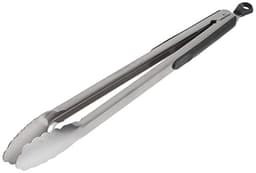
OXO Good Grips 16-Inch Locking Stainless Steel Tongs
Sixteen inches puts your knuckles well back from the grate, which is the whole argument for a smoker tong over the ones in your kitchen drawer, and the scalloped tips grip a slippery rack of ribs or a sausage link without crushing it. The lock-closed hinge means it hangs on a hook rather than sprawling in a drawer.
Price as of October 20, 2026. #ad How we’re funded
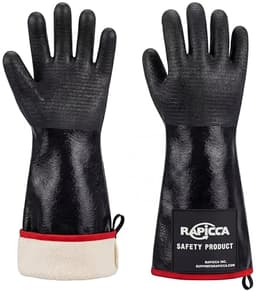
RAPICCA 932°F Heat-Resistant BBQ Gloves (14-inch)
Rotating a whole brisket or swapping two loaded racks is a two-hands job, not a tongs job. The 14-inch cuffs are the point: they cover your forearms, which is the part that actually gets burned reaching into a cabinet smoker or over a charcoal grate.
The habit worth building instead
Every reason to open a smoker should be a real one, and “checking” is not. The two legitimate ones are adding fuel or wood and taking a temperature, and both can be planned rather than improvised. USDA recommends running two thermometers while smoking — one in the food and one reading the chamber — which removes most reasons to lift a lid at all; our thermometer roundup covers what to use and how to use a smoker puts the whole routine in order.
Pair that with the discipline of leaving the food alone, and a long cook becomes dramatically less eventful — which is the goal. Bark forms, the temperature holds, and the only surprise left is the stall, which flipping would not have helped with anyway.
A note on food safety. Temperatures on this page follow USDA safe-minimum guidance. Always confirm doneness with a food thermometer, not by time or color. We’re enthusiasts sharing what we’ve researched, not professional pitmasters — when in doubt on safety, follow the USDA.
Frequently asked questions
Do you flip meat in a smoker?
Generally no. A smoker cooks by convection — hot air circulating around the food — so both sides are cooking the whole time and there is no down side waiting its turn. Flipping a brisket or a pork butt gains nothing and costs you heat, bark and sometimes a probe. The exceptions are small items on a grate, like sausage links and wings, and anything you are finishing over direct heat.
Should you rotate meat in a smoker?
Often yes, and this is the thing worth doing instead of flipping. Most smokers have a hot side — nearest the firebox on an offset, nearest the element or burner in a cabinet — and a long cut sitting across that gradient cooks unevenly. Turning it end-for-end once or twice, without turning it over, evens out the cook and costs you one lid opening.
Do you smoke a brisket fat side up or down?
Fat side toward your heat source. On an offset or a cabinet where the heat comes from below, that means fat side down, where it shields the meat from the most intense radiant heat. On a cooker where the heat arrives from above, flip the logic. The fat does not baste the meat — rendered fat runs off rather than soaking in — so treat the fat cap as a heat shield and place it accordingly.
Why shouldn't you open the smoker to flip meat?
Because every opening costs temperature and time, and in a charcoal cooker it also disturbs the fire's airflow. On a cabinet smoker the chamber dumps its heat the moment the door opens and then has to climb back, which lengthens the cook and makes your timing unpredictable. 'If you're lookin', you ain't cookin'' is a cliche because it is true.
Do you flip ribs when smoking them?
Not during a normal cook — ribs go on bone side down and stay there, because the bones shield the meat and the top surface is where the bark forms. The one exception is when you wrap: the usual method is to put the rack meat side down in the foil or paper, which means turning it over once at the wrap and once more when it comes out.
Should you turn sausage in a smoker?
Yes, once, if the links are lying on a grate. A sausage is round, so the part touching hot steel develops a flat, pale contact stripe while the rest of the casing dries evenly — turning the links halfway through fixes that. If you hang them instead, which is how a drum smoker works, there is nothing to turn.
Do you flip chicken in a smoker?
A whole bird, no — it cooks from all sides and you want the skin on top undisturbed. Wings and thighs on a grate, yes, turn them once, and turn them again if you are finishing them over high heat to crisp the skin. That finishing stage is grilling rather than smoking, and grilling is where flipping belongs.
What should you use to turn meat in a smoker?
Long tongs, not a fork — a fork punctures the meat and lets juice out, and a short pair of kitchen tongs puts your knuckles over a hot grate. USDA also warns against using the same utensils and platters for raw and cooked meat, because bacteria from raw juices can contaminate safely cooked food, so keep the pair you handled raw meat with away from anything coming off the cooker.
Sources
- USDA FSIS — Grilling and Food Safety — USDA guidance on utensils at the grill, quoted: 'Be sure there are plenty of clean utensils and platters. To prevent foodborne illness, don't use the same platter and utensils for raw and cooked meat and poultry. Harmful bacteria present in raw meat and poultry and their juices can contaminate safely cooked food.' And: 'When taking food off the grill, use a clean platter. Don't put cooked food on the same platter that held raw meat or poultry. Any harmful bacteria present in the raw meat juices could contaminate safely cooked food.' Surfaced by live search of fsis.usda.gov; the site returns HTTP 403 to a direct fetch from our build machine (accessed September 19, 2026)
- USDA FSIS — Smoking Meat and Poultry — USDA guidance to keep the smoker between 225°F and 300°F, use two thermometers (food + smoker), and refrigerate within 2 hours (accessed July 22, 2026)
- USDA FSIS — Food Thermometers — USDA on why a food thermometer is the only reliable way to know food has reached a safe temperature, and how to place the probe (accessed July 22, 2026)
- USDA FSIS — Safe Minimum Internal Temperature Chart — USDA safe minimum internal temperatures: 145°F for beef/pork/lamb steaks, chops and roasts (with a 3-minute rest), 160°F for ground meats, 165°F for all poultry (accessed July 22, 2026)
Keep reading
How to Control Temperature
The skill that makes lid-opening expensive, and how to hold a number without fiddling.
Learn the ventsHow to Get Good Bark
Why the top surface is where the crust forms, and what disturbing it actually costs you.
Build the barkBest BBQ Tongs
Length, tips and locking — the five pairs worth owning, including the cheap second pair for raw meat.
See picksHow to Smoke a Brisket
Where fat-side-down, rotating and the wrap all actually land in a real cook.
Cook it