How a drum smoker actually works
The barrel is essentially a chimney with the top mostly closed. Charcoal burns in a basket at the bottom, air enters through the intake vent near the base, and the heat travels straight up past the hanging meat before leaving through small holes in the lid. Because the barrel is tall and narrow, the column of hot air is fast-moving and remarkably even from top to bottom — much more so than a wide cooker of the same volume.
The self-regulating behavior comes from the fixed intake. With a set opening, the fire can only burn as hard as that opening allows, so it finds an equilibrium and holds it. Barrels run warmer than most people expect — in the 275°F to 300°F range rather than the traditional 225°F — and that turns out to be a feature rather than a compromise. Ribs finish in around four hours instead of six, pork butts in eight rather than twelve, and the higher heat renders fat more thoroughly.
If you have read that low and slow means 225°F and nothing else, this is the page to unlearn it on. What matters is that connective tissue gets enough time above roughly 160°F to break down into gelatin, and a cut held at 285°F reaches that state perfectly well — just sooner. The USDA guidance for home smoking keeps the cooker between 225°F and 300°F precisely because that whole band works.
Hanging versus grate cooking
Hanging is the drum’s signature and it does three things at once. It doubles your effective capacity, because a barrel that fits one grate can hang eight racks of ribs. It self-bastes, because the juices run down the length of the meat rather than pooling underneath it. And it puts the food in the hottest, fastest part of the air column, which is why drum cooks finish quickly.
It also takes practice. A slippery pork butt on a single hook can and will drop into the coals — the standard fix is two hooks, or a hook through the bone rather than the meat. Ribs hang from the second or third bone down so the weight is carried by a rib rather than by soft meat. Once you have done it twice it is second nature, but your first hang deserves a spare pair of hands.
Every drum here also takes a conventional grate, and there is no shame in using it. Brisket in particular is easier flat, and anything small — chicken thighs, sausages, a fatty — is simply less fuss on a grate. Hang what benefits from hanging and grate the rest.
Fixed vent or adjustable — which suits you
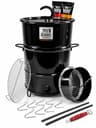
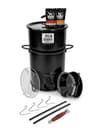
The Pit Barrel design gives you one vent and a philosophy: set it once, stop thinking about it — our barrel against the Weber Smokey Mountain is the comparison most people are really making, and the Pit Barrel Cooker review goes through what that costs you, starting with the 275–310°F range its maker publishes. The Bronco gives you an adjustable intake channel, so you can genuinely pull the temperature down toward 250°F for a long overnight cook or open it up for crisp chicken skin.
Neither is better; they suit different people. If the reason you are drawn to a drum is that you do not want to manage anything, take the fixed vent — the constraint is doing real work for you. If you already understand vents from a bullet smoker or a kamado and you want the hanging trick without giving up control, the Bronco is the better instrument. Our temperature control guide covers the vent logic if you want to understand what you would be adjusting.
Fuel and smoke in a drum
Drums run on charcoal with a couple of wood chunks buried in the basket. You do not need much wood — a barrel produces a lot of its flavor from the drippings hitting the coals, so two fist-sized chunks is plenty and four will be too much. Chunks, not chips: chips burn out in minutes in a fire this hot. See wood chips vs chunks for the reasoning, and the wood guide for which species to pair with which meat.
Either briquettes or lump works here. Briquettes give the steadier, more predictable burn that suits a set-and-forget cooker, and they are cheaper; lump burns hotter and leaves less ash. Our charcoal guide lays out the trade-off. Whichever you use, fill the basket completely even for a short cook — a drum snuffs its own fire when you close the vents at the end, and unburned charcoal is simply there for next time.
The honest downsides
Three, and none is a dealbreaker. First, a drum is not a low-temperature cooker, so if you are committed to 225°F brisket for its own sake, a fixed-vent barrel will frustrate you. Second, you cannot see or reach the fire once the lid is on and the meat is hanging — adding charcoal mid-cook means unloading the cooker, so load the basket properly at the start. Third, drums are poor grills; the fire sits too far below the grate for real searing.
What you get in exchange is the shortest distance between a beginner and genuinely good charcoal barbecue that we know of. If the offset is the romantic choice and the pellet grill is the convenient one, the drum is the pragmatic one.