Smoke & Slow

Best Charcoal for Smoking

Briquettes or lump, and which bag to actually buy. The fuel choice that decides how steady your first long cook runs — and why the cheap answer is usually the right one.

By Stephen V.Last updated How we pick

For low and slow, start with standard briquettes — and yes, that is the cheapest bag on the shelf. Briquettes are pressed to a uniform size, so they burn at a predictable, steady rate, and predictability is exactly what you want while you are still learning what your vents do. Lump charcoal burns hotter, faster and less evenly. It is the better fuel for a kamado and for searing, and the harder one to hold a twelve-hour temperature with.

That is the whole recommendation, and it saves most beginners about thirty dollars a bag. Below is what actually separates the two, when lump genuinely is the right answer, and four bags worth buying — chosen from what the listings state (how we pick), never from burn tests we did not run. Prices are pulled live. For how much of it to use, see how much charcoal to use in a smoker.

How this is funded:we earn a commission if you buy through our links, at no extra cost to you. It never changes which smoker we recommend, and we’ll tell you when we’d skip one. Full disclosure.

Quick picks

Ranked on published specs, beginner-friendliness and value. Select a row to jump to the full write-up. We haven’t cooked on every one of these — here is exactly what we do instead.

#ProductBest forPrice
1
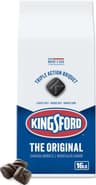
Kingsford Original Charcoal Briquettes (16 lb)

Kingsford Original Charcoal Briquettes (16 lb)

The right first charcoal, and it happens to be the cheap one. Briquettes are pressed to a uniform size, so they burn at a predictable rate — exactly what you want while you are still learning what your vents do. Lump burns hotter and less evenly; save it for searing and kamados. Start here and switch only when you have a specific reason.

Best overall for low and slow
2
Royal Oak Natural Organic Premium Briquettes (15.4 lb)

Royal Oak Natural Organic Premium Briquettes (15.4 lb)

The briquette to buy if the smell of charcoal lighting bothers you. It keeps the predictable shape and burn rate that make briquettes good for long cooks, but with a simpler ingredient list, so there is less to smell off during the first twenty minutes. You pay a real premium per pound for that.

Best cleaner-burning briquette
$28.41 · View on Amazon

Price as of September 5, 2026. #ad How we’re funded

3
Jealous Devil Chunx XL Lump Charcoal

Jealous Devil Chunx XL Lump Charcoal

The lump worth paying for. Big, dense hardwood chunks burn hotter and longer than the dusty small stuff, throw very little ash, and do not spark — which matters in a kamado, where you close a lid on the fire and leave it for hours. This is the bag that makes the case for lump rather than just being different from briquettes.

Best lump (kamados and searing)
$52.99 · View on Amazon

Price as of September 5, 2026. #ad How we’re funded

4
FOGO Premium Hardwood Lump Charcoal, Medium (17.6 lb) + 30 Fogostarters

FOGO Premium Hardwood Lump Charcoal, Medium (17.6 lb) + 30 Fogostarters

Medium-sized lump, which is the more practical shape for most smokers. Extra-large chunks are excellent in a deep kamado firebox but awkward in a shallow charcoal basket; these pieces stack evenly, light fast and still burn cleanly. This is the bundle version, which pairs the 17.6 lb bag with a box of thirty natural fire starters — the other half of getting a charcoal fire lit without lighter fluid.

Best everyday lump
$45.27 · View on Amazon

$49.358% off

Price as of September 5, 2026. #ad How we’re funded

The picks in full

#1Best overall for low and slow

Kingsford Original Charcoal Briquettes (16 lb)

The right first charcoal, and it happens to be the cheap one. Briquettes are pressed to a uniform size, so they burn at a predictable rate — exactly what you want while you are still learning what your vents do. Lump burns hotter and less evenly; save it for searing and kamados. Start here and switch only when you have a specific reason.

What’s good

  • Uniform size means a predictable, controllable burn rate
  • Cheapest fuel per hour of any charcoal on this page
  • Stocked everywhere, so restocking is never a project

Trade-offs

  • Leaves more ash than lump — clear the ash pan between cooks
  • Contains binders, so light it properly and let it ash over first
TypeBriquettes
Weight16 lb
BurnLong and steady; more ash than lump
Best forLow-and-slow in a bullet, drum or offset

Specs read from the product listing, on August 18, 2026. “Not published” means the maker doesn’t state that figure there.

#2Best cleaner-burning briquette

Royal Oak Natural Organic Premium Briquettes (15.4 lb)

The briquette to buy if the smell of charcoal lighting bothers you. It keeps the predictable shape and burn rate that make briquettes good for long cooks, but with a simpler ingredient list, so there is less to smell off during the first twenty minutes. You pay a real premium per pound for that.

What’s good

  • Uniform briquette burn with a simpler ingredient list
  • Noticeably less light-up smell than standard briquettes
  • Still burns long and steady enough for a full brisket cook

Trade-offs

  • Costs meaningfully more per pound than the standard bag
  • Harder to find in stores than the mainstream brand
TypeBriquettes
Weight15.4 lb
BurnSteady; cleaner light-up than standard briquettes
Best forCooks who dislike briquette light-up smell

Specs read from the product listing, on August 18, 2026. “Not published” means the maker doesn’t state that figure there.

#3Best lump (kamados and searing)

Jealous Devil Chunx XL Lump Charcoal

The lump worth paying for. Big, dense hardwood chunks burn hotter and longer than the dusty small stuff, throw very little ash, and do not spark — which matters in a kamado, where you close a lid on the fire and leave it for hours. This is the bag that makes the case for lump rather than just being different from briquettes.

What’s good

  • Large, dense pieces burn long and hot with very little ash
  • Almost no sparking or popping compared with cheap lump
  • Pure hardwood with no binders or additives, per the listing

Trade-offs

  • Several times the price per pound of standard briquettes
  • Irregular piece size makes a precise minion-method setup fiddlier
TypeLump (extra-large pieces)
Composition100% natural hardwood (per listing)
BurnHot and long, very low ash
Best forKamado cooking and searing

Specs read from the product listing, on August 18, 2026. “Not published” means the maker doesn’t state that figure there.

#4Best everyday lump

FOGO Premium Hardwood Lump Charcoal, Medium (17.6 lb) + 30 Fogostarters

Medium-sized lump, which is the more practical shape for most smokers. Extra-large chunks are excellent in a deep kamado firebox but awkward in a shallow charcoal basket; these pieces stack evenly, light fast and still burn cleanly. This is the bundle version, which pairs the 17.6 lb bag with a box of thirty natural fire starters — the other half of getting a charcoal fire lit without lighter fluid.

What’s good

  • Medium pieces stack evenly in a bullet or drum charcoal basket
  • FOGO rates it ready to grill about 15 minutes from lighting
  • Thirty aspen-and-wax fire starters included; they light from a match even when damp

Trade-offs

  • Burns down faster than extra-large lump on a long cook
  • More expensive per pound than briquettes
  • One 17.6 lb bag rather than a bulk pack — a long cook can use most of it
TypeLump (medium pieces)
Weight17.6 lb bag, bundled with 30 fire starters
BurnLit and ready in about 15 minutes, clean and hot
Best forCharcoal smokers and everyday grilling

Specs read from the product listing, on August 27, 2026. “Not published” means the maker doesn’t state that figure there.

Briquettes vs lump, honestly

 BriquettesLump
What it isCharcoal dust pressed with binders into uniform pillowsWhole hardwood charred into irregular chunks
Burn rateSlow, even, predictableHotter and faster; varies with piece size
Peak temperaturePlenty for smoking; modest for searingMuch higher — genuine searing heat
Ash producedNoticeably moreVery little
Cost per hourLowest of any smoker fuelTwo to four times higher
Best inBullet smokers, drums, offsetsKamados, and any high-heat grilling

The ash figure in that table is not trivia. Ash is what eventually chokes a long cook: it builds up under the fire, blocks the bottom vent, starves the coals of air, and your temperature slides away in hour six for no apparent reason. In an open bullet smoker there is room for it. In a kamado, with a small sealed intake, it is the single most common cause of a cook that mysteriously dies — which is why kamado makers insist on lump.

When lump is genuinely the right answer

Three cases, and only three.

  • You own a kamado. Use lump. The ash problem above is not optional advice, it is how the cooker works.
  • You want to sear. Lump reaches temperatures briquettes do not, which is what a steak crust needs. If your smoker doubles as a grill, keep a bag for grilling nights.
  • You dislike the smell of briquettes lighting. This is a real preference, not fussiness. Standard briquettes give off a distinct smell for the first fifteen or twenty minutes. Let them ash over fully before food goes near them and it disappears — or buy a simpler-ingredient briquette, or lump.

Outside those, briquettes will give you a steadier cook for less money. Competition cooks use both, and plenty of very good barbecue is made on the cheapest blue bag in the shop.

Never use these

Two things do not belong in a smoker, and one of them is sold right next to the charcoal.

  • Self-lighting or match-light briquettes. These are soaked in lighter fluid. In a grill, the fluid burns off in a few minutes before food goes on. In a smoker, where you are running a slow fire for twelve hours with the food in from the start, it taints everything. Buy plain briquettes and a chimney starter.
  • Lighter fluid, at any point. Same reasoning, worse. A chimney starter with a sheet of newspaper under it lights a load of charcoal in twelve minutes and costs about the price of one bottle.

A chimney starter is genuinely the highest-value cheap purchase in charcoal cooking, and it belongs on the same shopping trip as your first bag. Our chimney starter picks compare what each one actually holds, and our beginner starter kit covers the rest of the short list.

Charcoal is fuel, wood is flavor

A point that confuses a lot of first-time smokers: charcoal has already had its volatile compounds driven off during manufacture, which is exactly why it burns cleanly and steadily. That also means it contributes relatively little smoke flavor of its own. The barbecue flavor comes from wood you add on top of the coals.

For a charcoal smoker that means chunks, not chips — two or three fist-sized pieces buried in the unlit charcoal, so they catch gradually as the fire moves through rather than all at once. Our chips vs chunks guide explains why, and the wood guide covers which species to pair with which meat.

The corollary is that a bag of charcoal marketed with a flavor — mesquite briquettes, hickory briquettes — is not doing much. The wood content is small and burns off early. Buy plain charcoal and control the flavor with chunks, where you can actually adjust it.

How much to buy, and how to store it

A 16 lb bag of briquettes covers roughly two to three long cooks in a bullet smoker, depending on the weather and how well your cooker seals. Lump is harder to predict because piece size varies, but expect to get through it faster.

Charcoal keeps essentially forever if it stays dry, and is close to useless once it has been damp — it lights badly, burns cool and sputters. Store bags in a sealed bin or a dry shed rather than on a garage floor, where concrete wicks moisture upward. And never store charcoal that has been used and snuffed while it is still warm; give it a full day outdoors first.

On reuse: leftover charcoal from a snuffed fire is perfectly good, and in a kamado or drum it is the normal way to work. Shake the ash out, top up with fresh, and light as usual. Our guide to how much charcoal to use covers loading the basket for a given cook length.

Frequently asked questions

Is lump charcoal or briquettes better for smoking?

Briquettes for low and slow, because their uniform size gives a slow, predictable burn and they cost far less. Lump for kamados and for searing, because it burns hotter and leaves much less ash. In a sealed kamado the low ash matters enormously, since ash build-up chokes the intake and can kill a long cook.

What charcoal should a beginner buy?

Plain standard briquettes — the cheapest bag that is not self-lighting. They burn steadily and predictably while you are learning your vents, and they are the least expensive smoker fuel there is. Add a bag of lump later if you buy a kamado or want to sear.

Can you use match-light charcoal in a smoker?

No. Self-lighting briquettes are soaked in lighter fluid. On a grill the fluid burns off before food goes on, but in a smoker you are running a slow fire for hours with the food in from the start, so it taints everything. Use plain briquettes and a chimney starter.

Does charcoal add smoke flavor?

Very little. Charcoal has already had its volatile compounds driven off in manufacture, which is why it burns so cleanly. The barbecue flavor comes from wood chunks you add on top of the coals, which is also where you have real control over the result.

How long does a bag of charcoal last in a smoker?

A 16 lb bag of briquettes typically covers two to three long cooks in a bullet smoker, depending on weather and how well the cooker seals. Lump varies more because piece size does. Leftover charcoal from a snuffed fire is fully reusable once the ash is shaken out.

Sources

Keep reading