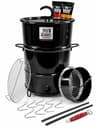
The two cookers on published figures
Both makers publish unusually little, and in opposite ways: Pit Barrel publishes a temperature range and a capacity list but no cooking area, while Weber publishes a cooking area and a component-by-component warranty but no temperature range and no weight for any Smokey Mountain size. Where a figure is not published we say so rather than estimate it.
| Pit Barrel Cooker 18.5 | Weber Smokey Mountain 18 |
|---|
| Air control | One vent, set once for altitude — not adjusted during the cook | Four dampers: three bottom intakes, one top exhaust |
| Published temperature | 275–310°F expected range when properly lit | Not published by Weber, for any WSM size |
| How food sits | Hangs from stainless hooks on rods, over the fire | On two plated steel grates, above a water pan |
| Published capacity | 8 racks of ribs, 2–3 pork butts or briskets, or 2 turkeys of 13–16 lb (maker) | Cooking area not published for the 18-inch; Weber publishes 726 sq in for the 22-inch |
| Charcoal per load | Approximately 10–12 lb (maker) | Not published |
| Water pan | None — drippings fall on the coals | Yes, and it is central to how the cooker behaves |
| Warranty | Not published on the pages we read | Weber publishes a tiered warranty: 10 years on the bowl, lid and center ring, 5 years on plastic parts, 2 years on everything else |
What the fixed vent actually buys and costs
The honest case for the Pit Barrel is that it removes the only part of charcoal smoking that beginners fail at. Temperature management is the skill, and a cooker with nothing to manage cannot be mismanaged. Pit Barrel’s own lighting instruction is a quarter basket of charcoal in a chimney for 11–12 minutes below 2,000 feet, or 12–15 minutes above it — and after that the barrel finds its cruising temperature and stays there.
The cost is that you cannot choose to cook low. A 275–310°F cooker finishes a pork shoulder in six or seven hours rather than ten, which many people consider the best feature on the page. But if you specifically want a long, cool brisket cook, or a gentle 200°F run on fish or sausage, the barrel will not do it — and the hanging method means a brisket cooks in a vertical orientation that takes getting used to.
The Smokey Mountain is the opposite trade. Nothing stops you running it at 225°F for fourteen hours, and the water pan makes that easy by absorbing swings — but there is no setting that guarantees it. You learn the vents, on your cooker, in your weather. For a lot of people that is the appeal rather than the price of entry.
Flavor, and the drippings argument
There is one genuine mechanical difference in how these two cookers make flavor. In the barrel, food hangs directly over the coals and the drippings fall into the fire, where they vaporize and come back up onto the meat. In the Smokey Mountain, a water pan sits between the fire and the food, catching the drippings and adding humidity instead.
That is why the two cookers taste different in a way the spec sheets cannot show: the barrel is closer to cooking over a fire, with a more roasted, direct character, while the bullet is closer to a gentle convection oven full of smoke. We have not run a side-by-side cook and will not pretend to have — but the mechanism is published, and it is not a small difference. People who have switched usually describe exactly that.
Which one should a beginner buy?
- Choose the Pit Barrel if your honest priority is getting a good result on the first attempt, you like the idea of a shorter cook day, and you mostly want ribs, chicken, wings and pork shoulder. It is also the better choice if you do not want to stand near a smoker learning anything.
- Choose the Smokey Mountain if you want to cook brisket low and slow, if you want one cooker that can be run at any temperature you choose, or if the long-term warranty and the enormous parts-and-community ecosystem matter to you.
- Choose the Oklahoma Joe’s Bronco if you read the above and wanted both. It is a drum — so it hangs food the same way — but with an adjustable air intake, so you can pull the temperature down for a long brisket or push it up for chicken skin. Oklahoma Joe’s publishes no temperature range for it, which is the honest limitation of that recommendation.
Two notes that apply whichever you buy. Both are charcoal cookers, so both want a chimney starter and a decision about lump or briquettes. And neither has a usable built-in way to know what the meat is doing — USDA puts the safe minimum for pork and beef at 145°F and poultry at 165°F, and a tough cut goes far past both, so a thermometer is not optional on either cooker.
Where to read more on each
We have a full review of each cooker rather than just this comparison: the Pit Barrel Cooker review goes through the hanging method, the fuel load and who should skip it, and the Weber Smokey Mountain review covers the vents, the water pan and the three sizes. If you have already settled on the bullet, our 14-inch versus 18-inch comparison is the next decision — the 18-inch fits a packer brisket and the 14-inch does not — and the bullet against a Weber kettle is the comparison worth reading if you already own a kettle.
Still deciding between charcoal and something easier? Our electric versus charcoal comparison is the honest version of that conversation, and best charcoal smokers lines up the whole category.