Can You Use a Smoker in the Rain?
Yes — barbecue happens in the rain all the time, and competition cooks do it every season. What changes is fuel use, temperature stability and how often you are willing to go outside. What does not change is the rule about electricity and the rule about never cooking under a roof.
How this is funded:we earn a commission if you buy through our links, at no extra cost to you. It never changes which smoker we recommend, and we’ll tell you when we’d skip one. Full disclosure.
Yes, you can smoke in the rain, and the food will be fine. What rain costs you is fuel, temperature stability and convenience — and what it costs you most is on a thin-walled cooker, least on an insulated one. The three rules that are not negotiable: electrical connections stay dry and off the ground, the cooker never moves under a roof, and nothing goes over the top of a hot smoker.
It is worth saying plainly, because a lot of people assume otherwise: the food is sealed inside a metal box. Rain does not land on your brisket, does not wash your rub off and does not make the smoke taste different. Every competition barbecue season includes wet weekends and the results are still good. The problem rain creates is entirely about the cooker, not the cook.
What rain actually does to a smoker
Two things, and the second one surprises people.
It takes heat out of the chamber, fast. Cold air pulls heat out of a cooker; cold water pulls it out much faster, because evaporating water carries away a lot of energy. A cooker holding 250°F comfortably on a dry 60°F day may sit ten or twenty degrees lower in steady rain at the same air temperature, and will burn through fuel trying to hold the gap. This is the same mechanism our cold weather guide describes, just accelerated.
It gets into everything that is not the cooking chamber. The hopper on a pellet grill. The chip tray on an electric cabinet. The ash pan. The vents. The plug. None of those are the part keeping your food hot and all of them are the part that fails. On an offset, the firebox opening faces sideways and wind-driven rain goes straight into it.
By cooker type
| Cooker | How it copes | The specific risk | What to do |
|---|---|---|---|
| Electric cabinet | Poorly — fixed element output, thin walls | The plug and the lead | Connections off the ground and dry, GFCI outlet, or postpone |
| Pellet grill | Well in light rain — it just burns more pellets | Water in the hopper jamming the auger | Keep the hopper lid shut and sealed; same electrical rules |
| Charcoal bullet / kettle | Reasonably — open the vents a little | Rain down the top vent; wet ash in the bowl | Cook on, clear the ash out once cold |
| Kamado | Best of anything here — ceramic or insulated walls | Very little; the fire barely notices | Nothing special |
| Offset | Badly in wind — thin steel, big surface area | Wind-driven rain into the firebox | Shelter the firebox end if you can; expect to feed it more |
| Propane cabinet | Reasonably — a burner has headroom an element does not | The burner assembly and ignition getting wet | Keep the base out of standing water |
If you had to pick one cooker for a wet climate on the strength of that table, it is the kamado — insulation is the single thing that makes weather irrelevant, which is the same argument our AKORN vs kettle comparison makes about long cooks. The kamado roundup covers the category.
The electrical rule, stated once and properly
This is the part of the page that matters. Electric smokers and pellet grills are outdoor appliances that run on mains power, and water plus mains power is the one combination in barbecue that can hurt you rather than just ruin dinner.
- Every connection stays off the ground. A plug lying in a puddle is the failure. Loop the lead up over something, or use a stand.
- Outdoor-rated extension lead, or no extension lead. An indoor lead run out through a window is not a wet-weather solution.
- Use a GFCI-protected outlet. Most modern outdoor sockets are. If yours is not, that is a reason to stop rather than a reason to improvise.
- Heavy, blowing rain means postpone. Not because the cooker will fail, but because the connections will get wet no matter how carefully you set them up.
Charcoal and propane cookers sidestep this entirely, which is the quiet argument for them in a wet climate. A propane cabinet needs no outlet at all — the case our MPS 230S review makes for the whole category.
Never move it under a roof. Never.
This is the instinct everybody has and it is the one that kills people. A smoker produces carbon monoxide — colourless, odourless, and lethal in an enclosed space. A garage with the door open is still an enclosed space. So is a car port with three walls, and so is the space under a low deck.
It is a fire problem as well as a gas one. NFPA’s own figures show that nearly a quarter of home grill structure fires started on an exterior balcony or open porch, 8% began when an outside wall caught fire and 3% with structural framing. The cooker does not have to be touching anything to set it alight; a sustained column of heat against a soffit will do it over several hours, which is exactly what a long smoke is.
What isacceptable: an open-sided canopy or pop-up gazebo with real clearance above the cooker, positioned well away from the house, with nothing flammable overhead and nothing resting on the smoker. Even then, keep the fire attended — NFPA’s first rule is never to leave a grill unattended in use, and our unattended smoker guide goes through what that means per cooker type.
And never put a grill cover on a hot cooker to keep the rain off. Covers are vinyl or polyester and they are not fire-rated. They melt onto the lid at best.
Planning a wet cook
The practical answer to rain is not technique, it is preparation. Three things make a wet cook painless.
Know the temperature without going outside. This is the big one. On a dry day, wandering out to look at the dial is free. On a wet day it means boots, a coat and a lid opening that costs you more heat than usual. A two-probe thermometer that reports the pit and the meat to a handheld receiver indoors turns a miserable cook into a normal one. USDA recommends two thermometers for smoking anyway — one in the food and one reading the chamber.
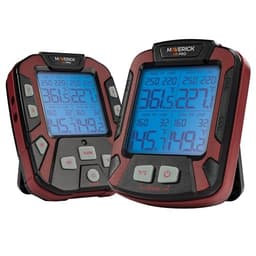
Maverick XR-50 Extended Range 4-Probe Wireless Thermometer
Four probes and a handheld receiver you can read from the kitchen table, with no phone, no app and no home WiFi involved. On a wet cook the whole value is not having a reason to go outside — you see the pit dropping and the meat climbing from indoors, and you only put a coat on when something actually needs doing.
Have more fuel than you need. Budget roughly a third again on a wet, cold day, whether that is charcoal, pellets or propane. Running out of fuel at hour eight in the rain is the genuinely bad outcome, and our cost to run a smoker page covers what a cook normally burns so you can scale it up.
Keep your dry things dry. Pellets and charcoal both suffer badly from damp — charcoal that has been rained on lights poorly and burns cool, and wet pellets disintegrate into sawdust, which our pellet storage guide covers. Keep both in sealed containers, not in the open bag on the patio.
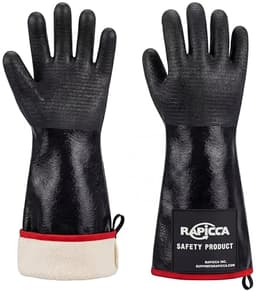
RAPICCA 932°F Heat-Resistant BBQ Gloves (14-inch)
Wet steel and wet handles are more slippery than dry ones, and a cooker running hot in the rain still has every bit of the heat it had on a dry day. Long cuffs cover the forearm, which is the part that touches a lid edge you are reaching past in bad light.
After the rain
Two jobs, both easy to skip and both worth doing.
Empty the ash once it is completely cold. Wet ash is caustic and it corrodes the bottom of a charcoal cooker far faster than rain alone does. NFPA also tells you where the cold ash goes: into a metal container with a tight-fitting lid used only for coals, after dousing the fire with water and checking the area is cool to the touch. Our cleaning guide covers the rest of the routine, and can you reuse charcoal covers what to do with the lumps that did not burn.
Dry it before you cover it. A cover trapping moisture against warm steel is a better rust machine than leaving the cooker open to the sky. Let it cool and dry, then cover.
And if a wet climate is the normal state of affairs where you live rather than an occasional nuisance, that is a genuine input into which cooker to buy. Our smoker buying guides sort the categories by how they behave rather than by price, and insulation is the single property that makes weather stop mattering.
That is really all there is to it. Rain is a logistics problem rather than a cooking one — and if you have a thermometer you can read from indoors and enough fuel to be generous with, it mostly stops being a problem at all.
A note on food safety. Temperatures on this page follow USDA safe-minimum guidance. Always confirm doneness with a food thermometer, not by time or color. We’re enthusiasts sharing what we’ve researched, not professional pitmasters — when in doubt on safety, follow the USDA.
Frequently asked questions
Can you use a smoker in the rain?
Yes. Rain does not ruin smoked food and it does not stop a cook — it makes the cook harder to hold steady and more expensive in fuel. The three rules that do not bend: keep electrical connections dry and off the ground, never move the cooker indoors or into a garage, and expect to use noticeably more fuel than a dry day.
Can you use an electric smoker in the rain?
Only with real care, and many makers advise against it. The cooker itself is designed for outdoor use, but the electrical connections are the weak point: the plug, the socket and any extension lead. Keep every connection out of standing water and off the ground, use an outdoor-rated lead and a GFCI-protected outlet, and if the rain is heavy enough to be blowing sideways, postpone. A wet connection is a genuine shock and fire risk, not a theoretical one.
Can you use a pellet grill in the rain?
Light rain, yes — a pellet grill's lid sheds water and the hopper lid is designed to keep the pellets dry. Two cautions. First, it is a mains-powered appliance, so the same electrical rules apply as for an electric smoker. Second, pellets are the thing to protect: if water gets into the hopper, the pellets swell, turn to sawdust and jam the auger, which is a repair rather than an inconvenience.
Can you smoke in a garage or under a covered porch?
Never in a garage, even with the door open, and not under anything enclosed. A smoker produces carbon monoxide, which is colourless and odourless, and it produces a lot of heat against whatever is above it. NFPA's own fire data shows nearly a quarter of grill structure fires started on an exterior balcony or open porch, with 8% beginning when an outside wall caught fire. An open-sided canopy well clear of the cooker and well clear of the house is the only sensible shelter.
Does rain affect the taste of smoked meat?
Not in any way you will notice. The food is inside a closed cooker and never touches the rain. What rain affects is the cooker's temperature stability and your fuel consumption, and indirectly the cook — a chamber swinging twenty degrees because of cold rain hitting the lid produces a less even result than a steady one.
How does rain affect smoker temperature?
Rain cools the outside of the cooker, which pulls heat out of the chamber the same way cold weather does, only faster because evaporating water carries heat away efficiently. Thin-walled cookers — cheap offsets, bullet smokers, electric cabinets — feel this most. Insulated cookers like a kamado barely notice. Expect to run the vents more open on charcoal, and expect an electric cabinet to struggle to reach its published ceiling.
Should you cover a smoker while cooking in the rain?
No — never put a grill cover on a hot cooker. Covers are not fire-rated and will melt or ignite against hot metal. Shelter the cooker with something that does not touch it, like an open-sided canopy or an awning well above it, or do nothing at all and accept the extra fuel use. The cover goes on after the cooker is completely cold.
Can you leave a smoker outside in the rain when you are not using it?
Most smokers live outdoors permanently and survive it, but water is what eventually kills them — rust in the chamber, seized vents, corroded electrics. Once the cooker is fully cold, cover it or move it under shelter, and empty the ash: wet ash makes a caustic, corrosive sludge that eats the bottom of a cooker faster than rain alone does.
What should you do if it starts raining mid-cook?
Usually nothing. Leave the lid shut, check the chamber temperature from wherever you are dry, and open the vents a little on a charcoal cooker to compensate for the heat loss. The two things that justify going out are an electrical connection sitting in water, which you should deal with immediately, and wind-driven rain into an open firebox. Resist the urge to keep opening the lid to check — every opening costs you more heat on a wet day than a dry one.
Sources
- NFPA — Grilling Safety Facts & Resources — NFPA's grilling safety guidance and its own fire statistics, stated as 2020-2024 annual averages: 'Never leave your grill unattended when in use.' July (15%) was the peak month for grill fires, followed by June (15%), May (13%) and August (11%). The grill had not been cleaned in roughly one-fifth (20%) of the fires. Nearly one-quarter of grill structure fires started on an exterior balcony or open porch; 8% began when an outside wall caught fire and 3% with a structural member or framing. Gas grills were involved in an average of 9,235 home fires per year, including 4,662 structure fires and 4,573 outdoor fires. On charcoal disposal: before going to sleep or leaving the area, douse the fire with water and make sure the area is cool to the touch, and empty coals into a metal container with a tight-fitting lid used only for coals (accessed September 18, 2026)
- USDA FSIS — Smoking Meat and Poultry — USDA guidance to keep the smoker between 225°F and 300°F, use two thermometers (food + smoker), and refrigerate within 2 hours (accessed July 22, 2026)
- USDA FSIS — Food Thermometers — USDA on why a food thermometer is the only reliable way to know food has reached a safe temperature, and how to place the probe (accessed July 22, 2026)
- USDA FSIS — Safe Minimum Internal Temperature Chart — USDA safe minimum internal temperatures: 145°F for beef/pork/lamb steaks, chops and roasts (with a 3-minute rest), 160°F for ground meats, 165°F for all poultry (accessed July 22, 2026)
Keep reading
Smoking in Cold Weather
The same physics, slower: what cold does to each type of cooker and how to plan around it.
Read itHow to Control Smoker Temperature
Vents, fuel and patience — the skills that matter most on the days the weather is working against you.
Learn itDo Wood Pellets Go Bad?
Why damp is the one thing that destroys pellets, and how to store a bag so rain never reaches it.
Read itCan You Leave a Smoker Unattended?
The honest answer per cooker type — and the reason a wet day is the wrong day to find out.
Read it