What a smoker box actually does
A gas grill has no wood in it. That is the entire problem a smoker box solves. Propane and natural gas burn clean, which is why a gas grill is so easy to live with and why food off one tastes like food off a very good broiler rather than like barbecue. Smoke flavor comes from wood combusting slowly and incompletely — smoldering, not burning — and a gas grill gives wood no chance to do that. Drop chips straight onto the flavorizer bars or the heat tent and they either flare into open flame or fall through into the burner.
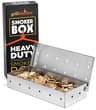
A smoker box is a steel container with vent holes in the lid. It starves the chips of enough oxygen to catch fire while letting the smoke out, and it keeps the debris out of your burners. That is all the engineering in it. The box does not hold temperature, it does not seal the grill, and it does not make your gas grill into a real smoker. It gives you smoke, and then the rest of the cook is down to your temperature control and a two-zone fire.
The four things that decide a smoker box
1. Steel thickness, which nobody publishes.This is the one spec that determines whether your box lasts five seasons or one, and not a single maker in this category states it. What happens to a thin box is predictable: it sits over a lit burner at 500°F or more, one side gets hotter than the other, and it warps into a shallow taco shape that no longer closes. Since you cannot read the gauge, the honest proxies are brand reputation, price, and material — cast iron cannot warp, and a $40 Weber is far likelier to be heavy-gauge than an $8 no-name box. We have not tried to invent a number for any of them.
2. Whether the lid hinges.A hinged lid sounds like a convenience feature and is really a safety one. Mid-cook you will want to add chips to a box that has been sitting over an open flame for an hour. With a hinge you flip a lid with tongs. Without one you lift a whole hot box off the grate, set it somewhere, refill it and put it back — four opportunities to burn yourself or spill smoldering chips into the burner. One pair of heat gloves and long tongs makes either version manageable, but the hinge is worth having.
3. The vent holes.Bigger holes let more air in, so the chips smolder harder and produce visible smoke sooner — and burn out sooner. Smaller holes mean a slower, longer, thinner smoke. Grillaholics is the only maker here that says anything at all about this, claiming “larger holes for higher smoker output”. Neither approach is wrong; more output means more refills, and that is the trade.
4. Whether it fits your grate. Grills differ enormously in how much clearance sits between the cooking grate and the lid. A tall box on a shallow grill will foul the lid or crowd the food. This is where published dimensions matter and where most of the category fails: Weber is the only maker on this page that publishes a size and a fitment statement, and that is the main reason it is our top pick despite costing roughly three times the cheapest option here.
Stainless or cast iron?
Both work. They fail differently, and they behave differently in the first twenty minutes of a cook, which is when most people decide whether the box was a good buy.
| Stainless steel | Cast iron |
|---|
| Time to first smoke | Faster — thin metal heats quickly | Slower — the iron has to come up first |
| Smoke through a lid-open moment | Stalls, then has to recover | Carries on — the mass holds the heat |
| How it dies | Warps out of shape if the gauge is thin | Rusts if stored damp or left outside |
| Weight and handling | Light, easy to lift hot with tongs | Heavy — a gloves-and-both-hands job |
| Hinged lid available | Yes, on most | Rarely — lift-off lids are the norm |
Our read: stainless for most people, because a hinged lid and a light box are worth more on a first attempt than a marginal gain in smoke stability. Cast iron if your grill is drafty and you are the kind of cook who opens the lid a lot, or if you want to put liquid in the base — GrillPro is the one maker here that publishes that as a feature.
Where the box goes (and the three places it does not)
This trips up more people than the choice of box does. A smoker box needs real, direct heat under it — more heat than the food is getting. It goes on the cooking grate, directly above a lit burner, with the food on the other side of the grill over the unlit burners.
| Where you put it | What happens |
|---|
| On the grate over a lit burner | Correct. Chips smolder in 10 to 20 minutes and smoke for roughly 45 to 60 minutes |
| On the grate over an unlit burner | Nothing. The chips warm up, dry out and never reach smolder point |
| Under the grate, on the flavorizer bars or heat tents | Sometimes works, often does not — and it blocks airflow to the burner. Weber says to place it on the cooking grates |
| Directly on the burner itself | Do not. You are putting a metal box across a gas burner’s ports and starving the flame |
Give it 10 to 20 minutes with the lid down before the food goes on. You are waiting for thin, wispy smoke rather than a thick white plume — our thin blue smoke guide explains why that distinction is the difference between smoke flavor and an acrid one.
Chips, not chunks — and do not soak them
A smoker box takes chips. Chunks are for charcoal, where there is a bed of live coals hot enough to work through a fist-sized piece of wood; a box sitting on a grate never gets hot enough to do that, and a chunk in a box mostly just sits there. Our chips vs chunks guide covers the full logic, and our wood for beginners page covers which flavor to start with. Apple or cherry if you want forgiving; hickory if you want the taste you are picturing.
Do not soak the chips, whatever the bag says. Soaked wood does not smoke for longer — it steams until the water has boiled off, and only then starts smoldering, so you have traded smoke time for steam time and a wet box. “Soak wood” is one of the four barbecue myths HarperCollins lists on the jacket of Meathead Goldwyn’s The Science of Great Barbecue and Grilling, alongside searing to seal in juices. A handful of dry chips, a full box, and a refill when the smoke stops is the whole routine.
How long one fill actually lasts
This is where a box stops being the right answer, and it is worth being blunt about it before you buy one. Here is the honest comparison of the ways to get smoke onto a gas grill, using the figure each maker publishes where one exists.
| Method | Smoke per fill | Refills on a 6-hour cook | Verdict |
|---|
| Foil packet of chips | 20 to 40 minutes | Many | Free, works, relentless |
| Stainless smoker box | 45 to 60 minutes | Several | The standard answer for short cooks |
| Cast iron smoker box | Similar, but steadier once hot | Several | Better on a drafty grill |
| Pellet smoker tube | Up to 5 hours per fill (LIZZQ’s listing) | Usually none | The right tool for a long cook |
There is also a piece of good news buried in this table. Meat takes on most of its smoke early — after the first two or three hours a surface is largely done absorbing, and continuing to feed wood past that point mostly adds bitterness rather than flavor. So on a long cook you are not obliged to keep a box running for six hours. Two or three fills at the start, then let the grill finish the job, is a legitimate way to cook.
The safety part, which is not optional here
Smoking on a gas grill means running a lit grill for hours, which is a different activity from grilling burgers for twelve minutes, and NFPA’s guidance is unambiguous: “Never leave your grill unattended when in use.” NFPA’s own 2020–2024 averages put gas grills in about 9,235 home fires a year, and it notes the grill had not been cleaned in roughly a fifth of those fires. A smoker box changes nothing about that arithmetic except the duration.
Two practical consequences. First, a long smoke on a gas grill is a stay-in-the-yard cook, not an overnight one — we go into what each fuel type really means for this in can you leave a smoker unattended. Second, clean the grill before you do it: hours of low, smoky heat over an old grease layer is exactly the scenario NFPA is describing. On temperature, USDA guidance for smoking meat is to hold the cooker between 225°F and 300°F and to use two thermometers — one for the chamber, one for the food. A dome gauge in the lid is not one of them; see our thermometer picks.
When a smoker box is the wrong purchase
You own a charcoal grill or kettle.You do not need this. Put wood chunks directly on the coals — that is what a charcoal fire is good at, and a box between the wood and the fire only gets in the way. Our charcoal grill smoking guide is the version of this page for you. The one exception is a very long charcoal cook where you want a slow trickle of extra smoke, and even then a tube does it better.
Your first cook is a brisket or a pork shoulder. Buy the pellet tube instead, or both. Twelve hours of smoke out of a box you refill hourly is a miserable introduction to the hobby.
You already own a pellet grill or an electric smoker.A box is redundant. If you want more smoke than your cooker makes on its own — a common and legitimate complaint about both types — a tube is the accessory that fixes it, which is why it appears on this page.
You have already decided you want to smoke properly. Then the money is better spent toward the cooker. Our smokers under $300 round-up exists for exactly that decision, and a box will not change the answer.
What we left off, and why
Brand-specific drop-in boxes.Napoleon, Broil King and others sell trays designed to replace a section of grate on their own grills. They work well and they are a fitment problem we cannot solve honestly from a listing: the model compatibility is the whole product, and getting it wrong for a reader is worse than not covering it. If your grill’s maker sells one for your exact model, that is a good option and your manual is a better source than we are.
Unbranded “heavy duty” boxes at the bottom of the results. There is an endless shelf of these. The steel grade is unverifiable, the sellers rotate monthly, and the branded Kingsford box on this page costs little more.
Boxes with a built-in thermometer in the lid. The dial reads the temperature of a metal box sitting over an open flame, which tells you nothing about your food or your cooking chamber. It is a feature that exists to be printed on the packaging.
Anything we could not confirm was purchasable.All five picks were resolved to a live Amazon listing and confirmed in stock on 2026-09-29. A well-known Char-Broil cast iron box came up in the same search showing “Currently unavailable”, so it is not on the page.
So is a smoker box worth it?
For the reader this site is written for — someone who owns a gas grill and is curious about barbecue — yes, clearly. It is the smallest amount of money that will answer a real question, and the answer arrives on the first cook. Chicken thighs or a rack of ribs with two box-fills of apple chips will tell you more about whether you want a smoker than another week of reading will.
What it will not do is taste like a charcoal smoker. A gas grill leaks, and the smoke you make in a box mostly goes out of the vents and around the lid rather than staying in contact with the meat. Expect a lighter version of the flavor, not a lesser version of the food. If you like the lighter version, you are going to love the real thing, and our how to choose your first smoker guide is the next page to read.