How to Smoke on a Charcoal Grill
Before you spend a dollar on a smoker, find out whether you actually enjoy this — using the charcoal grill already in your yard, a bag of wood chunks and about twenty dollars of kit.
How this is funded:we earn a commission if you buy through our links, at no extra cost to you. It never changes which smoker we recommend, and we’ll tell you when we’d skip one. Full disclosure.
There is a smoker in your yard already. It is the round charcoal grill you have been making burgers on, and the only thing standing between it and a rack of ribs is where you put the coals. Not an accessory, not a technique that takes a season to learn — where you put the coals.
This matters because the most expensive mistake in barbecue is buying a smoker before you know whether you enjoy standing outside for six hours adjusting a vent. Some people love it. Some people find out, two hundred dollars in, that they wanted a slow cooker. An afternoon with a kettle, a chunk of hickory and a rack of ribs answers that question for the price of dinner.
Why a kettle grill works as a smoker
A charcoal smoker and a charcoal grill burn the same fuel and make the same smoke. The difference is geometry. In a smoker the fire sits far away from the food, usually underneath and shielded, and the food cooks in hot smoky air. On a grill the fire sits directly under the food and cooks it by radiant heat.
Move the fire to one side and the grill becomes the first thing. That is genuinely the whole trick. The food is now cooking in indirect heat, the lid is trapping smoke around it, and the vents are doing the same job the vents on a bullet smoker do. What you have made is a small, uninsulated, low-capacity charcoal smoker — which, for a four-hour cook, is not much of a compromise at all.
The two setups worth knowing
Two-zone: the simple one
Pile the unlit charcoal against one half of the charcoal grate. Light around a dozen briquettes in a chimney and pour them over the pile. Food goes on the empty side, lid on, vents set. It takes two minutes to build and will hold a low temperature for two to three hours before it needs more fuel.
Use it for chicken, pork tenderloin, sausages and anything else finishing inside three hours. It is the setup to start with, because there is nothing to get wrong.
The snake: the one that runs for hours
Lay unlit briquettes around the outer edge of the charcoal grate in a curved double row — two wide, two high — following roughly two-thirds of the circle and leaving a gap so the fire cannot jump the ends and short-circuit itself. Set your wood chunks along the top of the row at intervals. Drop a dozen lit coals on one end.
The fire now creeps along the snake like a fuse, burning only a few coals at a time. On a 22-inch kettle a full snake will run five or six hours at 225–250°F without you adding anything, which covers a full rack of ribs start to finish. It is the single most useful thing in this guide and it costs nothing.
What you need, and what you do not
Three things make this work and none of them are expensive. Everything else sold as a “kettle smoking kit” is optional at best.
| You need | Why |
|---|---|
| A chimney starter | Lights a controlled number of coals evenly, with no lighter fluid near a six-hour cook |
| Hardwood chunks, not chips | Chips burn out in minutes on an open fire; a chunk smolders for an hour or more |
| A thermometer | The lid dial is inches from the vent and often badly wrong. The food temperature is what finishes the cook |
| A foil pan of water (optional) | Steadies the temperature and catches drips. Nice to have, not essential |
The kit, once you know what it is for
These are the three things above, from our own picks. Each is chosen on published specs and honest fit for a beginner (how we pick), never on testing we did not do, and the price on each button is pulled live.
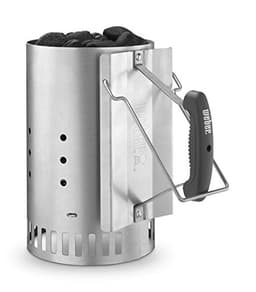
Weber Rapidfire Chimney Starter
The one piece of kit that makes everything else on this page repeatable: a known number of coals, evenly lit in about twenty minutes, with no lighter fluid anywhere near food that will sit in smoke for six hours.
Price as of September 17, 2026. #ad How we’re funded
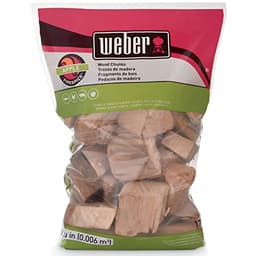
Weber Apple Wood Chunks (4 lb)
Chunks rather than chips, because a chip burns out in minutes on an open fire. Apple is the forgiving starting point — mild enough that one chunk too many will not ruin the food, which is exactly what you want while you are still learning how much smoke is enough.
Price as of September 17, 2026. #ad How we’re funded
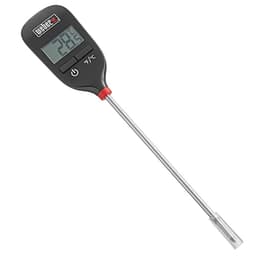
Weber Instant-Read Thermometer
USDA is explicit that a food thermometer is the only reliable way to know food has reached a safe temperature, and on a kettle you also need it to check grate temperature where the food actually is — the lid dial sits in the wrong place and reads the wrong thing.
Holding the temperature
Open the top vent fully and leave it there. It is not a control; it is the chimney, and closing it makes smoke stagnate around the food, which is how you get the acrid, ashtray flavor people blame on the wood. Control the fire from the bottom vent only, because that is where the air comes in.
Start with the bottom vent about a quarter open for 225–250°F. Then the important part: make one small adjustment and wait ten minutes. Charcoal responds slowly, and almost every runaway temperature is someone fiddling every two minutes and stacking four adjustments on top of each other. Position the lid so the top vent sits over the food rather than over the coals, which pulls smoke across the meat on its way out.
USDA’s smoking guidance is to keep the cooker between 225°F and 300°F, so you have a genuinely wide target. Our guide to controlling temperature goes deeper, and thin blue smoke explains what the smoke should look like before food goes on.
What a kettle cannot do
Being honest about the ceiling is more useful than pretending there is not one.
- Long cooks. A snake gets you five or six hours. A packer brisket wants twelve or more, which on a kettle means feeding it all day.
- Capacity. Half your round grate has fire under it, so you are cooking on half a circle. Two racks of ribs is a realistic maximum, and only if you curve them.
- Cold and wind. A single skin of thin steel loses heat fast. In November you will burn noticeably more charcoal — see smoking in cold weather.
- Walking away. It is a live fire in an uninsulated container with no thermostat. NFPA’s advice is never to leave a grill unattended while it is in use, and that applies here exactly as it does to grilling.
If you hit all four of those limits regularly, that is the signal to buy a real smoker — and by then you will know exactly which kind you want, which is the whole point of starting here. Our beginner roundup is the next step when you get there.
If you do not own a charcoal grill yet
Then you have a genuine decision to make, because a 22-inch kettle is the cheapest cooker that will do both jobs competently. It grills on a Tuesday and smokes on a Saturday, it costs less than most dedicated smokers, and it is simple enough to last decades.
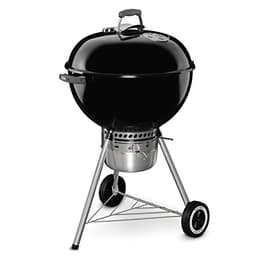
Weber Original Kettle Premium 22-inch
Not a dedicated smoker, and the most versatile single cooker a beginner can own. With the coals banked to one side it smokes ribs and chicken properly; the rest of the time it is a full-size charcoal grill. If you can only own one thing, this is the strongest case on the site.
Price as of September 17, 2026. #ad How we’re funded
If you already know you want a dedicated smoker and the kettle is just a stepping stone, do not buy one for this — borrow a friend’s for an afternoon instead, and put the money toward the real thing. Our first smoker guide covers that decision, and best first cooks tells you what to put on it either way.
A note on food safety. Temperatures on this page follow USDA safe-minimum guidance. Always confirm doneness with a food thermometer, not by time or color. We’re enthusiasts sharing what we’ve researched, not professional pitmasters — when in doubt on safety, follow the USDA.
Frequently asked questions
Can you really smoke meat on a charcoal grill?
Yes, and it is the closest thing to a real smoker you can do without owning one. Bank the coals to one side, put a chunk of wood on them, sit the food on the empty side and hold 225 to 275°F with the vents. The heat source, the fuel and the smoke are identical to a charcoal smoker's — what a kettle lacks is insulation, capacity and the ability to run for twelve hours without attention.
What is the snake method?
A way of making a small charcoal fire last for hours. You lay unlit briquettes in a curved double row around the edge of the charcoal grate, two wide and two high, drop a dozen lit coals on one end, and the fire creeps along the snake like a fuse. A full snake around a 22-inch kettle will run five or six hours at a low temperature without you touching it — which is longer than most ribs take.
How many coals do I need to smoke on a kettle?
Far fewer than you expect. Around a dozen lit briquettes dropped onto a much larger unlit pile is the usual starting point for 225 to 250°F. The classic beginner mistake is lighting a full chimney, which is a grilling fire — it will sit at 400°F and there is no vent setting that brings it down quickly.
Which vent do I use to control the temperature?
The bottom one. Leave the top vent fully open so smoke moves through rather than stagnating, and control the fire by restricting the air going in underneath. Move it in small increments and wait ten minutes before judging — a charcoal fire responds slowly, and the most common cause of a wild temperature swing is someone adjusting the vents every two minutes.
Do I need to soak wood chunks before smoking?
No. Soaking does not make wood smolder for longer; it makes it spend the first several minutes boiling off surface water as steam before it starts producing smoke at all. Use a dry chunk, and use one rather than four — a kettle is a small space and the mistake here is almost always too much smoke rather than too little.
How long can you smoke on a charcoal grill?
A snake will run five or six hours unattended on a 22-inch kettle, and you can extend a cook indefinitely by adding fresh coals every hour. That covers ribs, chicken and pork tenderloin comfortably. A twelve-hour brisket is where a kettle genuinely struggles — not because it cannot, but because you will be feeding it all day and night.
Is a kettle grill as good as a smoker?
For four hours of ribs, it is close enough that most people could not tell. Past that, a dedicated smoker wins on three counts: insulation, so it holds temperature with less fuel and less attention; capacity, because a kettle's round grate is half taken up by the fire; and runtime. A kettle is a brilliant way to learn whether you like this, and a frustrating way to cook a brisket every weekend.
Can I leave a charcoal grill smoking unattended?
NFPA's guidance is never to leave a grill unattended while it is in use, and a kettle running a snake is still a live fire in an uninsulated container. Nearly a quarter of grill structure fires started on an exterior balcony or open porch. Stay on the property, keep it well clear of walls and railings, and read our page on leaving a smoker unattended before you plan anything overnight.
How do I put the fire out and dispose of the coals?
Close both vents fully and leave the lid on — starving it of air will put it out and any unburned briquettes can be reused. For disposal, NFPA's guidance is to douse the fire with water before going to sleep or leaving the area and make sure the area is cool to the touch, then empty the coals into a metal container with a tight-fitting lid used only for coals, kept outside and away from anything that can burn. Never empty coals into a trash can.
Sources
- USDA FSIS — Smoking Meat and Poultry — USDA guidance to keep the smoker between 225°F and 300°F, use two thermometers (food + smoker), and refrigerate within 2 hours (accessed July 22, 2026)
- USDA FSIS — Safe Minimum Internal Temperature Chart — USDA safe minimum internal temperatures: 145°F for beef/pork/lamb steaks, chops and roasts (with a 3-minute rest), 160°F for ground meats, 165°F for all poultry (accessed July 22, 2026)
- NFPA — Grilling Safety Facts & Resources — NFPA's grilling safety guidance and its own fire statistics, stated as 2020-2024 annual averages: 'Never leave your grill unattended when in use.' July (15%) was the peak month for grill fires, followed by June (15%), May (13%) and August (11%). The grill had not been cleaned in roughly one-fifth (20%) of the fires. Nearly one-quarter of grill structure fires started on an exterior balcony or open porch; 8% began when an outside wall caught fire and 3% with a structural member or framing. Gas grills were involved in an average of 9,235 home fires per year, including 4,662 structure fires and 4,573 outdoor fires. On charcoal disposal: before going to sleep or leaving the area, douse the fire with water and make sure the area is cool to the touch, and empty coals into a metal container with a tight-fitting lid used only for coals (accessed September 18, 2026)
- Kingsford — How to Use a Charcoal Chimney Starter — Kingsford states a standard chimney holds about 4 pounds of Kingsford Original briquets, which is about 100 briquets; that after about 15 to 20 minutes the coals start to glow through the vents; that you pour once all the coals are ashed over; and that you should use heat-resistant gloves because the chimney will be hot (accessed August 28, 2026)
Keep reading
How to Smoke on a Gas Grill
The same experiment on the other kind of grill — two-zone burners, a smoker box and a pellet tube.
Read the gas versionHow to Smoke Ribs
The cut this method suits best. Five hours, forgiving, and well inside what one banked fire will do.
Cook ribsBest Charcoal Smokers for Beginners
When the kettle starts to frustrate you, this is the next step and why.
See charcoal smokersHow to Control Temperature
The vent discipline that makes all of this work, explained properly.
Learn the vents