Can You Reuse Charcoal?
Yes. Charcoal that has been lit and then snuffed out is still almost pure carbon, and it lights faster the second time than it did the first. Throwing it away is one of the more expensive habits in barbecue, and it is entirely unnecessary.
How this is funded:we earn a commission if you buy through our links, at no extra cost to you. It never changes which smoker we recommend, and we’ll tell you when we’d skip one. Full disclosure.
Yes, and you should. A cook almost never uses up all its fuel — you light enough charcoal to be sure, the meat comes off, and there is a pan of half-consumed lumps sitting in ash. Those lumps are still carbon and they are still fuel. Reused charcoal lights faster than fresh, because the part that is awkward to light has already burned away.
There are three things to get right: how you put the fire out, how you store what is left, and what to do about ash. None of them is difficult, and the third one is the one people skip.
Putting the fire out so there is something to save
Close every vent and put the lid on. That is the whole method. Starved of air the fire goes out in anything from twenty minutes to an hour or so depending on how much fuel is in there, and what is left is dry, reusable charcoal.
Do not pour water on it.It works — it is what you do in an emergency — but it soaks the charcoal through, and soaked charcoal is the one version of this that genuinely cannot be reused in any convenient timeframe. It also throws a face-full of steam and ash, and thermal-shocks a ceramic kamado badly enough to crack it.
Then leave it alone. This is the part worth taking seriously: a snuffed cooker full of charcoal holds live embers for far longer than people expect, often most of a day. NFPA’s grilling guidance treats ash and ember disposal as a genuine fire hazard, and the standard advice — wait until everything is completely cold, and never put ash in anything combustible — is exactly right here. Give it twenty-four hours before you touch it or move it indoors.
Ash is the thing that ruins the second cook
Charcoal burns from the outside in and leaves ash behind, and ash is inert — it produces no heat and it does one actively unhelpful thing: it blocks airflow. In a bottom-vented cooker, air has to come up through the fuel bed, and a layer of ash packed around your saved lumps smothers the fire from underneath.
That is almost always the explanation when somebody says reused charcoal “does not work” or runs cool. The fuel was fine. The ash was the problem. So sieve it, or at least separate it:
- Tip the cold contents of the pan through a coarse sieve, an old cooking grate or a cheap garden riddle. The lumps stay, the ash falls through.
- Or pour it slowly from one bucket into another outdoors with a breeze, which blows most of the ash away. Crude, effective, do it away from the house.
- Then clear the ash pan or the bottom of the cooker properly before you reload. Our cleaning guidecovers how often the rest of the cooker genuinely needs attention — less than you think, but the ash pan is the exception.
Lump and briquettes behave differently when wet
This is the one place the lump-versus-briquette distinction has a practical consequence beyond burn rate.
| Situation | Lump charcoal | Briquettes |
|---|---|---|
| Snuffed by closing the vents | Reuse it— ideal | Reuse it— ideal |
| Rained on in an open cooker | Dry it thoroughly — usually fine | Often crumbles as it dries — check before trusting it |
| Soaked, or doused with water | Dry in the sun for days, then test one | Bin it— the binders have gone |
| Mostly dust in the bottom of the bag | Bin the dust, keep the lumps | Bin the dust, keep whole briquettes |
The reason is in what they are. Lump is solid carbon with nothing holding it together, so water wets the surface and then leaves when it dries. A briquette is charcoal dust pressed together with binders, and water dissolves the thing doing the holding — so it swells, loses its shape and turns into a pile of dust that cannot hold a fire. Dust does not burn usefully in a smoker; it packs down and chokes the airflow in the same way ash does.
How to actually use the saved charcoal
Do not try to run a whole cook on leftovers. A partly burnt piece has less carbon in it than a fresh one, which means less total heat and a shorter burn, so a pan of saved fuel will not see a ten-hour brisket through.
The arrangement that works is the one most charcoal cooks use without thinking about it: saved charcoal underneath, fresh lit charcoal on top. Put the sieved lumps in the bottom of the basket or ring, light a chimney of fresh fuel, and pour it over. The old pieces catch almost immediately from the new ones, and a cook that would have taken a full chimney and a half takes a chimney. Our how much charcoal guide has the quantities for a given temperature and cook length, and those numbers are what the saved fuel is coming off.
Two tools make the whole routine easy, and neither is expensive.
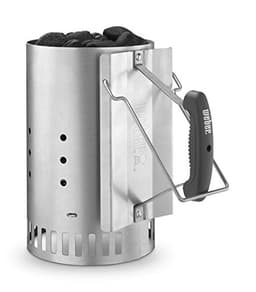
Weber Rapidfire Chimney Starter
A chimney is how you light the fresh charcoal that catches the saved stuff, with newspaper rather than lighter fluid — fluid-soaked fuel is the one thing you genuinely should not reuse, because the taste lingers. Weber publishes the capacity at 1.6 gallons, about 5.7 lb of briquettes, which makes it easy to judge how much fresh fuel you are adding on top of the old.
Price as of October 6, 2026. #ad How we’re funded
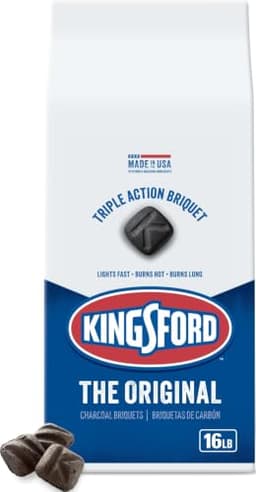
Kingsford Original Charcoal Briquettes (16 lb)
Uniform briquettes are the easiest fuel to count, which matters more than usual when half your fuel bed is irregular saved lumps — you can keep the fresh half predictable even when the saved half is not. It is also the cheapest fuel per hour of anything we rank, so a bag lasts a long time once you stop throwing the ends of it away.
Price as of October 6, 2026. #ad How we’re funded
When to give up on it
Three cases. Charcoal that was soaked with lighter fluid and never properly burned off — the smell transfers to food, and it is not worth the risk. Briquettes that have crumbled into dust, which will choke a fire rather than feed it. And anything that has been sitting in a wet ash sludge for weeks, which is not really charcoal any more.
Everything else is fuel. Sieve it, keep it dry in a metal container with a lid, and put it under the next chimney. If you are still deciding which bag to buy in the first place, the charcoal roundup ranks them, and what it costs to run a smoker is where the saving on this page actually shows up.
Frequently asked questions
Can you reuse charcoal that didn't burn all the way?
Yes, and it is the single easiest saving in charcoal cooking. Partly burnt charcoal is still carbon — what burned off was the outer layer and, in briquettes, the binders. It has already been through its light-up phase, so it catches faster and smells less the second time than fresh charcoal does.
How do you save charcoal after cooking?
Close every vent on the cooker and put the lid on. Starved of oxygen the fire goes out within an hour or so, and what is left in the pan is reusable fuel sitting in ash. Never pour water on it to save it — that soaks the charcoal and ruins it. When it is completely cold, sieve the ash off and keep the lumps.
Can you reuse charcoal that got wet?
Lump charcoal usually survives if you dry it thoroughly, because it is solid carbon with nothing holding it together. Briquettes usually do not: water dissolves the binders that press them into shape, so they swell and crumble into dust that will not hold a fire. Dry wet lump in the sun for a few days before judging it; bin crumbled briquettes.
Does reused charcoal burn as long?
No. A partly burnt piece has less carbon left in it than a fresh one, so it produces less total heat and burns out sooner. Treat it as a head start rather than a full load: a chimney of fresh charcoal plus the saved lumps underneath is the usual arrangement, not a whole cook on leftovers.
Is it safe to reuse charcoal?
Yes. Nothing harmful accumulates in it, and the grease that dripped on it during the last cook burns off long before food goes near it. The genuine safety issue is not the fuel, it is the handling: a snuffed cooker can hold live embers for many hours, and NFPA treats ash disposal as a real fire hazard for exactly that reason.
Should you sieve the ash out of reused charcoal?
Yes, and it matters more than people think. Ash is inert and it blocks airflow — it packs around the lumps and smothers the fire from below, which is the most common reason a second cook on saved charcoal runs cool. A coarse sieve, an old barbecue grate or just tipping the lot gently from one bucket to another in the wind will do it.
How long can you store used charcoal?
Indefinitely, if it is completely cold and completely dry. Store it in a metal container with a lid, not a plastic tub — a trace of ember in a plastic bucket is a fire, and a bin bag of ash is how sheds burn down. Give it a full twenty-four hours before it goes anywhere enclosed.
Can you mix used and fresh charcoal?
That is the standard way to use it. Put the saved lumps in the bottom of the basket or ring, then a chimney of lit fresh charcoal on top. The old pieces catch quickly from the new, and you get a full-length cook while using less of the bag.
Sources
- USDA FSIS — Smoking Meat and Poultry — USDA guidance to keep the smoker between 225°F and 300°F, use two thermometers (food + smoker), and refrigerate within 2 hours (accessed July 22, 2026)
- NFPA — Grilling Safety Facts & Resources — NFPA's grilling safety guidance and its own fire statistics, stated as 2020-2024 annual averages: 'Never leave your grill unattended when in use.' July (15%) was the peak month for grill fires, followed by June (15%), May (13%) and August (11%). The grill had not been cleaned in roughly one-fifth (20%) of the fires. Nearly one-quarter of grill structure fires started on an exterior balcony or open porch; 8% began when an outside wall caught fire and 3% with a structural member or framing. Gas grills were involved in an average of 9,235 home fires per year, including 4,662 structure fires and 4,573 outdoor fires. On charcoal disposal: before going to sleep or leaving the area, douse the fire with water and make sure the area is cool to the touch, and empty coals into a metal container with a tight-fitting lid used only for coals (accessed September 18, 2026)
- Kingsford — How to Use a Charcoal Chimney Starter — Kingsford states a standard chimney holds about 4 pounds of Kingsford Original briquets, which is about 100 briquets; that after about 15 to 20 minutes the coals start to glow through the vents; that you pour once all the coals are ashed over; and that you should use heat-resistant gloves because the chimney will be hot (accessed August 28, 2026)
Keep reading
How Much Charcoal to Use
Quantities for a given temperature and cook length — which is also how you end up with leftovers worth saving.
Get the numbersLump Charcoal vs Briquettes
Which type survives a soaking, which belongs in a smoker, and which belongs in a kamado.
CompareHow to Clean a Smoker
What to scrub and what to leave — including how often the ash pan genuinely needs emptying.
Read itWhat It Costs to Run a Smoker
The per-cook running costs, which is where saving half a chimney of charcoal actually shows up.
See the numbers