Smoke & Slow

Pit Barrel Cooker Review (18.5-inch Classic)

A sealed steel drum with one vent, eight hooks and nothing to adjust. It makes excellent charcoal barbecue by removing your ability to fiddle with it — which is either the best thing about it or a dealbreaker, depending on the cook you want to be.

By Stephen V.Last updated How we pick

Buy the Pit Barrel if you want real charcoal barbecue and you do not want to learn fire management. Do not buy it if you were planning to cook at 225°F. Those two sentences are the whole review. The barrel has one air intake, which you set once for your altitude and then leave alone forever; the food hangs from hooks in the middle of the drum rather than sitting on a grate; and Pit Barrel states the cooker’s expected range when properly lit is 275–310°F. There is no thermostat, no damper to chase, and essentially nothing to get wrong.

That temperature is the honest catch, and it is the thing most reviews skate past. Nearly every beginner guide on the internet — ours included, in places — teaches low-and-slow at 225 to 250°F. This cooker does not live there. It runs above it by design, which makes your food finish sooner and your bark set faster, and which also means an overnight brisket and a heavily sugared sauce both need rethinking. It is a hot-and-fast cooker wearing a smoker’s clothes, and it is very good at that.

We have not cooked on this barrel, and nothing below pretends otherwise. Every figure on this page — the temperature range, the charcoal load, the capacity, what is in the box — is published by Pit Barrel itself and cited at the foot of the page, because the retail listing states none of it (how we pick). Prices are pulled live. Where the maker publishes nothing, we say so instead of estimating.

How this is funded:we earn a commission if you buy through our links, at no extra cost to you. It never changes which smoker we recommend, and we’ll tell you when we’d skip one. Full disclosure.

Quick picks

Ranked on published specs, beginner-friendliness and value. Select a row to jump to the full write-up. We haven’t cooked on every one of these — here is exactly what we do instead.

#ProductBest forPrice
1
Pit Barrel Cooker Premier Series 18.5-inch Drum Smoker

Pit Barrel Cooker Premier Series 18.5-inch Drum Smoker

The charcoal smoker that deleted the hard part. There is one vent, and you set it once for your altitude — after that the barrel finds its own cruising temperature and stays there. Food hangs from hooks over the coals, so drippings fall on the fire and come back as flavor. If you want charcoal barbecue but the phrase 'vent management' makes you tired, this is the answer.

Our top drum pick for beginners
$459.99 · View on Amazon

Price as of September 5, 2026. #ad How we’re funded

2
Pit Barrel Cooker PBX 22.5-inch Drum Smoker (XL Package)

Pit Barrel Cooker PBX 22.5-inch Drum Smoker (XL Package)

The same barrel, the same single vent, scaled up to a size almost nobody cooking for a family needs. Pit Barrel states the 22.5-inch PBX hangs 16 to 20 racks of ribs, four pork butts, four full packer briskets or 60-plus party wings, and ships with 16 hooks and three hanging rods to do it. If you cook for a crowd — a team, a fundraiser, a family that hosts thirty people — this is the one. If you do not, buy the 18.5-inch and spend the difference on charcoal.

Best for cooking for a crowd
$599.99 · View on Amazon

Price as of September 5, 2026. #ad How we’re funded

The picks in full

#1Our top drum pick for beginners

Pit Barrel Cooker Premier Series 18.5-inch Drum Smoker

The charcoal smoker that deleted the hard part. There is one vent, and you set it once for your altitude — after that the barrel finds its own cruising temperature and stays there. Food hangs from hooks over the coals, so drippings fall on the fire and come back as flavor. If you want charcoal barbecue but the phrase 'vent management' makes you tired, this is the answer.

What’s good

  • One vent, set once — no dialing the temperature up and down
  • Hanging meat cooks faster than grate cooking and bastes itself
  • Simple sealed drum with very little on it to break

Trade-offs

  • Runs hot by design — it is not a 225°F cooker
  • Cooking area is not published as a square-inch figure
  • Hanging takes a little practice with slippery cuts
Fuel typeCharcoal (hanging, one fixed vent setting)
Cooking areaNot published
Temperature range275–310°F expected range (maker)
Ease for beginnersEasiest

Specs read from the product listing, on August 18, 2026. “Not published” means the maker doesn’t state that figure there.

#2Best for cooking for a crowd

Pit Barrel Cooker PBX 22.5-inch Drum Smoker (XL Package)

The same barrel, the same single vent, scaled up to a size almost nobody cooking for a family needs. Pit Barrel states the 22.5-inch PBX hangs 16 to 20 racks of ribs, four pork butts, four full packer briskets or 60-plus party wings, and ships with 16 hooks and three hanging rods to do it. If you cook for a crowd — a team, a fundraiser, a family that hosts thirty people — this is the one. If you do not, buy the 18.5-inch and spend the difference on charcoal.

What’s good

  • Maker states 16-20 racks of ribs, 4 pork butts, 4 full packer briskets or 4 turkeys
  • Ships with 16 stainless hooks and three hanging rods, so the capacity is usable out of the box
  • Identical set-the-vent-once operation as the smaller barrels — scale without added complexity
  • Same published 275-310°F expected range, so cook times you learn on a smaller barrel carry over

Trade-offs

  • Far more cooker than a household needs, and the most expensive Pit Barrel
  • Pit Barrel states approximately 14-16 lb of charcoal per load against 10-12 lb for the 18.5-inch
  • A 22.5-inch steel drum is heavy and awkward to move once it is set up
  • Still a fixed-vent barrel, so it will not hold 225°F any better than the smaller ones
Capacity (maker)16-20 racks of ribs, 4 pork butts, 4 briskets or 4 turkeys
Charcoal per load (maker)Approximately 14-16 lb
Temperature275–310°F expected range when properly lit (maker)
In the package16 stainless hooks, 3 hanging rods, charcoal basket, grill grate, stand, rubs

Specs read from the product listing, on September 5, 2026. “Not published” means the maker doesn’t state that figure there.

What it actually is

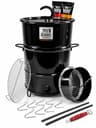
A porcelain-coated steel drum about the size of a kitchen trash can, standing on a three-point base. A charcoal basket sits in the bottom. Two steel rods drop across the top of the barrel, and your food hangs from stainless hooks on those rods, down in the middle of the drum. The lid goes on. That is the entire machine.

Pit Barrel describes the design as placing the food in the center of the action, heating the meat from all sides at once, and calls the result a combination of a grill and a smoker rather than either one. That is fair. Fat and juice drip straight onto the coals and come back up as smoke and steam, so the cooker bastes the food continuously in a way a bullet smoker with a water pan between the fire and the meat deliberately does not.

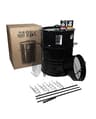
The 18.5-inch Classic Premier package arrives with the cooker, a charcoal basket, two hanging rods, eight stainless steel hooks, a grill grate, an attachable ash pan, a hook tool, a barrel stand, a heat shield and two rubs. Read that list again: unlike almost every other smoker we cover, there is nothing else you have to buy to cook on the first day except charcoal and a thermometer. On a category where the “real” price is usually the sticker plus a hundred dollars of missing parts, that matters.

The temperature question, honestly

Pit Barrel states 275–310°F as the expected range when the cooker is properly lit. The USDA puts smoking generally in the 225–300°F band, so the barrel sits at the top of that envelope and its stated ceiling reaches slightly past it. This is not a fault — it is the design. The single fixed intake is sized to hold that range without your help, and the trade for not having to manage a fire is not being allowed to manage one.

What that means in practice:

  • Everything finishes sooner. Ribs, chicken and pork butt all cook faster at 285°F than at 235°F. For a beginner cooking on a Saturday afternoon rather than starting at 4am, that is a genuine feature.
  • Sugar burns. A sweet rub or a tomato-and-sugar sauce that behaves at 250°F will darken faster up here. Our rub guide and sauce guideboth explain which bottles tolerate heat and which want to go on in the last twenty minutes — on this cooker that advice is not optional.
  • There is no overnight cook. A fourteen-hour brisket at 225°F is not what this barrel does. Brisket on a Pit Barrel is a hot-and-fast cook, which is a legitimate technique and a different one.
  • You cannot dial it down. If your ambition is to learn temperature control as a craft, this cooker actively prevents you from practicing. Our temperature control guide is written for cookers that let you steer.

One number Pit Barrel does not publish is how long a load of charcoal burns. We are not going to invent a figure for it. What the maker does state is the load size: approximately 10 to 12 pounds of charcoal for the 18.5-inch barrel. For context on what a bag costs to burn through, our cost-to-run guide does the arithmetic by fuel type.

Lighting it, per the maker

The lighting routine is unusually specific, and it is worth following exactly because it is what sets the temperature you are then stuck with. Pit Barrel instructs you to fill the charcoal basket, remove about a quarter of that charcoal into a chimney starter, and light the chimney for 11 to 12 minutes maximum if you are below 2,000 feet of elevation, or 12 to 15 minutes above it. The lit quarter goes back on top of the unlit charcoal, the rods and food go on, and the lid goes down.

Two things follow from that. First, you need a chimney starter, and it is not included — it is the one genuinely missing item in an otherwise complete package. Second, the timing is by the clock rather than by eye, which is the opposite of how you light a chimney for a kettle: you are deliberately pouring coals that are not fully ashed over, because the barrel is supposed to come up to temperature slowly and hold. Over-lighting is the single most common way to end up above the stated range. Ordinary briquettes are the right fuel here; our charcoal guide covers why self-lighting charcoal never belongs in a smoker.

What it holds

Pit Barrel publishes capacity in food rather than square inches, which is unusual and, for a hanging cooker, more useful. For the 18.5-inch Classic the maker states eight racks of ribs, or two to three pork butts or briskets, and two 13 to 16 pound turkeys using turkey hangers.

Eight racks of ribs is a serious number for a cooker this size, and it is possible only because the food hangs vertically instead of lying flat. It also means our usual square-inch sizing framework does not really apply: there is a grill grate in the box for things that cannot hang, but the barrel’s capacity is a hanging number, and no square-inch figure is published for it.

Which size to buy

Pit Barrel currently lists four barrels — a 14-inch Junior, a 16.5-inch Badger, the 18.5-inch Classic and the 22.5-inch PBX. For almost everyone reading this, the answer is the 18.5-inch Classic, which the maker positions for families and backyard barbecues. The maker’s own stated capacities make the decision easy:

BarrelMaker’s stated capacityCharcoal per load
14-inch Junior6 racks of ribs, 1 pork butt, 1 full packer brisket, 6 chicken halves or a 17 lb turkeyAbout 6–8 lb
18.5-inch Classic8 racks of ribs, 2–3 pork butts or briskets, 2 turkeys of 13–16 lb on hangersAbout 10–12 lb
22.5-inch PBX16–20 racks of ribs, 4 pork butts, 4 briskets, 60+ party wings or 4 turkeysAbout 14–16 lb

The Junior is the one to want if your constraint is space rather than money — it saves less on price than its size suggests, and it is the model we list on our drum smokers roundup. Its Amazon listing goes in and out of stock; when it shows as unavailable that is the listing, not the model, since Pit Barrel still lists all four barrels on its own site. The PBX is a genuine crowd cooker and overkill for a household. We have not covered the 16.5-inch Badger because Pit Barrel publishes no capacity figures for it, and we will not fill that gap with a guess.

Pit Barrel vs Weber Smokey Mountain

This is the comparison people actually search for, and the two cookers are close in price and opposite in philosophy.

Pit Barrel 18.5-inchWeber Smokey Mountain 18-inch
TemperatureFixed. Maker states 275–310°F expectedYours to set with three dampers, 225°F upward
How food sitsHanging on hooks, or on the included grateTwo flat grates over a water pan
Learning curveEffectively none after the first lightReal — several cooks to learn the vents
Overnight cooksNot what it is forA signature strength
In the boxHooks, rods, basket, grate, ash pan, stand, rubsCooker, grates and water pan

Pick the barrel if you want dinner to be good with no fuss, and the Smokey Mountainif the fire is part of what you are buying. Neither is the better cooker in the abstract; they answer different questions. If you are not sure which of those people you are, that uncertainty is itself an argument for the barrel — you can always add a cooker you have to steer later, and beginners give up on equipment that demands attention far more often than they get bored of equipment that does not.

Living with it

Cleaning is close to nothing. Pit Barrel’s own guidance is to scrape the interior debris out with a plastic putty knife and run a burnout — hot coals until the fire exhausts itself. There is no water pan to scrub, no grease tray, no auger, no gasket. The attachable ash pan in the Premier package takes care of the one messy step.

The thing to actually watch is weather and storage. It is a coated steel drum with a lid; left uncovered through a wet winter, the outside will eventually tell you about it. Keep it covered and dry between cooks. And do the hanging practice on something forgiving first — a rack of ribs hooked between the third and fourth bone is the standard first cook, and it is much easier to hook than a slippery pork butt, which many people simply put on the grate instead.

One safety point that applies to every cooker but bites harder on a fast one: the barrel not having a thermostat does not mean the food does not have a target. Chicken still needs 165°F and pork butt is only pulled when it is far past its safe minimum. A leave-in probe is the accessory we would buy before any Pit Barrel branded extra.

The verdict

The Pit Barrel Cooker is the most beginner-proof way to get genuine charcoal-and-wood barbecue that we know of, and the reason is subtraction rather than technology: with one fixed vent there is no setting to get wrong, and with the food hanging over the fire there is no configuration to learn. It arrives complete, it cleans up in minutes, and the first cook works.

Buy it if you want charcoal flavor and dinner at a reasonable hour. Skip it if you want to cook at 225°F, run twelve-hour overnights, or learn fire management as a skill — those readers should start at our charcoal smokers guide. And if you are still deciding between cooker types entirely, our best smokers for beginners page lays the options out side by side.
Frequently asked questions

What temperature does the Pit Barrel Cooker run at?

Pit Barrel states 275°-310°F is the expected range when the cooker is properly lit. There is no thermostat and only one intake vent, which you set once for your altitude, so the barrel finds that range and holds it rather than letting you choose a different one. For reference, the USDA puts smoking generally in the 225-300°F band, so the Pit Barrel sits at the top of it.

Can you cook low and slow at 225°F in a Pit Barrel?

Not really, and that is the honest answer. The fixed intake is sized for the maker's stated 275-310°F range, so a 225°F overnight brisket is not what this cooker does. Brisket on a Pit Barrel is a hot-and-fast cook. If a long, low overnight is what you are picturing, a bullet smoker or a pellet grill will suit you better.

How much charcoal does a Pit Barrel use?

Pit Barrel states approximately 10-12 lb for the 18.5-inch Classic, 6-8 lb for the 14-inch Junior and 14-16 lb for the 22.5-inch PBX. The maker does not publish how long a load burns, and we are not going to estimate a figure it has not stated.

How do you light a Pit Barrel Cooker?

Per the maker: fill the charcoal basket, take about a quarter of that charcoal out into a chimney starter, and light the chimney for 11-12 minutes maximum below 2,000 feet of elevation or 12-15 minutes above it. Pour the lit coals back on top, hang the food and put the lid on. The chimney is not included in the package, so it is the one extra you need on day one.

How much food does the 18.5-inch Pit Barrel hold?

The maker states 8 racks of ribs, 2-3 pork butts or briskets, or 2 turkeys of 13-16 lb using turkey hangers. That capacity comes from hanging the food vertically rather than laying it on a grate, which is why no square-inch cooking-area figure is published for it. A standard grill grate is included for anything that cannot hang.

Pit Barrel Cooker vs Weber Smokey Mountain — which should a beginner buy?

Buy the Pit Barrel if you want good barbecue with nothing to manage: one vent, no learning curve, and everything in the box. Buy the Smokey Mountain if you want to set your own temperature, cook overnight at 225°F, and treat fire management as part of the hobby. They cost similar money and answer opposite questions.

Does the meat fall off the hooks?

It can, which is why the first cook people are pointed at is ribs — hooked between the third and fourth bone, they hold securely. Slippery, heavy cuts like a pork butt are the ones that give beginners trouble, and the simplest answer is to put those on the included grill grate instead of hanging them. The package ships with eight stainless hooks and two rods.

Which Pit Barrel size should I get?

The 18.5-inch Classic for almost everyone — the maker positions it for families and backyard barbecues and states it holds 8 racks of ribs. Take the 14-inch Junior only if space is the constraint, since it saves less money than its size suggests, and the 22.5-inch PBX only if you genuinely cook for crowds; the maker states that one holds 16-20 racks of ribs.

Sources

  • Pit Barrel Cooker — Top questions our customer service team answers oftenMaker states 275°-310° is the expected range when properly lit; approximately 10-12 lb of charcoal for the 18.5-inch, 6-8 lb for the 14-inch Junior and 14-16 lb for the 22.5-inch PBX; lighting instructions of a quarter basket in a chimney for 11-12 minutes below 2,000 ft and 12-15 minutes above it; and cleaning by scraping the interior with a plastic putty knife and running a burnout (accessed September 5, 2026)
  • Pit Barrel Cooker — Which Pit Barrel is right for you?Maker states the 14-inch Junior holds 6 racks of ribs, 1 pork butt, 1 full packer brisket, 6 chicken halves or a 17 lb turkey; the 18.5-inch Classic holds 8 racks of ribs, 2-3 pork butts or briskets and 2 turkeys of 13-16 lb on turkey hangers; and the 22.5-inch PBX holds 16-20 racks of ribs, 4 pork butts, 4 full packer briskets, 12-16 chicken halves, 60+ party wings or 4 turkeys (accessed September 5, 2026)
  • Pit Barrel Cooker — Cooker collection (package contents)Maker lists the 18.5-inch Classic Premier package as including the cooker, Ultimate Hook Tool, attachable ash pan, 8 stainless steel hooks, 2 steel hanging rods, charcoal basket, standard grill grate, dual-tier heat shield, 3-point barrel stand and two pit rubs; the 22.5-inch PBX package as including 16 stainless hooks and 3 hanging rods; and lists the four current models as the 14-inch Junior, 16.5-inch Badger, 18.5-inch Classic and 22.5-inch PBX (accessed September 5, 2026)
  • USDA FSIS — Smoking Meat and PoultryUSDA guidance to keep the smoker between 225°F and 300°F, use two thermometers (food + smoker), and refrigerate within 2 hours (accessed July 22, 2026)
  • USDA FSIS — Safe Minimum Internal Temperature ChartUSDA safe minimum internal temperatures: 145°F for beef/pork/lamb steaks, chops and roasts (with a 3-minute rest), 160°F for ground meats, 165°F for all poultry (accessed July 22, 2026)

Keep reading