Smoke & Slow

Best Smokers for Turkey

A turkey is the one cook where a smoker's maximum temperature genuinely matters. USDA puts a smoked bird between 225 and 300°F — and the difference between excellent skin and rubbery skin is whether your cooker can hold the top of that range.

By Stephen V.Last updated How we pick

Buy a smoker that will comfortably hold 300°F, and your turkey problem is solved. This is the one cut on the site where the top of the temperature dial is not a vanity spec. USDA’s own instructions for smoking a turkey are to bring the smoker to 225–300°F and to maintain 225–300°F throughout, estimating 20 to 30 minutes per pound, until a thermometer reads 165°F in the innermost part of the thigh and wing and the thickest part of the breast. Everything below is about which cookers sit comfortably in that window — and specifically at the top of it, because that is where the skin gets crisp instead of going the color and texture of a wet paper bag.

That single requirement reshuffles the rankings you will have read elsewhere on this site. The 30-inch electric cabinet we recommend to almost every beginner tops out, by its own listing, at 275°F. That is inside USDA’s band and it will cook a turkey safely. It will not crisp the skin, and it is not on this list for that reason — which is a real example of why we do not just re-run the same five picks on every page.

The second question is room. A 14-pound bird is bulky in a way a flat brisket is not: it needs vertical clearance above the grate and it needs a grate wide enough to take it without touching the walls. Makers publish cooking area in square inches and almost never publish clearance, so where a listing says nothing our spec tables print “Not published” rather than a guess (how we pick). Prices are pulled live. If you want the cook itself rather than the cooker, start with our smoked turkey guide.

How this is funded:we earn a commission if you buy through our links, at no extra cost to you. It never changes which smoker we recommend, and we’ll tell you when we’d skip one. Full disclosure.

Quick picks

Ranked on published specs, beginner-friendliness and value. Select a row to jump to the full write-up. We haven’t cooked on every one of these — here is exactly what we do instead.

#ProductBest forPrice
1
Z Grills 700-Series Wood Pellet Grill & Smoker

Z Grills 700-Series Wood Pellet Grill & Smoker

Our overall pick for a first pellet smoker. You get real wood-pellet smoke with digital PID temperature control — you dial in 225°F and the auger and fan hold it — plus a 700 sq in cook space and dual meat probes, for a few hundred dollars less than the famous-name pellet grills.

Best overall for turkey
$539.00 · View on Amazon

$609.0011% off

Price as of September 17, 2026. #ad How we’re funded

2
Char-Griller AKORN Kamado Charcoal Grill and Smoker (E16620)

Char-Griller AKORN Kamado Charcoal Grill and Smoker (E16620)

The kamado to start on. It gives you the thing that makes kamados special — insulated walls that hold a low temperature for hours on a couple of pounds of lump — without the ceramic price tag or the ceramic fragility. It is steel, so it will not crack if it tips, and one person can move it. For a first kamado that combination beats a heavier, prettier cooker.

Best for crisp skin
$399.99 · View on Amazon

Price as of September 17, 2026. #ad How we’re funded

3
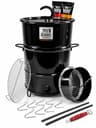
Pit Barrel Cooker Premier Series 18.5-inch Drum Smoker

Pit Barrel Cooker Premier Series 18.5-inch Drum Smoker

The charcoal smoker that deleted the hard part. There is one vent, and you set it once for your altitude — after that the barrel finds its own cruising temperature and stays there. Food hangs from hooks over the coals, so drippings fall on the fire and come back as flavor. If you want charcoal barbecue but the phrase 'vent management' makes you tired, this is the answer.

Best hands-off
$459.99 · View on Amazon

Price as of September 17, 2026. #ad How we’re funded

4
Weber Smokey Mountain Cooker 18-inch

Weber Smokey Mountain Cooker 18-inch

The bullet smoker that has a cult following for good reason. Two cooking grates, a water pan and three dampers give you real charcoal-and-wood flavor, and once you learn to set the vents it holds 225–250°F for hours with almost no fuss. It is the charcoal smoker we'd point a committed beginner toward.

Best charcoal for turkey
$419.00 · View on Amazon

Price as of September 17, 2026. #ad How we’re funded

5
Masterbuilt 40-inch ThermoTemp Propane Vertical Smoker (MB20051316)

Masterbuilt 40-inch ThermoTemp Propane Vertical Smoker (MB20051316)

The one propane smoker that removes the last hard part. A thermostat on the gas valve opens and closes the burner to hold the temperature you dialed in, so it behaves like an electric smoker that happens to run on gas. That plus 960 square inches makes it the propane pick for a nervous first-timer cooking for a crowd.

Best for a big bird
$339.99 · View on Amazon

$399.9915% off

Price as of September 17, 2026. #ad How we’re funded

The picks in full

#1Best overall for turkey

Z Grills 700-Series Wood Pellet Grill & Smoker

Our overall pick for a first pellet smoker. You get real wood-pellet smoke with digital PID temperature control — you dial in 225°F and the auger and fan hold it — plus a 700 sq in cook space and dual meat probes, for a few hundred dollars less than the famous-name pellet grills.

What’s good

  • PID controller holds your set temperature far better than older pellet grills
  • Dual built-in meat probes — you can watch the meat, not the pit
  • Big 28-hour hopper and 700 sq in for the price undercuts the name brands

Trade-offs

  • Needs electricity and a full hopper to run
  • No app and no WiFi on this model — you set and watch it on the grill's own LCD
  • Pellet grills give a lighter smoke ring than charcoal or an offset
Fuel typeWood pellets
Cooking area700 sq in
Temperature range180–450°F
Ease for beginnersEasiest

Specs read from the product listing, on September 11, 2026. “Not published” means the maker doesn’t state that figure there.

#2Best for crisp skin

Char-Griller AKORN Kamado Charcoal Grill and Smoker (E16620)

The kamado to start on. It gives you the thing that makes kamados special — insulated walls that hold a low temperature for hours on a couple of pounds of lump — without the ceramic price tag or the ceramic fragility. It is steel, so it will not crack if it tips, and one person can move it. For a first kamado that combination beats a heavier, prettier cooker.

What’s good

  • Insulated steel body sips charcoal — long cooks on one load
  • 445 sq in with a warming rack, plenty for ribs or a pork butt
  • Far lighter than ceramic and it will not shatter

Trade-offs

  • Steel does not hold heat quite as steadily as thick ceramic
  • The bottom vent needs ash cleared to keep airflow honest
  • No heat deflector included for true indirect smoking
Fuel typeLump charcoal
Cooking area445 sq in
Temperature range200–700°F (maker)
Ease for beginnersEasy

Specs read from the product listing, on August 18, 2026. “Not published” means the maker doesn’t state that figure there.

#3Best hands-off

Pit Barrel Cooker Premier Series 18.5-inch Drum Smoker

The charcoal smoker that deleted the hard part. There is one vent, and you set it once for your altitude — after that the barrel finds its own cruising temperature and stays there. Food hangs from hooks over the coals, so drippings fall on the fire and come back as flavor. If you want charcoal barbecue but the phrase 'vent management' makes you tired, this is the answer.

What’s good

  • One vent, set once — no dialing the temperature up and down
  • Hanging meat cooks faster than grate cooking and bastes itself
  • Simple sealed drum with very little on it to break

Trade-offs

  • Runs hot by design — it is not a 225°F cooker
  • Cooking area is not published as a square-inch figure
  • Hanging takes a little practice with slippery cuts
Fuel typeCharcoal (hanging, one fixed vent setting)
Cooking areaNot published
Temperature range275–310°F expected range (maker)
Ease for beginnersEasiest

Specs read from the product listing, on August 18, 2026. “Not published” means the maker doesn’t state that figure there.

#4Best charcoal for turkey

Weber Smokey Mountain Cooker 18-inch

The bullet smoker that has a cult following for good reason. Two cooking grates, a water pan and three dampers give you real charcoal-and-wood flavor, and once you learn to set the vents it holds 225–250°F for hours with almost no fuss. It is the charcoal smoker we'd point a committed beginner toward.

What’s good

  • Excellent temperature stability once the vents are dialed in
  • Two grates hold a lot — several racks of ribs, or a brisket and a pork butt
  • Simple, near-indestructible design with strong resale value

Trade-offs

  • You manage a live fire — a learning curve the electric and pellet options skip
  • No thermostat; a leave-in thermometer is essential
  • Refueling and ash cleanup take more effort
Fuel typeCharcoal (with wood chunks)
Cooking areaNot published
Temperature rangeNot published
Ease for beginnersModerate

Specs read from the product listing, on July 22, 2026. “Not published” means the maker doesn’t state that figure there.

#5Best for a big bird

Masterbuilt 40-inch ThermoTemp Propane Vertical Smoker (MB20051316)

The one propane smoker that removes the last hard part. A thermostat on the gas valve opens and closes the burner to hold the temperature you dialed in, so it behaves like an electric smoker that happens to run on gas. That plus 960 square inches makes it the propane pick for a nervous first-timer cooking for a crowd.

What’s good

  • ThermoTemp valve holds your set temperature without fiddling
  • 960 sq in across four racks — holiday-dinner capacity
  • Insulated body copes with cold and wind better than thin gas smokers

Trade-offs

  • The most expensive propane smoker we would put in front of a beginner
  • Tall and heavy; it wants a permanent spot
  • Analog dial, so no app or probe alarms
Fuel typePropane (wood chips for smoke)
Cooking area960 sq in
Temperature rangeNot published
Ease for beginnersEasiest

Specs read from the product listing, on August 18, 2026. “Not published” means the maker doesn’t state that figure there.

What USDA actually says about smoking a turkey

This is worth quoting properly, because the internet is full of confident advice that contradicts it. USDA’s guidance for a turkey in a smoker is to bring the cooker to 225–300°F before the bird goes on and to add charcoal every one to two hours as needed to maintain 225–300°F. It puts the estimate at 20 to 30 minutes per pound, and it is explicit that the bird is safely cooked when a food thermometer reads 165°F in the innermost part of the thigh and wing and the thickest part of the breast — not when a timer goes off.

Three other USDA points about smoked turkey specifically:

  • Do not stuff it. USDA’s stated reason is that smoking cooks at a low temperature, so it can take too long for the stuffing to reach 165°F. It adds that smoked stuffing has an undesirable flavor anyway. Cook the dressing separately.
  • Shield the smoker from wind. USDA gives this as a safe cooking-temperature instruction, not a comfort one — wind pulls heat out of a cooker and can drop it below the safe band without the dial telling you.
  • Hardwood or fruitwood only. USDA says never to use a softwood — pine, fir, cedar or spruce — because it gives food a turpentine flavor and coats it with a black pitch or resin. Our wood guide only covers hardwoods for exactly this reason.

Worth noting the contrast: for a turkey in an ordinary oven, USDA says to set the temperature no lower than 325°F. Smoking is the documented exception to that, which is why the 225–300°F band matters and why a cooker that cannot reach the top of it is a poor turkey cooker rather than an unsafe one.

Why the top of the band is where the skin is

Poultry skin is the one thing in barbecue that low-and-slow actively works against. At 225°F the fat under the skin renders slowly and the skin itself never dries out enough to crisp; you get a bird that is perfectly cooked and unpleasant to eat the outside of. Push the same cook to 275–300°F and the skin dries, tightens and browns while the meat still has time to take smoke.

That is the entire argument for the picks on this page. A cooker that runs comfortably at 300°F gives you a turkey people fight over the skin of. A cooker capped at 275°F gives you a good turkey with soft skin. A cooker you have to fight to get above 250°F in November — which is what a thin-walled smoker does in the cold — gives you a long afternoon.

A dry brine helps considerably here and costs nothing, because it draws moisture out of the skin over a day in the fridge. It is not a substitute for temperature.

How much room a whole bird needs

A 12–16 pound turkey is roughly 14 inches long, about a foot wide at the breast and 8 to 10 inches tall sitting in a pan. Three practical consequences:

Cooker shapeWhole turkey?What to watch
Pellet grill, wide single grateComfortablyLid clearance over a bird in a pan — check before the day.
Kamado / insulated roundYes, on a deflectorWants indirect setup; a big bird can crowd the dome.
Bullet, 18.5 inchYes, on the top grateRemove the lower grate for height. A round grate wastes corners.
Hanging drumYes, hung or on the grateRuns hot by design, which suits turkey more than most cuts.
Tall gas or electric cabinetYes, with racks removedPlenty of height. Check the temperature ceiling for skin.

If the bird will not fit, the answer is not a bigger smoker — it is a smaller bird or two of them. Two 10-pound turkeys cook faster than one 20-pounder and feed the same table. Our sizing guide works the same problem through for every cut, and a turkey breast is a genuinely good answer for a smaller table.

November is a cold-weather cook, and that changes things

Almost everyone who searches for this is buying for Thanksgiving, which means the first turkey many of these smokers ever cook is a cold-weather cook with a wind on it. A thin single-skin cabinet that holds 275°F happily in August can struggle in a 30°F breeze, which is exactly why USDA tells you to shield the cooker from wind.

Insulated and heavy cookers — a ceramic or steel kamado, a double-walled gas cabinet, a thick drum — care far less. That is a real advantage in November and close to irrelevant in July, and it is why the picks here skew heavier than our general roundup does. Our guide to smoking in cold weather covers what to do about it with the cooker you already own.

So which one should you buy?

Buy the pellet grill if you want one cooker for everything. A published range that reaches well past 300°F means you can smoke the bird at 250°F for flavor and then push the last stretch hot to finish the skin, on the same cooker, without moving anything. It is also the easiest of these to run while you are dealing with nine other dishes.

Buy the kamado if the skin is the point. A maker-published ceiling of 700°F means 300°F is nothing to it, the insulation shrugs off a cold day, and it uses very little charcoal doing so. Check whether the heat deflector is included — on the one here it is sold separately, and without it you have a grill rather than a smoker.

Buy the drum if you want to hang it and walk away. The maker publishes an expected range of 275–310°F, which is almost exactly the turkey window, with one vent setting and nothing to manage. For this one cut, the thing that makes a drum awkward elsewhere is the thing that makes it excellent.

Buy the big gas cabinet if you are cooking for twenty. 960 square inches over four racks takes a bird and the sides, runs off a tank rather than an outdoor outlet, and holds a set temperature on a thermostat. Use our how-much-meat-to-buy guide to work out whether you need that much before you pay for it.

Frequently asked questions

What temperature should I smoke a turkey at?

Between 225 and 300°F, which is USDA's own stated range for smoking a turkey. Practically, aim for the upper half — 275 to 300°F — because that is where the skin crisps rather than turning rubbery, and it shortens a long cook. USDA estimates 20 to 30 minutes per pound in a smoker, and the bird is done when a thermometer reads 165°F in the innermost thigh and wing and the thickest part of the breast.

Can you smoke a turkey in an electric smoker?

Safely, yes, but check the ceiling first. Many 30-inch electric cabinets top out around 275°F, which is inside USDA's 225 to 300°F smoking band and will cook the bird through — it just will not crisp the skin, because skin needs the hot end of that range. If your electric smoker is what you own, smoke the turkey in it and finish the bird in a 400°F oven for fifteen minutes to fix the skin.

Should I stuff a turkey before smoking it?

No. USDA is explicit about this one: do not stuff a turkey you are going to smoke, because smoking cooks at a low temperature and it can take too long for the center of the stuffing to reach 165°F. USDA also notes that smoked stuffing tastes unpleasant. Cook the dressing separately in the oven.

How long does it take to smoke a turkey?

USDA's estimate is 20 to 30 minutes per pound in a smoker, so roughly four to seven hours for a 14-pound bird depending on where in the 225 to 300°F band you run. Treat that as a planning figure only — the cook is finished at 165°F measured in the innermost part of the thigh and wing and the thickest part of the breast, not at a time.

Why is my smoked turkey skin rubbery?

Almost always because the cooker ran too cool. Skin needs heat and dry air to tighten and brown; at 225°F it slowly poaches in its own rendering fat instead. Run at 275 to 300°F, dry-brine the bird uncovered in the fridge the day before so the skin starts dry, and do not baste it. If your smoker cannot get there, finish the bird in a hot oven.

What wood should I use for a smoked turkey?

A hardwood or fruitwood — apple and cherry are the usual choices for poultry because turkey is mild and takes smoke quickly. USDA's one hard rule is the negative: never use a softwood such as pine, fir, cedar or spruce, which it says gives food a turpentine flavor and coats it with a black pitch or resin. Our wood guides only cover hardwoods for that reason.

Is a whole turkey too big for an 18-inch smoker?

No, a 12 to 16 pound bird fits an 18.5-inch bullet on the top grate with the lower grate removed for height. What it does not leave is room for anything else, and a round grate wastes its corners. If you are cooking a turkey plus sides, or a bird over about 18 pounds, you want a wide pellet grate or a tall cabinet instead. Two smaller birds beat one huge one in every case.

Does cold weather affect smoking a turkey?

Yes, and it matters more for this cook than most because almost everyone does it in November. Wind and cold pull heat out of a cooker, and USDA specifically tells you to place the smoker in an area shielded from winds to maintain a safe cooking temperature. Heavy and insulated cookers barely notice; thin single-skin cabinets can struggle to hold the top of the range on a cold day.

Sources

  • USDA FSIS — Turkey: Alternate Routes to the Table (smoking a turkey)USDA's smoking instructions for turkey: bring the smoker to 225 to 300°F before the bird goes on and add charcoal every 1 to 2 hours as necessary to maintain 225 to 300°F; place the smoker in an area shielded from winds to maintain a safe cooking temperature; do not stuff the turkey, because smoking cooks at a low temperature and it can take too long for the stuffing to reach 165°F; estimate 20 to 30 minutes per pound; use hardwood or fruitwood and never a softwood (pine, fir, cedar or spruce), which gives food a turpentine flavor; and the turkey is safely cooked when a food thermometer reads 165°F in the innermost part of the thigh and wing and the thickest part of the breast (accessed September 18, 2026)
  • USDA FSIS — Turkey Basics: Safe CookingUSDA guidance for cooking a whole turkey: set the oven temperature no lower than 325°F, and the turkey (and the center of any stuffing) must reach a safe minimum internal temperature of 165°F, checked in the innermost part of the thigh and wing and the thickest part of the breast (accessed September 18, 2026)
  • USDA FSIS — Safe Minimum Internal Temperature ChartUSDA safe minimum internal temperatures: 145°F for beef/pork/lamb steaks, chops and roasts (with a 3-minute rest), 160°F for ground meats, 165°F for all poultry (accessed July 22, 2026)
  • USDA FSIS — Smoking Meat and PoultryUSDA guidance to keep the smoker between 225°F and 300°F, use two thermometers (food + smoker), and refrigerate within 2 hours (accessed July 22, 2026)

Keep reading