Smoke & Slow

Best Smokers for Pulled Pork

Pork shoulder is the most forgiving thing you will ever put in a smoker, and that changes what you should buy. You are not shopping for precision. You are shopping for a cooker that will sit at 250°F for ten hours without you standing next to it.

By Stephen V.Last updated How we pick

Buy the Masterbuilt 30-inch Digital Electric Smoker. It is the right pick for pulled pork specifically because pulled pork is the one cut that does not care about the things a cheap electric smoker gives up. You set 250°F on the panel, load the chip tray from the side, and come back in nine hours. There is no fire to feed and nothing to go wrong at 2 a.m.

Every other roundup on this site sorts smokers by type or by budget. This one sorts them by a single question: what does a pork butt actually need? The answer is unusually narrow. A pork shoulder is a fatty, collagen-heavy cut that gets cooked far past any safety threshold — USDA puts the safe minimum for pork at 145°F, and you will be taking this to somewhere around 200°F before the connective tissue lets go. That enormous margin is why pork shoulder forgives swings that would ruin a brisket, and it is why the cheapest sensible cooker on this page is also the one we would pick.

What a butt doesneed is duration and room. Ten hours is a normal cook. Two bone-in butts is a normal shop. Those two things — will it run that long unattended, and will two shoulders fit — are the only specs we have sorted on below.

How this is funded:we earn a commission if you buy through our links, at no extra cost to you. It never changes which smoker we recommend, and we’ll tell you when we’d skip one. Full disclosure.

Quick picks

Ranked on published specs, beginner-friendliness and value. Select a row to jump to the full write-up. We haven’t cooked on every one of these — here is exactly what we do instead.

#ProductBest forPrice
1
Masterbuilt 30-inch Digital Electric Smoker

Masterbuilt 30-inch Digital Electric Smoker

The closest thing to a set-it-and-forget-it first smoker. You set a temperature on the digital panel, it holds it, and you top up wood chips from the side without opening the door. For a nervous first-timer, that is the whole ballgame.

Best overall for pulled pork
$268.51 · View on Amazon

$299.9910% off

Price as of October 6, 2026. #ad How we’re funded

2
Z Grills 700-Series Wood Pellet Grill & Smoker

Z Grills 700-Series Wood Pellet Grill & Smoker

Our overall pick for a first pellet smoker. You get real wood-pellet smoke with digital PID temperature control — you dial in 225°F and the auger and fan hold it — plus a 700 sq in cook space and dual meat probes, for a few hundred dollars less than the famous-name pellet grills.

Best if you want real wood smoke
$548.00 · View on Amazon

$609.0010% off

Price as of October 6, 2026. #ad How we’re funded

3
Weber Smokey Mountain Cooker 18-inch

Weber Smokey Mountain Cooker 18-inch

The bullet smoker that has a cult following for good reason. Two cooking grates, a water pan and three dampers give you real charcoal-and-wood flavor, and once you learn to set the vents it holds 225–250°F for hours with almost no fuss. It is the charcoal smoker we'd point a committed beginner toward.

Best charcoal pick
$419.00 · View on Amazon

Price as of October 6, 2026. #ad How we’re funded

4
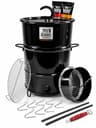
Pit Barrel Cooker Premier Series 18.5-inch Drum Smoker

Pit Barrel Cooker Premier Series 18.5-inch Drum Smoker

The charcoal smoker that deleted the hard part. There is one vent, and you set it once for your altitude — after that the barrel finds its own cruising temperature and stays there. Food hangs from hooks over the coals, so drippings fall on the fire and come back as flavor. If you want charcoal barbecue but the phrase 'vent management' makes you tired, this is the answer.

Fastest, and the least to manage
$459.99 · View on Amazon

Price as of October 6, 2026. #ad How we’re funded

5
Masterbuilt 40-inch ThermoTemp Propane Vertical Smoker (MB20051316)

Masterbuilt 40-inch ThermoTemp Propane Vertical Smoker (MB20051316)

The one propane smoker that removes the last hard part. A thermostat on the gas valve opens and closes the burner to hold the temperature you dialed in, so it behaves like an electric smoker that happens to run on gas. That plus 960 square inches makes it the propane pick for a nervous first-timer cooking for a crowd.

Best for several butts at once
$339.99 · View on Amazon

$399.9915% off

Price as of October 6, 2026. #ad How we’re funded

The picks in full

#1Best overall for pulled pork

Masterbuilt 30-inch Digital Electric Smoker

The closest thing to a set-it-and-forget-it first smoker. You set a temperature on the digital panel, it holds it, and you top up wood chips from the side without opening the door. For a nervous first-timer, that is the whole ballgame.

What’s good

  • Digital thermostat holds the temperature for you — no fire management
  • Side chip loader means you never open the door to add smoke
  • 710 sq in over four racks fits a lot of ribs or a couple of pork butts

Trade-offs

  • Electric smoke is milder than charcoal or a stick burner
  • Needs an outdoor outlet within reach
  • Thin insulation struggles a little in cold weather
Fuel typeElectric (wood chips for smoke)
Cooking area710 sq in
Temperature rangeUp to 275°F
Ease for beginnersEasiest

Specs read from the product listing, on September 11, 2026. “Not published” means the maker doesn’t state that figure there.

#2Best if you want real wood smoke

Z Grills 700-Series Wood Pellet Grill & Smoker

Our overall pick for a first pellet smoker. You get real wood-pellet smoke with digital PID temperature control — you dial in 225°F and the auger and fan hold it — plus a 700 sq in cook space and dual meat probes, for a few hundred dollars less than the famous-name pellet grills.

What’s good

  • PID controller holds your set temperature far better than older pellet grills
  • Dual built-in meat probes — you can watch the meat, not the pit
  • Big 28-hour hopper and 700 sq in for the price undercuts the name brands

Trade-offs

  • Needs electricity and a full hopper to run
  • No app and no WiFi on this model — you set and watch it on the grill's own LCD
  • Pellet grills give a lighter smoke ring than charcoal or an offset
Fuel typeWood pellets
Cooking area700 sq in
Temperature range180–450°F
Ease for beginnersEasiest

Specs read from the product listing, on September 11, 2026. “Not published” means the maker doesn’t state that figure there.

#3Best charcoal pick

Weber Smokey Mountain Cooker 18-inch

The bullet smoker that has a cult following for good reason. Two cooking grates, a water pan and three dampers give you real charcoal-and-wood flavor, and once you learn to set the vents it holds 225–250°F for hours with almost no fuss. It is the charcoal smoker we'd point a committed beginner toward.

What’s good

  • Excellent temperature stability once the vents are dialed in
  • Two grates hold a lot — several racks of ribs, or a brisket and a pork butt
  • Simple, near-indestructible design with strong resale value

Trade-offs

  • You manage a live fire — a learning curve the electric and pellet options skip
  • No thermostat; a leave-in thermometer is essential
  • Refueling and ash cleanup take more effort
Fuel typeCharcoal (with wood chunks)
Cooking areaNot published
Temperature rangeNot published
Ease for beginnersModerate

Specs read from the product listing, on July 22, 2026. “Not published” means the maker doesn’t state that figure there.

#4Fastest, and the least to manage

Pit Barrel Cooker Premier Series 18.5-inch Drum Smoker

The charcoal smoker that deleted the hard part. There is one vent, and you set it once for your altitude — after that the barrel finds its own cruising temperature and stays there. Food hangs from hooks over the coals, so drippings fall on the fire and come back as flavor. If you want charcoal barbecue but the phrase 'vent management' makes you tired, this is the answer.

What’s good

  • One vent, set once — no dialing the temperature up and down
  • Hanging meat cooks faster than grate cooking and bastes itself
  • Simple sealed drum with very little on it to break

Trade-offs

  • Runs hot by design — it is not a 225°F cooker
  • Cooking area is not published as a square-inch figure
  • Hanging takes a little practice with slippery cuts
Fuel typeCharcoal (hanging, one fixed vent setting)
Cooking areaNot published
Temperature range275–310°F expected range (maker)
Ease for beginnersEasiest

Specs read from the product listing, on August 18, 2026. “Not published” means the maker doesn’t state that figure there.

#5Best for several butts at once

Masterbuilt 40-inch ThermoTemp Propane Vertical Smoker (MB20051316)

The one propane smoker that removes the last hard part. A thermostat on the gas valve opens and closes the burner to hold the temperature you dialed in, so it behaves like an electric smoker that happens to run on gas. That plus 960 square inches makes it the propane pick for a nervous first-timer cooking for a crowd.

What’s good

  • ThermoTemp valve holds your set temperature without fiddling
  • 960 sq in across four racks — holiday-dinner capacity
  • Insulated body copes with cold and wind better than thin gas smokers

Trade-offs

  • The most expensive propane smoker we would put in front of a beginner
  • Tall and heavy; it wants a permanent spot
  • Analog dial, so no app or probe alarms
Fuel typePropane (wood chips for smoke)
Cooking area960 sq in
Temperature rangeNot published
Ease for beginnersEasiest

Specs read from the product listing, on August 18, 2026. “Not published” means the maker doesn’t state that figure there.

Why pulled pork changes the shopping list

A brisket roundup is a precision argument: steady temperature, enough length for a full packer, honest airflow. A pulled-pork roundup is almost the opposite. The cut is a wedge of muscle laced with fat and connective tissue, and your whole job is to hold it inside the 225–300°F band USDA recommends for smoking until that tissue turns to gelatin. Overshoot by 25°F for an hour and the pork is fine. Undershoot and it just takes longer.

That has three consequences for what you buy.

  • Hands-off beats accurate.A thermostat that wanders 10°F is irrelevant here. A cooker that needs a log every forty-five minutes for ten hours is not, because you will be doing that in the dark.
  • Capacity matters more than it looks.Butts come in pairs in most packs, and pulled pork is party food. A shoulder also loses a great deal of weight in the cook — USDA publishes cooking yields for exactly this reason — so the raw weight you need is well above the cooked weight you want to serve. Our meat-per-person guide does that arithmetic.
  • Smoke intensity matters less than on beef. Pork takes smoke readily and the fat carries it. This is the cut where a mild electric smoker genuinely holds its own, which is not something we would say about brisket.

The picks against the two specs that matter

Published figures only. Where a maker publishes no number we print “Not published” rather than estimate it — two of the best charcoal smokers ever made publish no square-inch figure at all.

CookerFuelPublished cooking areaTen hours unattended?
Masterbuilt 30-inch DigitalElectric710 sq in, four racksYes— thermostat and a side chip loader
Z Grills 700-SeriesPellets700 sq inYes— PID controller, hopper rated 28 hours
Weber Smokey Mountain 18CharcoalNot publishedNearly — one fuel load, vents set, checked occasionally
Pit Barrel Cooker 18.5CharcoalNot publishedIt will not need ten hours — 275–310°F (maker)
Masterbuilt ThermoTemp 40Propane960 sq in, four racksYes— thermostatic gas valve

How many butts will actually fit

A bone-in pork shoulder is a rough cube rather than a long slab, which is why a cabinet smoker with four shortish racks holds more pork than its square-inch figure suggests and less brisket. On the 710 sq in Masterbuilt you can comfortably run two butts on separate racks. On the 960 sq in ThermoTemp you can run four. On the bullet you get two, one per grate, and that is the honest ceiling of the 18-inch.

The Pit Barrel is the outlier, and it is the reason it is on this list. Food hangs from hooks rather than sitting on a grate, so capacity is a question of how many hooks fit round the rim, and a hanging shoulder bastes itself as the fat runs down it. It also runs hot by design, in the 275–310°F range Pit Barrel itself publishes, which turns a ten-hour cook into something closer to six or seven. If what you dislike about barbecue is the length of the day, that is a real answer rather than a compromise.

What to buy alongside it

Pulled pork is the cook we tell every beginner to do first, for the reason this whole page is about: it has the widest margin for error in barbecue. Our step-by-step pork shoulder guide has the temperatures and the timing. The one accessory we would not start without is a leave-in thermometer— a butt is done by internal temperature and by feel, never by the clock. For wood, hickory is the classic match and apple is the safer first bag; both are covered on our wood for pork page. If you plan to wrap, the butcher paper roundup covers what to wrap it in and the paper-versus-foil guide covers whether to.

One warning worth repeating, because it is the single most common first-pulled-pork panic. The internal temperature will park around 150–170°F for hours while moisture evaporates off the surface. It is not a broken smoker and it is not a bad butt. The stall explains what is happening and why turning the heat up is usually the wrong response. If you are cooking a crowd-sized quantity, the capacity roundup sorts cookers purely on published square inches.

Frequently asked questions

What is the best smoker for pulled pork?

For most people, an electric cabinet smoker like the Masterbuilt 30-inch Digital. Pork shoulder is cooked far past any safety threshold and forgives temperature swings, so the precision you would pay for on a brisket cooker buys you nothing here. What you want is a cooker that holds 250°F for ten hours while you sleep. If you want real wood smoke with the same hands-off behavior, a PID pellet grill like the Z Grills 700 is the upgrade.

How long does pulled pork take in a smoker?

Plan on roughly 1.5 to 2 hours per pound at 225–250°F, so eight to twelve hours for a typical 8-pound bone-in butt, plus a rest. Cooking hotter shortens it: a Pit Barrel running in its published 275–310°F range will get there in closer to six or seven. Never cook a pork butt to a schedule. It is done when a probe slides in with no resistance, usually somewhere around 200°F internal, not at a particular hour.

Do I need a big smoker for pulled pork?

Bigger than you would need for ribs, because pork butts are chunky rather than flat and because pulled pork is usually cooked for a crowd. Two bone-in shoulders fit on a 700-ish square-inch cabinet with four racks, or on the two grates of an 18-inch bullet. For four butts you are into 960 square inches of cabinet, which is the ThermoTemp 40 on this page.

Is an electric smoker good for pulled pork?

It is genuinely good, and this is the cut where that is most true. The usual knock on electric smokers, that the smoke is milder than charcoal, matters least on a fatty cut that takes smoke readily and gets served shredded and sauced. You give up the smoke ring and some depth of flavor, and you get a ten-hour cook with no fire management at all.

Can you make pulled pork on a pellet grill?

Yes, and it is one of the best things a pellet grill does. A full hopper covers the whole cook, the controller holds your set temperature, and the smoke is real wood rather than an element plus chips. A pellet grill gives a lighter smoke ring than charcoal, which on shredded pork is close to impossible to notice.

What temperature should I smoke a pork butt at?

Anywhere in the 225–300°F band USDA recommends for smoking will work. 250°F is the sensible default: hot enough to finish in a normal day, gentle enough to render the fat properly. The temperature that genuinely matters is the one inside the meat. USDA's safe minimum for pork is 145°F, but pulled pork needs around 200°F for the connective tissue to break down.

Charcoal or electric for pulled pork?

Charcoal tastes better and electric is easier, and on pork shoulder that gap is narrower than on any other cut. If you enjoy tending a fire, a Weber Smokey Mountain gives you a better result and a smoke ring. If the appeal of a ten-hour cook is that you can ignore it, the electric cabinet is not a consolation prize here.

How much pork shoulder do I need per person?

Raw weight is roughly double what you want to serve, because a bone-in shoulder loses a lot to rendered fat, bone and bark. A common planning figure is about a third of a pound of finished pulled pork per person for sandwiches, which means buying around two-thirds of a pound raw. Our meat-per-person guide works through it properly, including the USDA cooking-yield figures behind it.

Sources

  • USDA FSIS — Smoking Meat and Poultry — USDA guidance to keep the smoker between 225°F and 300°F, use two thermometers (food + smoker), and refrigerate within 2 hours (accessed July 22, 2026)
  • USDA FSIS — Safe Minimum Internal Temperature Chart — USDA safe minimum internal temperatures: 145°F for beef/pork/lamb steaks, chops and roasts (with a 3-minute rest), 160°F for ground meats, 165°F for all poultry (accessed July 22, 2026)
  • USDA ARS — Table of Cooking Yields for Meat and Poultry (Release 2) — USDA Agricultural Research Service measurements of how much weight cuts of meat and poultry lose to moisture and fat during cooking, under defined laboratory protocols. Figures quoted on our page, read from the Release 2 data table downloadable here: beef brisket flat half trimmed to 1/8 inch fat, braised — 69% cooking yield (n=20, range 65-76%); pork shoulder arm picnic, braised — 74% (n=12, range 70-78%); pork spareribs, baked or roasted — 76% (n=12, range 68-79%); pork loin back ribs bone-in, baked or roasted — 82% (n=12, range 74-90%); turkey from whole, non-enhanced, dark meat with skin, roasted — 69%; turkey breast retail part, non-enhanced, with skin, roasted — 72%. These are cooking losses only, measured on the cut as prepared for the protocol — they are NOT barbecue yields and do not account for trimming or bone (accessed September 18, 2026)
  • USDA FSIS — Doneness Versus Safety — USDA on the difference between a safe internal temperature and the higher 'done/tender' temperature cooks pull tough cuts to (accessed July 22, 2026)

Keep reading