Why the ceiling is the spec that matters
USDA puts the safe minimum internal temperature for all poultry at 165°F, and its smoking guidance keeps the chamber between 225°F and 300°F. Those two numbers are entirely compatible with terrible skin. A chicken held at 250°F will reach 165°F in the thigh long before the fat under the skin has rendered, which is why you can serve a safely cooked, juicy, technically perfect bird that nobody wants to eat the outside of.
Chicken is also fast. A whole bird is two to three hours; wings are closer to one. There is no eight-hour window for the skin to sort itself out, and no stall to wrap through. The entire cook is short enough that the useful question about a cooker is not “can it hold 225°F all day” but “can it change gear at the end.”
The picks against their published ranges
Published figures only. Where a maker publishes no temperature range we print “Not published” rather than estimate one — two of the five cookers here are in that position, and it is the main thing holding them back on this page.
| Cooker | Fuel | Published temperature range | Can it crisp skin? |
|---|
| Char-Griller AKORN | Lump charcoal | 200–700°F (maker) | Yes — comfortably, in the same cooker |
| Weber Original Kettle 22 | Charcoal | Not published | Yes — open the vents and it is a grill again |
| Z Grills 700-Series | Wood pellets | 180–450°F | Yes — 450°F is enough, with patience |
| Masterbuilt Gravity Series 600 | Charcoal (gravity-fed, fan) | 225–700°F (maker) | Yes — maker states 700°F in 10 minutes |
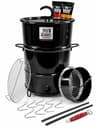
| Pit Barrel Cooker 18.5 | Charcoal (hanging) | 275–310°F expected range (maker) | Partly — it runs hot by design, but it does not reach 375°F |
The Weber kettle is the interesting row. Weber publishes no temperature range for it at all, so the table says so — but a charcoal kettle with the vents wide open is the original high-heat cooker, and nobody doubts it will crisp skin. What it will not do is hold a low temperature without you managing the fire, which is the trade this whole page is about.
The honest exclusion: electric smokers
This site recommends an electric cabinet smoker to more beginners than anything else, and it is not on this list. The reason is a single published number: the listings for both electric smokers we carry state a ceiling of “up to 275°F.” That is below the heat chicken skin needs, and no amount of technique gets around it.
If you already own one, you have not wasted your money — you have a two-appliance cook. Smoke the chicken in the cabinet for flavor and finish it in a hot oven or under a broiler for the last ten minutes. That genuinely works, and it is the standard workaround. It is just not something we would buy a smoker to do on purpose.
Wings in quantity, which is a different problem
Wings are the most-cooked chicken on a smoker and they are a capacity question as much as a temperature one, because thirty wings laid flat need a lot of grate. This is where the Pit Barrel earns its place despite the lowest ceiling on the page: food hangs from hooks rather than lying on a grate, and Pit Barrel states the 22.5-inch PBX will take 60-plus party wings. The 18.5-inch here is smaller, but the hanging trick still multiplies what fits, and the barrel runs in a published 275–310°F range rather than the 225°F a normal smoker idles at — so the skin comes out better than a low-and-slow cook would give you, just not fully crisp.
On any of the others, the move is the two-stage cook. Smoke at 250°F until the wings are nearly done, then take the cooker up as high as it goes for the last ten to fifteen minutes. Dry skin matters as much as heat: pat the wings dry, and give them an uncovered hour in the fridge if you have time.
What else actually changes the result
- A thermometer, not a timer. Chicken goes from juicy to chalky in a narrow window and the thigh and breast finish at different times. USDA is clear that 165°F in the thickest part is the number that decides safety — our thermometer roundup covers what to use.
- A mild wood. Chicken takes smoke fast and hickory can turn acrid on it. Apple or cherry, lightly — see best wood for chicken.
- A rub without much sugar, if you are finishing hot. A sugar-first rub at 400°F darkens fast. Our rub roundup explains which bottles tolerate heat.
Two of these picks have more detail elsewhere on the site: the Z Grills 700 review goes through the pellet pick in full, and kamado versus pellet is the head-to-head between our top pick here and the hands-off one.
And if you are choosing a first cooker generally rather than for chicken specifically, start at best smokers for beginners or at the budget rung that fits: under $300 or under $500. Chicken is a great first cook on almost anything — it is cheap, fast and forgiving everywhere except the skin.