How Often Should You Add Wood Chips?
A tray of chips in an electric smoker is spent in under an hour, so the honest answer is 'more often than you would like.' The more useful answer is that you can stop adding them long before the cook is over.
How this is funded:we earn a commission if you buy through our links, at no extra cost to you. It never changes which smoker we recommend, and we’ll tell you when we’d skip one. Full disclosure.
In an electric or propane cabinet: about every 45 to 60 minutes, half a cup to a cup of chips at a time, for the first three to four hours of the cook. After that you can stop. In a charcoal smoker you are adding chunks rather than chips, and the rhythm is every couple of hours alongside the fuel. In a pellet grill there is nothing to add at all.
That is the practical answer. The rest of this page is why the interval is so short, why the stopping point matters more than the interval, and what to do if reloading a tray every forty-five minutes is not your idea of a relaxing Saturday.
Why chips burn out so fast
A wood chip is a thin flake with a lot of surface area for its volume, sitting in a metal tray directly over an electric element or a burner. It dries, smolders and is gone — that is the whole lifecycle, and it takes well under an hour. A chunk is a fist-sized block of the same wood with a fraction of the surface area per pound, buried in or beside a charcoal fire, so it smolders slowly from the outside in and lasts hours.
Neither format is better. They belong in different cookers, which is the entire point of our chips versus chunks guide: a chunk in an electric smoker’s tray barely smolders because there is not enough heat concentrated on it, and chips in a charcoal firebox flash off in minutes. If you own an electric or gas cabinet, chips are not a compromise — they are the correct fuel for the tray you have.
The interval by cooker type
| Cooker | What goes in | How often | How much |
|---|---|---|---|
| Electric cabinet | Chips | Every 45–60 min, while you want smoke | Half a cup to a cup |
| Propane cabinet | Chips | Every 30–45 min — a gas burner is hotter than an element | Half a cup to a cup |
| Charcoal (bullet, drum, kamado) | Chunks | 2–3 at the start, then one every couple of hours if you want more | Fist-sized pieces |
| Offset | Splits or chunks | Every 30–60 min — here the wood IS the fuel | One split at a time |
| Pellet grill | Nothing | Never — the auger feeds pellets automatically | Keep the hopper full |
| Gas grill with a smoker box | Chips | Every 30–45 min | Box about two-thirds full |
The one piece of federal guidance that touches this is about fuel rather than flavor: USDA’s instructions for smoking a turkey say to add charcoal every one to two hours as necessary to maintain 225 to 300°F. That is a sensible cadence to check your wood on as well, because you are already at the cooker with the lid off.
The part that matters more: when to stop
Most people asking this question are really asking the wrong one. The interval is trivia; the stopping point is the decision that changes how your food tastes.
Our editorial read, and it is ours rather than a lab finding: run wood for the first three to four hours of a long cook and then let it finish clean. A cold, damp meat surface takes on smoke readily; a dried, set bark does so far less eagerly, and by hour seven you are mostly adding bitterness rather than flavor. A ten-hour pork butt does not need ten hours of smoke, and a brisket that tasted like an ashtray was almost always a brisket that got wood all day.
This is a taste judgment, so test it on yourself rather than taking our word for it. Cook one rack of ribs with wood for the first two hours and nothing after, and the next one with wood the whole way, and you will know your own preference permanently. What you should not do is assume that more wood is more flavor indefinitely — that assumption is behind most over-smoked barbecue.
Signs you are adding too much
- Billowing white smoke rather than a thin haze. That is wood smoldering dirty, usually because the tray is packed too full or the chips went in wet, and it carries the compounds that taste harsh. See thin blue smoke.
- A bitter, ashy edge on the finished bark, especially on poultry and fish, which pick up smoke fastest.
- A black, sooty deposit inside the lid that comes off on your fingers. Some buildup is normal and good; wet soot is a sign of consistently dirty smoke — our cleaning guide covers what to leave alone and what to scrape.
The opposite problem — a tray that produces nothing at all — has a different and longer list of causes, most of them to do with chamber temperature and whether the tray is properly seated against the element. Our electric smoker not producing smoke guide works through them in order.
The right format for your cooker
If you own an electric or gas cabinet, buy chips and stop fighting the tray. If you own anything charcoal, buy chunks and reload far less often. And if the reloading itself is the problem, there is a third option that most people with a cabinet smoker end up at.
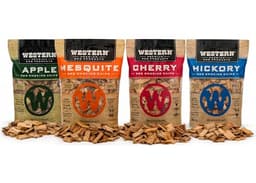
Western BBQ Smoking Wood Chips Variety Pack (4)
Chips are the correct format for a tray sitting over an element, and four separate bags — apple, cherry, hickory and mesquite — let you find out what you actually like across a few cooks instead of committing to a single flavor. Use the mesquite sparingly; it is by far the strongest of the four.
Price as of October 20, 2026. #ad How we’re funded
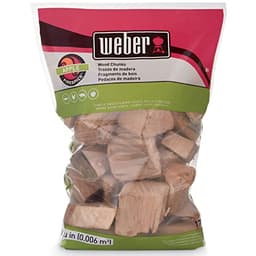
Weber Apple Wood Chunks (4 lb)
Two or three chunks at the start of a cook do what six tray-loads of chips do, which is the whole reason chunks exist. Apple is the mildest widely sold wood, so it is the one bag that is hard to overdo while you are still working out how much smoke you like.
Price as of October 20, 2026. #ad How we’re funded
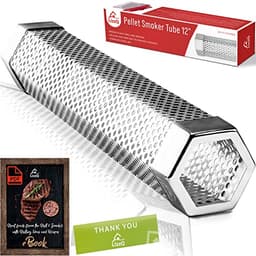
LIZZQ Premium Pellet Smoker Tube (12 inch)
A perforated tube you fill with pellets, light once and set on a rack — the listing states up to five hours of smoke per fill, which replaces the entire 45-minute cycle this page is about. It works inside an electric or propane cabinet as well as on a gas grill, and it is the standard answer for anyone who wants smoke without a chore attached.
Price as of October 20, 2026. #ad How we’re funded
Two cooks where the usual interval does not apply
Fish. A salmon fillet is in the cooker for well under ninety minutes and absorbs smoke faster than anything else you will cook. Load wood once, lightly, and do not top it up at all — our wood for salmon page explains why restraint is the whole technique there.
Chicken. A two-hour cook only has room for one or two loads anyway, and poultry takes smoke readily. One tray of a mild wood at the start is usually the right answer; see wood for chicken.
And how much to buy. Reloading every forty-five minutes gets through a bag faster than most people expect, which makes pack size a real buying decision rather than an afterthought. Our wood chips for an electric smoker roundup does the arithmetic on how many cooks a bag covers, and explains why the bags sold by weight cannot be compared with the ones sold by volume.
For everything long — brisket, pork shoulder, beef ribs — the pattern at the top of this page holds, and the cook’s real job is keeping the chamber steady while it runs. That is what how to control temperature is for, and USDA’s advice to run two thermometers — one in the meat, one reading the chamber — matters more to your result than any wood schedule.
Frequently asked questions
How often should you add wood chips to an electric smoker?
Roughly every 45 to 60 minutes while you want smoke, using about half a cup to a cup of chips per load. Chips are small and burn out fast, which is simply what the format does. The part most people get wrong is the other half of the answer: you do not need to keep topping up for the whole cook. Most of the smoke flavor lands in the first few hours, so many cooks stop adding wood at the halfway point.
Do you keep adding wood chips the whole time you smoke?
No, and a ten-hour pork butt does not need ten hours of smoke. Our own practice is to run wood for the first three to four hours and then let the cook finish clean. The surface takes on smoke most readily while it is still tacky; once bark has formed and dried out, more wood mostly means a harsher edge rather than more flavor. If you like heavy smoke, run it longer — it is a taste decision, not a rule.
How many wood chips do you use at a time?
About half a cup to a cup per load in an electric or propane smoker's tray — a handful, not a tray packed full. Overfilling smothers the chips at the bottom, which smolder dirty rather than burning cleanly and give you the acrid flavor people blame on the wood itself. Smaller loads more often beats one big load.
Should you soak wood chips before adding them?
No. Soaked chips do not smoke sooner or for longer — the water simply has to boil off first, which cools the tray and delays the smoke. Load them dry. Our chips versus chunks guide goes through the soaking myth in detail.
How often should you add wood chunks in a charcoal smoker?
Far less often than chips. Two or three chunks at the start of the cook is normal, and one more every couple of hours if you want continuous smoke — the fuel itself is what you are topping up on a charcoal cooker. USDA's own smoking instructions tell you to add charcoal every one to two hours as necessary to maintain 225 to 300°F, which is a good rhythm to check the wood on too.
Do you add wood chips to a pellet grill?
There is nothing to add — the pellets are the wood and the fuel at the same time, and the controller feeds them automatically. If a pellet grill is not giving you enough smoke, the usual fix is a pellet tube on the grate or a lower cooking temperature, not chips. There is no chip tray to load.
Why does my smoker stop making smoke?
Usually the chips are spent, which on a tray is a 45-to-60-minute event. The other common causes are a tray packed so full that the chips are smothered, chips that were soaked and are still boiling off their water, or a chamber running too cool to get them smoldering. If you keep hitting this, a pellet tube sidesteps the whole problem.
Can you open the smoker to add chips?
You can, but try not to. Every door opening dumps heat and lengthens the cook, which is why most electric and propane cabinets have a side chip loader you can use without opening the main door. If yours does not have one, batch the job: add chips when you are already opening up for something else, like spritzing or checking a probe.
Sources
- USDA FSIS — Turkey: Alternate Routes to the Table (smoking a turkey) — USDA's smoking instructions for turkey: bring the smoker to 225 to 300°F before the bird goes on and add charcoal every 1 to 2 hours as necessary to maintain 225 to 300°F; place the smoker in an area shielded from winds to maintain a safe cooking temperature; do not stuff the turkey, because smoking cooks at a low temperature and it can take too long for the stuffing to reach 165°F; estimate 20 to 30 minutes per pound; use hardwood or fruitwood and never a softwood (pine, fir, cedar or spruce), which gives food a turpentine flavor; and the turkey is safely cooked when a food thermometer reads 165°F in the innermost part of the thigh and wing and the thickest part of the breast (accessed September 18, 2026)
- USDA FSIS — Smoking Meat and Poultry — USDA guidance to keep the smoker between 225°F and 300°F, use two thermometers (food + smoker), and refrigerate within 2 hours (accessed July 22, 2026)
- USDA FSIS — Food Thermometers — USDA on why a food thermometer is the only reliable way to know food has reached a safe temperature, and how to place the probe (accessed July 22, 2026)
Keep reading
Wood Chips vs Chunks
Which format belongs in which smoker, how much to use, and why soaking does nothing at all.
Chips or chunks?Thin Blue Smoke
What good smoke looks like, what billowing white smoke is doing to your food, and how to fix it.
Read the smokeBest Wood for Beginners
The one bag to start with, and the two woods to leave on the shelf until you know your tolerance.
Pick a woodBest Electric Smokers
The cabinets this question is really about — including which ones have a side chip loader.
See electric