Smoke & Slow

Best Smokers for Ribs

Ribs are the friendliest big cook in barbecue — five or six hours, forgiving, hard to genuinely ruin. Which means the smoker question is not 'can it' but 'how many racks at once', and that is decided by shelves rather than square inches.

By Stephen V.Last updated How we pick

Ribs do not need a special smoker. They need a smoker with enough shelves. A rack of ribs is a five-to-six hour cook at 225–275°F, it is forgiving about temperature swings in a way brisket is not, and every cooker on this site can produce a good one. What separates them is a problem of geometry: ribs are long, flat and awkward, you almost never cook just one rack, and a cooker that swallows four racks costs about the same as one that swallows two.

Here is the arithmetic that surprises people. A rack of St. Louis-cut spare ribs is roughly 13 inches long and 6 to 7 inches wide, so it wants around 90 square inches of grate laid flat. On paper a 700-square-inch smoker should hold seven racks. In practice it holds three or four, because the grate is 15 inches across and you cannot lay a 13-inch rack sideways across it twice. Square inches is the wrong unit for ribs. Shelf count and shelf width is the right one — or, on one cooker here, a set of hooks that sidesteps the problem entirely by hanging the ribs vertically.

Our picks come from published specs, USDA’s own smoking guidance and honest beginner-fit (how we pick), never from a rib cook-off we did not run. Prices are pulled live. If you have not cooked a rack yet, our step-by-step rib guide is the place to start — ribs are the first cook we point almost every beginner at.

How this is funded:we earn a commission if you buy through our links, at no extra cost to you. It never changes which smoker we recommend, and we’ll tell you when we’d skip one. Full disclosure.

Quick picks

Ranked on published specs, beginner-friendliness and value. Select a row to jump to the full write-up. We haven’t cooked on every one of these — here is exactly what we do instead.

#ProductBest forPrice
1
Masterbuilt 30-inch Digital Electric Smoker

Masterbuilt 30-inch Digital Electric Smoker

The closest thing to a set-it-and-forget-it first smoker. You set a temperature on the digital panel, it holds it, and you top up wood chips from the side without opening the door. For a nervous first-timer, that is the whole ballgame.

Best overall for ribs
$268.51 · View on Amazon

$299.9910% off

Price as of September 17, 2026. #ad How we’re funded

2
Weber Smokey Mountain Cooker 18-inch

Weber Smokey Mountain Cooker 18-inch

The bullet smoker that has a cult following for good reason. Two cooking grates, a water pan and three dampers give you real charcoal-and-wood flavor, and once you learn to set the vents it holds 225–250°F for hours with almost no fuss. It is the charcoal smoker we'd point a committed beginner toward.

Best charcoal for ribs
$419.00 · View on Amazon

Price as of September 17, 2026. #ad How we’re funded

3
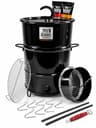
Pit Barrel Cooker Premier Series 18.5-inch Drum Smoker

Pit Barrel Cooker Premier Series 18.5-inch Drum Smoker

The charcoal smoker that deleted the hard part. There is one vent, and you set it once for your altitude — after that the barrel finds its own cruising temperature and stays there. Food hangs from hooks over the coals, so drippings fall on the fire and come back as flavor. If you want charcoal barbecue but the phrase 'vent management' makes you tired, this is the answer.

Best for hanging ribs
$459.99 · View on Amazon

Price as of September 17, 2026. #ad How we’re funded

4
Z Grills 700-Series Wood Pellet Grill & Smoker

Z Grills 700-Series Wood Pellet Grill & Smoker

Our overall pick for a first pellet smoker. You get real wood-pellet smoke with digital PID temperature control — you dial in 225°F and the auger and fan hold it — plus a 700 sq in cook space and dual meat probes, for a few hundred dollars less than the famous-name pellet grills.

Best pellet for ribs
$539.00 · View on Amazon

$609.0011% off

Price as of September 17, 2026. #ad How we’re funded

5
Dyna-Glo Vertical Offset Charcoal Smoker (DGO1176BDC-D)

Dyna-Glo Vertical Offset Charcoal Smoker (DGO1176BDC-D)

The budget charcoal cabinet. A tall vertical body with an offset charcoal box gives you a lot of rack space cheaply, and it takes charcoal and wood chunks for real smoke flavor. Expect to seal a few gaps and babysit the fire more than you would on a Weber — the price reflects the build.

Most racks per dollar
$211.04 · View on Amazon

Price as of September 17, 2026. #ad How we’re funded

The picks in full

#1Best overall for ribs

Masterbuilt 30-inch Digital Electric Smoker

The closest thing to a set-it-and-forget-it first smoker. You set a temperature on the digital panel, it holds it, and you top up wood chips from the side without opening the door. For a nervous first-timer, that is the whole ballgame.

What’s good

  • Digital thermostat holds the temperature for you — no fire management
  • Side chip loader means you never open the door to add smoke
  • 710 sq in over four racks fits a lot of ribs or a couple of pork butts

Trade-offs

  • Electric smoke is milder than charcoal or a stick burner
  • Needs an outdoor outlet within reach
  • Thin insulation struggles a little in cold weather
Fuel typeElectric (wood chips for smoke)
Cooking area710 sq in
Temperature rangeUp to 275°F
Ease for beginnersEasiest

Specs read from the product listing, on September 11, 2026. “Not published” means the maker doesn’t state that figure there.

#2Best charcoal for ribs

Weber Smokey Mountain Cooker 18-inch

The bullet smoker that has a cult following for good reason. Two cooking grates, a water pan and three dampers give you real charcoal-and-wood flavor, and once you learn to set the vents it holds 225–250°F for hours with almost no fuss. It is the charcoal smoker we'd point a committed beginner toward.

What’s good

  • Excellent temperature stability once the vents are dialed in
  • Two grates hold a lot — several racks of ribs, or a brisket and a pork butt
  • Simple, near-indestructible design with strong resale value

Trade-offs

  • You manage a live fire — a learning curve the electric and pellet options skip
  • No thermostat; a leave-in thermometer is essential
  • Refueling and ash cleanup take more effort
Fuel typeCharcoal (with wood chunks)
Cooking areaNot published
Temperature rangeNot published
Ease for beginnersModerate

Specs read from the product listing, on July 22, 2026. “Not published” means the maker doesn’t state that figure there.

#3Best for hanging ribs

Pit Barrel Cooker Premier Series 18.5-inch Drum Smoker

The charcoal smoker that deleted the hard part. There is one vent, and you set it once for your altitude — after that the barrel finds its own cruising temperature and stays there. Food hangs from hooks over the coals, so drippings fall on the fire and come back as flavor. If you want charcoal barbecue but the phrase 'vent management' makes you tired, this is the answer.

What’s good

  • One vent, set once — no dialing the temperature up and down
  • Hanging meat cooks faster than grate cooking and bastes itself
  • Simple sealed drum with very little on it to break

Trade-offs

  • Runs hot by design — it is not a 225°F cooker
  • Cooking area is not published as a square-inch figure
  • Hanging takes a little practice with slippery cuts
Fuel typeCharcoal (hanging, one fixed vent setting)
Cooking areaNot published
Temperature range275–310°F expected range (maker)
Ease for beginnersEasiest

Specs read from the product listing, on August 18, 2026. “Not published” means the maker doesn’t state that figure there.

#4Best pellet for ribs

Z Grills 700-Series Wood Pellet Grill & Smoker

Our overall pick for a first pellet smoker. You get real wood-pellet smoke with digital PID temperature control — you dial in 225°F and the auger and fan hold it — plus a 700 sq in cook space and dual meat probes, for a few hundred dollars less than the famous-name pellet grills.

What’s good

  • PID controller holds your set temperature far better than older pellet grills
  • Dual built-in meat probes — you can watch the meat, not the pit
  • Big 28-hour hopper and 700 sq in for the price undercuts the name brands

Trade-offs

  • Needs electricity and a full hopper to run
  • No app and no WiFi on this model — you set and watch it on the grill's own LCD
  • Pellet grills give a lighter smoke ring than charcoal or an offset
Fuel typeWood pellets
Cooking area700 sq in
Temperature range180–450°F
Ease for beginnersEasiest

Specs read from the product listing, on September 11, 2026. “Not published” means the maker doesn’t state that figure there.

#5Most racks per dollar

Dyna-Glo Vertical Offset Charcoal Smoker (DGO1176BDC-D)

The budget charcoal cabinet. A tall vertical body with an offset charcoal box gives you a lot of rack space cheaply, and it takes charcoal and wood chunks for real smoke flavor. Expect to seal a few gaps and babysit the fire more than you would on a Weber — the price reflects the build.

What’s good

  • Tall cabinet holds a lot of ribs and sausage for the money
  • Real charcoal-and-wood flavor at a budget price
  • Offset firebox keeps the heat source away from the food

Trade-offs

  • Thin steel loses heat and leaks smoke until you seal it
  • Holding a steady temperature takes more attention
  • Build quality is entry-level — this is a starter, not a lifer
Fuel typeCharcoal (with wood chunks)
Cooking areaNot published
Temperature rangeNot published
Ease for beginnersModerate

Specs read from the product listing, on July 22, 2026. “Not published” means the maker doesn’t state that figure there.

Why ribs are a capacity question and not a performance one

Ribs sit in the sweet spot of low-and-slow. They finish in five or six hours rather than twelve, so an overnight cook never comes into it and you are never asleep while the fire does something stupid. They are pork, so they tolerate a wobble between 225°F and 275°F without anyone noticing in the finished product. And they are thin, so they do not stall for hours the way a twelve-pound brisket does.

Take away the runtime problem and the temperature-stability problem and what is left is the thing nobody mentions in reviews: on the day you actually cook ribs, you are cooking for people. Four adults will comfortably eat two racks. Eight will eat four. If your smoker holds two, you are either cooking twice or you are hosting fewer people, and neither was the plan.

How many racks does each shape really hold?

The honest answer is that we are reasoning from published cooking areas and shelf counts, because almost no maker publishes grate dimensions. Where a listing states nothing, the spec tables below print “Not published” and we do not invent a figure. What we can do is explain what each shape does with a 13-inch rack.

ShapeHow ribs go inThe catch
Tall cabinet (electric, gas, charcoal)Flat, one or two racks per shelf, across four shelvesThe most racks for the money. Shelves near the heat cook faster, so rotate.
Bullet (two round grates)Flat, curved to the circle, or stood in a rib rackA round grate wastes the corners. A rib rack roughly doubles what fits.
Drum (hanging)Hung vertically from hooks, several racks at onceRibs must be trimmed to hang and the drippings go on the coals.
Pellet grill (one wide grate)Flat, usually three or four racks side by sideWide and shallow, so it is the shape ribs suit best of any single grate.
OffsetFlat along a long chamberPlenty of room; the far end runs cooler than the firebox end.

A rib rack — the wire stand that holds racks on edge like files in a drawer — is the cheapest capacity upgrade in barbecue and roughly doubles what a bullet or a cabinet takes. We do not have one in our gear picks because we have not found one worth singling out; any sturdy stainless one from the same shelf as your smoker will do the job.

The temperature ribs actually want

USDA’s smoking guidance is 225–300°F, and ribs are happy across the whole of it. Cooking at the low end for six hours gives you the most bark and the most smoke; cooking at 275°F gets you there in around four and is what most competition cooks do. Neither is wrong. This is worth saying plainly because it changes the buying decision: a cooker with a 275°F ceiling is not compromised on ribs at all, and the hanging drum here, which the maker says runs hotter than most people expect, is running in exactly the band ribs like.

Pork ribs are also the cut where the safe temperature and the good temperature are furthest apart. USDA’s safe minimum for pork is 145°F with a rest, and USDA separately points out that tough cuts are taken well beyond that to become tender. Ribs finish somewhere around 195–203°F, which is why the bend test and a probe matter more than the clock, and why a thermometer belongs in the same order as the smoker.

What about the 3-2-1 method?

You will meet it everywhere: three hours of smoke, two wrapped in foil, one unwrapped with sauce. It is a reasonable set of training wheels for spare ribs, it is far too long for baby backs, and it is a technique rather than a reason to buy one smoker over another. Every cooker on this page does it identically. Our wrapping guide covers what the wrap is actually for, and the rib guide gives you the version we would actually cook.

So which one should you buy?

Buy the electric cabinet if ribs are the main event. Four shelves, a dial, and nothing to learn. It is the most racks per dollar with the least that can go wrong, and ribs do not need the heavier smoke flavor that would otherwise push you toward charcoal. This is the smoker we point a “I want to make ribs for my family on Saturdays” buyer at, almost without exception.

Buy charcoal if you want the flavor and do not mind vents. A bullet makes better ribs than an electric cabinet, full stop. It also asks you to learn a fire. Ribs are the ideal cut to learn it on, because a five-hour cook that goes slightly wrong is still dinner.

Buy the drum if you want the best ribs with the least fiddling. Hanging ribs over a fire is the oldest trick in the book and a drum does it with one vent setting and no thermometer wrangling. The trade is that it cooks hot, so it is a poor fit if you also want long 225°F overnight cooks.

Buy the pellet grill if you want ribs plus everything else. A wide single grate is the best shape on this page for laying racks flat, and the same cooker handles brisket overnight and a turkey in November. Not the cheapest way to cook ribs; much the most versatile.

Frequently asked questions

What is the best smoker for ribs for a beginner?

A 30-inch electric cabinet. Ribs are forgiving about temperature and finish in five or six hours, so the hard parts of smoking barely apply — which leaves capacity as the real question, and a four-shelf cabinet holds more racks for the money than anything else at that price. If you want a stronger smoke flavor and are willing to learn vents, a charcoal bullet makes better ribs.

How many racks of ribs fit in a 30-inch smoker?

Realistically three or four laid flat across four shelves, not the seven a square-inch figure suggests. A rack of St. Louis spare ribs is about 13 inches long and 6 to 7 inches wide, and most cabinet shelves are around 15 inches across, so you fit one rack per shelf comfortably and two only if the shelf is genuinely wide. A rib rack that stands them on edge roughly doubles it. Makers publish square inches rather than grate dimensions, so treat any exact rack count you read as an estimate.

What temperature should I smoke ribs at?

Anywhere in USDA's 225 to 300°F smoking band. 225°F for about six hours gives the most bark and smoke; 275°F gets you there in roughly four and is what most competition cooks use. Ribs genuinely do not mind, which is why a smoker with a 275°F ceiling is no handicap here even though it would be on poultry.

Do I need a rib rack?

Not to cook ribs, but it is the cheapest way to cook more of them. It is a wire stand that holds racks on edge like files in a drawer, and it roughly doubles what a round bullet grate or a cabinet shelf will take. We have not singled one out in our gear picks because there is nothing to choose between them — buy a sturdy stainless one sized to your cooker.

Are ribs better on charcoal or a pellet smoker?

Charcoal, marginally, and the gap is smaller than the internet claims. A live charcoal-and-wood fire lays down a heavier smoke and tends to build a firmer bark than a pellet controller cycling around a set temperature. A pellet grill gives you a wide flat grate that suits the shape of ribs better than any other single surface, and it holds temperature without you. Both make ribs that disappear.

How do I know when ribs are done?

By feel, backed by a probe. USDA's safe minimum for pork is 145°F with a three-minute rest, but that is a safety line, not a tenderness one — USDA itself distinguishes between the two, and ribs become tender far beyond it, usually somewhere around 195 to 203°F. The practical test is the bend: lift a rack from one end with tongs and it should crack on the surface and bow heavily without breaking apart.

Can you smoke ribs on a charcoal grill instead of a smoker?

Yes, and it is the cheapest way to find out whether you like doing this. Bank the coals to one side of a kettle, put a chunk of wood on them, sit the ribs on the cool side and hold around 250°F. We have written the whole method out in our guide to smoking on a charcoal grill. Ribs are the cut it suits best, because five hours is within what one banked fire will do.

Is a bigger smoker better for ribs?

Only up to the number of racks you actually cook. Past that, a bigger cabinet is more metal to bring up to temperature, more fuel per cook and more space to store, for no improvement in the food. Work out how many people you feed, use our meat-per-person guide to turn that into racks, then buy one shelf more than that — not three.

Sources

Keep reading