Can You Leave a Smoker Unattended?
This question has three answers and they do not agree with each other: what the fire safety people say, what the food safety people say, and what your particular cooker will actually do while you are asleep.
How this is funded:we earn a commission if you buy through our links, at no extra cost to you. It never changes which smoker we recommend, and we’ll tell you when we’d skip one. Full disclosure.
Search this question and you will get two kinds of answer. Forums will tell you they have run a pellet grill overnight for ten years and nothing has ever happened. Manufacturers will tell you never to leave the appliance unattended. Both are being honest, and neither is answering the question you asked, which is really: what is the actual risk, and what should I do about it?
So here is all three parts of the answer, separately, because they genuinely come apart: the fire safety position, the food safety position, and the engineering reality of what each kind of cooker does while nobody is watching.
1. What the fire safety guidance says
NFPA’s advice is short and does not equivocate: never leave your grill unattended when in use. There is no carve-out for smokers, for pellet grills, or for “it has a controller.”
Its own figures, given as 2020–2024 annual averages, show where the risk actually sits, and it is worth reading closely because the pattern is specific rather than general:
- Nearly a quarter of grill structure fires started on an exterior balcony or open porch. Another 8% began when an outside wall caught fire, and 3% with a structural member or framing. In other words, the danger is overwhelmingly about where the cooker is, not what fuel it burns.
- The grill had not been cleaned in roughly one-fifth (20%) of the fires. Grease is the fuel that turns a contained fire into an uncontained one.
- Gas grills were involved in an average of 9,235 home fires per year, including 4,662 structure fires and 4,573 outdoor fires. Leaks and breaks caused 6% of gas grill structure fires.
- July was the peak month at 15%, followed by June at 15%, May at 13% and August at 11% — which is simply when people cook outside.
Read those together and a practical conclusion falls out that is more useful than the blanket rule. A greasy cooker three feet from a wooden deck rail is the fire risk. A clean cooker standing on concrete, well away from the structure, is a very different proposition — still a live fire, but without the thing that turns a fire into a house fire. If you are going to stretch the rule at all, that is the variable to fix first.
2. What the food safety guidance says
USDA’s position on smoking is that the cooker should be held between 225°F and 300°F, and that you should use two thermometers — one in the food and one reading the smoker itself. It also says to refrigerate smoked food within two hours.
Note what this does and does not say about overnight cooks. The hours are not the problem: a smoker sitting at 250°F is holding the meat well above the temperature range where bacteria multiply, for as long as it stays there. The problem is the word stays. The food safety risk of an unattended cook is not that it ran for twelve hours — it is that the fire went out at 2am, the cabinet coasted down to 90°F, and nobody knew until breakfast. That is the scenario a probe with an alarm exists to prevent.
The two-hour rule bites at the other end. A brisket finishing at 6am while the house sleeps is food sitting out, and the answer is to wrap it and hold it properly — see how to rest smoked meat, which covers holding a cooked cut safely for hours.
3. What your cooker actually does at 3am
This is the part nobody writes down, and it varies enormously by fuel. None of this is permission — it is what changes if you do it anyway.
| Fuel | Can it hold 10–12 hours? | How it fails unattended |
|---|---|---|
| Pellet | Yes, hopper permitting | Hopper empties and the fire dies; or a fire pot problem stalls the auger |
| Electric cabinet | Yes, while there is power | A tripped breaker or pulled cord and it simply stops, silently |
| Thermostatic propane | Yes, tank permitting | The tank empties, usually at the worst moment |
| Charcoal bullet | Often, on one full ring | Drifts hot or cold with weather; no controller to correct it |
| Drum | Usually several hours | Runs hot by design; drippings on coals can flare |
| Offset | No | Needs a split roughly every 45 minutes; the fire is out within two hours |
The important column is the third one. Almost every unattended failure is undramatic: the cooker stops, the temperature falls, and the food sits. That is a food safety problem rather than a fire, and it is completely detectable — which is what makes the next section the practical answer to this whole page.
The compromise most people should actually make
You rarely need to sleep through a cook. You need the cook to be finished by a certain time, which is a different constraint with far more give in it than beginners realize.
- Shift the cook later, not earlier. Put a brisket on at 10pm, stay up until 2am with the pit stable, and sleep for the last stretch with the cooker already in the stall — the flattest, least eventful hours of the whole cook.
- Or start very early instead. A 4am start beats a midnight one, because a cooked brisket holds wrapped and insulated for hours. Finish time is the flexible part.
- Move the cooker. Given nearly a quarter of grill structure fires start on a balcony or porch, getting the smoker onto concrete and away from walls and railings is the single highest-value change here.
- Clean it first. A fifth of these fires involved a cooker that had not been cleaned. Ten minutes with a scraper before a long cook, not after.
- Alarm it. So that the failure you cannot prevent is one you find out about in five minutes rather than five hours.
The one piece of kit that changes this
Everything above comes down to detection. A probe that sits in the pit and in the meat, and shouts at your phone when either leaves a range you set, converts the entire question from “is it safe to not be watching” to “something is watching, and it will wake me.” USDA already treats a food thermometer as the only reliable way to know food is at a safe temperature; a remote one extends that to the hours you are not standing there.
These are our picks for that job, chosen from published specs and beginner-fit (how we pick), with prices pulled live.
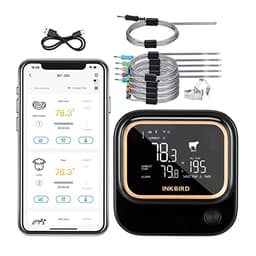
Inkbird WiFi & Bluetooth 6-Probe Thermometer
WiFi rather than Bluetooth, which is the difference between an alarm that reaches you through the walls of a house and one that does not. Six probes means the pit temperature and several pieces of meat at once — and on an overnight cook, the pit probe is the one that actually matters.
Price as of September 17, 2026. #ad How we’re funded
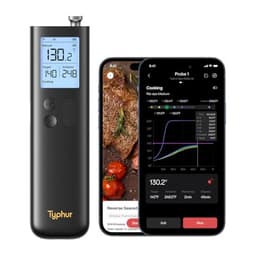
Typhur Sync Gold Gen2 Wireless Meat Thermometer
A cordless probe with a base you can read without picking up a phone, at a price that makes it a reasonable first leave-in thermometer. Enough for a cook happening a room away; check the published range against the distance you actually need before relying on it overnight.
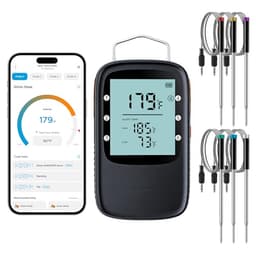
Govee Bluetooth Meat Thermometer
The lowest-cost route to phone alerts, which is the only feature on this page that genuinely matters for an unattended cook. Bluetooth range is the limitation and the maker’s published figure is a line-of-sight one, so treat walls as a real reduction.
Price as of September 17, 2026. #ad How we’re funded
Our full comparison lives at best wireless meat thermometers, and instant-read versus leave-in explains why you eventually want one of each.
The honest bottom line
We are not going to tell you it is fine to go to bed with a fire lit, because the fire safety guidance says otherwise and it says so for reasons its own data supports. What we will say is that the risk is not evenly distributed, and the things that concentrate it — a greasy cooker, a position against a structure, no way to know something has gone wrong — are all things you control.
Fix those three, shift your timings so the sleeping hours fall in the dullest part of the cook, and the question mostly stops needing to be asked. And if the reason you are asking is that a brisket genuinely needs twelve hours, consider that ribs take five and are better than most people’s brisket anyway.
A note on food safety. Temperatures on this page follow USDA safe-minimum guidance. Always confirm doneness with a food thermometer, not by time or color. We’re enthusiasts sharing what we’ve researched, not professional pitmasters — when in doubt on safety, follow the USDA.
Frequently asked questions
Can you leave a smoker unattended overnight?
Not safely, in the sense the safety authorities mean it. NFPA's guidance is never to leave a grill unattended when in use, and a smoker is a lit cooker outdoors for far longer than a grill is. Plenty of cookers will physically hold temperature all night — pellet, thermostatic gas and electric cabinets all can — but 'it will run' and 'you should sleep through it' are different claims, and only the first is an engineering question.
Is it safe to leave a pellet smoker running overnight?
A pellet smoker is the most capable of it — an auger feeds the fire and a controller holds the temperature, so it does not need you. It still contains a live fire and a hopper of dry fuel, and NFPA's guidance does not carve out an exception for it. If you are going to do a long overnight cook, this is the fuel type that makes it most plausible, with the cooker well clear of the house and a remote thermometer alarming to your phone.
How long will a charcoal smoker run without attention?
A bullet smoker will typically hold 225 to 250°F for eight to twelve hours on one full ring of charcoal once you know its vents, and a snake on a kettle gives five or six. That is how long the fuel lasts, not how long the fire behaves — an unnoticed gust, a vent left open or a fat flare can move the temperature a long way in half an hour, and there is no controller to correct it.
What does NFPA say about leaving a grill unattended?
Its guidance is direct: never leave your grill unattended when in use. Its 2020-2024 figures also show where the risk concentrates — nearly a quarter of grill structure fires started on an exterior balcony or open porch, 8% began when an outside wall caught fire, and the grill had not been cleaned in roughly one-fifth of the fires. Gas grills alone were involved in an average of 9,235 home fires a year.
Is it safe to eat meat that smoked all night?
Yes, provided the cooker genuinely stayed in the safe band. USDA's smoking guidance is to keep the smoker between 225°F and 300°F and to use two thermometers — one for the food and one for the smoker itself. The risk of an unattended overnight cook is not the hours, it is that nobody was watching when the fire went out and the meat spent three hours in the danger zone. A leave-in probe with an alarm is what turns that from a gamble into a known.
What is the two-hour rule?
USDA's guidance on smoked food is to refrigerate it within two hours. It applies after the cook, not during it — a properly running smoker is holding the food above the danger zone the whole time. It matters most on the tail end of an overnight cook, when a brisket comes off at 6am and sits on a counter while everyone is asleep.
Can you leave an electric smoker on overnight?
An electric cabinet will hold a set temperature for as long as it has power, which makes it the least dramatic of the fuel types — there is no fire to go out and no fuel to run down. It is still an outdoor appliance running unattended, and the general fire-safety advice does not exempt it. Keep it well clear of walls, railings and anything that can burn, and put a remote thermometer on it.
What is the safest way to do a long overnight cook?
Start it late rather than sleeping through the middle. Put the meat on at 10pm and go to bed at 2am with the cook well established, or start at 4am instead of midnight — most twelve-hour cuts can be held wrapped for hours afterwards, so the finish time is far more flexible than beginners assume. Beyond that: a remote-alarm thermometer, a cooker placed well away from the structure, and a clean cooker, since NFPA found roughly a fifth of grill fires involved one that had not been cleaned.
Do I need a WiFi thermometer for overnight cooks?
If you intend to sleep while a cooker runs, a probe that will wake you when the pit drifts is the difference between finding out at 3am and finding out at 7am. Bluetooth is enough if the cooker is close to the bedroom; WiFi is what you want if it is across the yard or you are inside a building with walls between you. Either way, the point is the alarm, not the graph.
Sources
- NFPA — Grilling Safety Facts & Resources — NFPA's grilling safety guidance and its own fire statistics, stated as 2020-2024 annual averages: 'Never leave your grill unattended when in use.' July (15%) was the peak month for grill fires, followed by June (15%), May (13%) and August (11%). The grill had not been cleaned in roughly one-fifth (20%) of the fires. Nearly one-quarter of grill structure fires started on an exterior balcony or open porch; 8% began when an outside wall caught fire and 3% with a structural member or framing. Gas grills were involved in an average of 9,235 home fires per year, including 4,662 structure fires and 4,573 outdoor fires. On charcoal disposal: before going to sleep or leaving the area, douse the fire with water and make sure the area is cool to the touch, and empty coals into a metal container with a tight-fitting lid used only for coals (accessed September 18, 2026)
- USDA FSIS — Smoking Meat and Poultry — USDA guidance to keep the smoker between 225°F and 300°F, use two thermometers (food + smoker), and refrigerate within 2 hours (accessed July 22, 2026)
- USDA FSIS — Safe Minimum Internal Temperature Chart — USDA safe minimum internal temperatures: 145°F for beef/pork/lamb steaks, chops and roasts (with a 3-minute rest), 160°F for ground meats, 165°F for all poultry (accessed July 22, 2026)
- USDA FSIS — Food Thermometers — USDA on why a food thermometer is the only reliable way to know food has reached a safe temperature, and how to place the probe (accessed July 22, 2026)
Keep reading
Best Smokers for Brisket
The cook that raises this question. Which cookers can genuinely hold twelve hours, and which cannot.
See the picksBest Wireless Meat Thermometers
The full comparison of leave-in probes — range, alarms, battery and what each maker publishes.
Compare probesHow to Control Temperature
Why a fire drifts in the first place, and the vent discipline that stops it.
Learn the ventsHow to Clean a Smoker
NFPA found the grill had not been cleaned in roughly a fifth of grill fires. Here is the routine.
Clean it properly