What a drum smoker is, in one paragraph
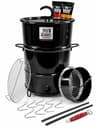
A drum smoker is a steel barrel with a charcoal basket in the bottom and hanging rods across the top. You light coals, hang the meat from hooks directly above the fire, and shut the lid. Drippings fall on the coals, flash into smoke and come straight back up onto the food, which is why drum cooks taste the way they do and why they run faster than a cabinet cook at the same thermometer reading. There is no water pan, no offset firebox and almost nothing to go wrong. Our drum smoker roundup covers the category and where it sits against the other charcoal options.
The thing that varies between drums is airflow. A fixed-vent barrel is set once for your altitude and then left alone: it finds a cruising temperature and holds it. The Bronco instead gives you an adjustable intake channel on the side and asks you to use it.
The published numbers
All of these come from Oklahoma Joe’s own spec table and features list, read on the date in the sources below.
| Spec | What Oklahoma Joe’s publishes | Why it matters |
|---|
| Primary cooking area | 284 sq in | About two racks of ribs laid flat, or one pork butt with room around it |
| Total cooking area | 284 sq in — the same figure | Hanging capacity is not counted anywhere in square inches |
| Hooks and hangers | 9 meat hooks, 3 hangers | The real capacity. Hanging is how you cook more than the grate holds |
| Charcoal capacity | Up to 8 lb of charcoal and wood | One basket load. A long cook is one fill, not a refill schedule |
| Burn time claim | “14+ hours of uninterrupted smoking” | Maker’s claim, and long enough for any single cut you will cook |
| Temperature range | Not published— a lid gauge is listed, no range | The one figure that would prove the adjustable intake does something |
| Grate material | Porcelain-coated steel | Easier to clean than bare steel; chips if you gouge it |
| Weight | 136.5 lb | Heavy for a barrel. This is a cooker you site once |
| Assembled size | 44.4" W x 26.6" D x 43.4" H | Wider than the drum itself — measure your space, not the barrel |
| Warranty | 2 years on all parts, grate and lid/firebox | Published and specific, which is more than most charcoal makers manage |
The missing number, and what to do about it
Here is the finding that shapes this review. The Bronco’s reason to exist is that you can adjust its airflow. Oklahoma Joe’s describes a “purpose-built airflow system” and ships a lid thermometer, but it publishes no temperature range, no damper position chart and no figure of any kind that tells you what the dial actually achieves. Its fixed-vent rival does the opposite: Pit Barrel states that 275–310°F is the expected range when the cooker is properly lit, which is a real, checkable claim about a cooker with no dial at all.
So the cooker that sells you control is the one that will not tell you what the control does, and the cooker that sells you simplicity publishes its number. That is not a reason to avoid the Bronco — the intake plainly works, every air-fed fire responds to air — but it does change how you should buy it. Buy it expecting to learn your own cooker with a thermometer, the way you would with any offset smoker, rather than expecting a published range you can dial to. Our guide to controlling temperature in a smoker is the method for that, and it applies here more than on any other drum.
Practically: light less charcoal than you think for a low cook, start with the intake well short of wide open, and give the cooker twenty minutes to settle before you judge it. USDA’s own smoking guidance puts the chamber between 225°F and 300°F, and a drum sits naturally toward the upper half of that band — which suits ribs, chicken and pork shoulder better than it suits a brisket you wanted to run at 225°F.
284 square inches is not the capacity
The spec table above contains a quiet oddity: Oklahoma Joe’s lists the primary cooking area as 284 square inches and the total cooking area as the same 284 square inches. On a cooker whose headline feature is hanging meat, that means the hanging capacity is not in the square-inch figure at all.
So judge this cooker by the hooks, not the grate. Nine hooks and three hangers is a real amount of food — ribs hang in pairs from a single hook, and a pork butt takes one — and it is why a 284 sq in number badly undersells what the Bronco holds. It is also why the comparison with a cabinet smoker is awkward: our smoker sizing guide works in square inches because almost every other kind of smoker does, and a drum simply does not fit that arithmetic.
What will not fit: a whole packer brisket laid flat. There is no 284 sq in cooker on which it does. On a drum you hang it, or you separate the point from the flat, and our brisket guide covers both.
136.5 lb, and 44 inches wide
Two published figures people miss. The Bronco weighs 136.5 lb, which is substantial for an 18-inch barrel and is good news for heat stability and bad news for moving it. And its assembled width is 44.4 inches — more than twice the barrel’s diameter, because the shelf and handles stick out. If you are shopping for a balcony or a narrow side yard, measure the 44.4, not the 18. Our small-space smoker picks exist for exactly that problem and the Bronco is not on that list.
Where it sits against the alternatives
Against the Pit Barrel Cooker. The Pit Barrel is the simpler machine and the one we recommend to most people who want a drum: one vent, set once, no decisions. The Bronco is for the cook who finds that constraint annoying rather than restful, and who wants to pull a long cook down toward the bottom of the smoking band or push a chicken cook up for better skin. It is the same trade as a barrel against a bullet: fewer choices, or more.
Against an electric cabinet. If reading this review has made charcoal sound like work, that is a fair reaction and the Masterbuilt digital cabinet above is the honest alternative. You set a number, it holds it, and you lose the fat-dripping-on-coals flavor that is the whole reason to own a drum. Our electric vs charcoal comparison is the page that decides that question properly.
Against a pellet grill. A pellet grill is easier again and smokier than electric, and our Traeger vs Z Grills comparison covers the two we would actually buy. No pellet grill tastes like a drum. That is the trade, in both directions.
Price, and the thing to check before you buy
Oklahoma Joe’s own final price for this cooker on the day we read its page was $499.99. The live retail price on the card above is usually below that, and it moves — which is the whole reason we never print a stored price anywhere on this site.
The thing to check is stock rather than price. The Bronco sells through in batches, and the listing has run thin on us more than once. If the buy button on the card above is showing a low stock warning, that is the listing talking, not us — and it is worth either buying then or checking back rather than settling for a different cooker in the same tab.
Who should not buy it
Three groups. Anyone who wants a 225°F cooker above all else should buy a charcoal bullet with a water pan instead — drums run hotter by nature and the Bronco gives you influence, not a thermostat. Anyone short of space should look at the 44.4 inch width again. And anyone who wanted barbecue without learning a fire should buy the electric cabinet and spend the savings on good wood.
For everyone else — a cook who likes the idea of hanging meat over live coals and wants the option to turn it down — this is the drum with the dial, and it is the only one in our registry that has one. Here is exactly how we pick, including what we refuse to claim about cookers we have not run.