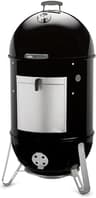
The published figures, side by side
| Spec | Smokey Mountain 18" | Gravity Series 600 |
|---|
| Cooking area | 481 sq inover two grates (726 sq in on the 22") | 600 sq in |
| Temperature range | Not published by Weber for any size | 225–700°F |
| Temperature control | Adjustable dampers and a water pan — by hand | DigitalFan and controller — set a number |
| Fuel load | Charcoal ring — no capacity published | GravityFed hopper: up to 12 lb lump or 18 lb briquettes |
| Burn time | Not published | Up to 18 hours at 225°F; up to 3 hours at 700°F |
| Needs mains power | No | Yes— no outlet, no cook |
| Meat probes / app | None — built-in lid thermometer only | Up to 4 probes, app connectivity |
| Grates | Two cooking grates; material not published | Reversible cast iron, included |
| Size, lid closed | 41" H x 19" W x 21" D | 52.8" W x 49.7" H x 30.4" D |
| Weight | Not published | Not published |
| Warranty | Published per component on the 22": 10 years no rust-through on bowl, lid and center ring; 5 years plastics; 2 years remaining parts | 1 year — and Masterbuilt’s warranty states it does not cover rust |
| Maker list price on the dates read | $419.00 (18"), $549.00 (22") | $799.99 |
Note the first row carefully, because it is the one people get wrong. The Gravity 600 has more grate than the 18-inch Weber and lessthan the 22-inch. “600” in the Masterbuilt name is the cooking area in square inches, not a capacity class, so if you are comparing on space the honest matchup is the 600 against the 22-inch bullet — and the Weber wins that on published area while costing less than Masterbuilt’s own list price.
The two warranties say the opposite thing
This is the most useful thing on the page and almost nobody compares it. Weber publishes the Smokey Mountain warranty per component on its 22-inch page, and the headline term is ten years against rust-through or burn-through on the bowl, lid and center ring, with five years on plastic parts and two on everything else. Masterbuilt’s warranty is one year from retail purchase against defects in material and workmanship — and it states in plain words that the warranty “does not cover rust” and “does not cover paint finish as it may burn off during normal use”.
Both positions are defensible. The Weber is an enameled steel bowl with no electronics in it, so the maker can afford a decade on the metal. The Masterbuilt is a fan, a controller, a hopper and a temperature probe bolted to a steel box, and more parts means more to fail and less a maker will promise. But read it as a lifespan signal: one of these cookers is sold as a thing you keep, and the other as a thing you use. Masterbuilt also publishes that buying through an unauthorized dealer voids the warranty entirely, which rules out bargain grey-market listings.
What the fan actually buys you
Charcoal temperature control is an airflow problem. Burn rate follows oxygen, so on the Weber you set the dampers, let the cooker settle, and nudge them when the weather changes — a skill that takes a couple of cooks to learn and then lasts forever. The Gravity 600 solves the same problem with a fan on a thermostat: it measures the chamber, blows air at the charcoal column when the temperature drops, and stops when it does not need to.
What that genuinely buys is three things. A number you can set, so your first cook is far likelier to work. A refuel interval you can plan— Masterbuilt publishes up to 18 hours at 225°F from one hopper, which is longer than any brisket needs, whereas Weber publishes no fuel capacity or burn time at all for the bullet. And a 700°F ceiling, which means the same cooker sears steaks after it has smoked a pork butt. The Weber will run hot with the vents open but Weber publishes no temperature range for it, so we will not put a number on what it tops out at.
What the fan costs you is dependency. The Gravity needs mains power as well as charcoal; an extension cord across a wet patio is a real consideration, and a controller failure is a cook cancelled rather than a vent to adjust. There is also more to clean: ash management on a hopper-fed cooker with a fan is a chore next to lifting the lid off a bullet and tipping the ash out.
Either way, buy a leave-in thermometer. The Weber’s only gauge is in the lid, which reads the air at the top of the dome rather than the temperature where the meat is, and the Gravity’s controller tells you what the cooker thinks rather than what the meat is doing. Our guide to controlling temperature covers the damper method on the Weber, and how much charcoal to use covers the quantities.
Flavor: the honest answer
Both burn real charcoal and both take wood chunks, so neither is the “less smoky” choice the way a gas or electric cabinet is. If you want the comparison where flavor genuinely differs, that is pellet vs charcoal or our ThermoTemp XL review, where smoke comes off a chip tray rather than a fire.
There is a real difference in how the smoke happens, though. On the bullet, your wood chunks sit on a live coal bed in the open, which is the classic way to get thin blue smoke and the classic way to get bitter white smoke if you smother the fire. On the Gravity, the burn happens in a narrow column at the bottom of the hopper, so you are feeding wood into a smaller, hotter, fan-driven fire and have less control over how it smolders. Owners of fan-driven charcoal cookers commonly add a smoke tube for longer cooks, which is a ten-dollar fix and tells you something about where the limitation sits.
USDA’s smoking guidance puts the chamber between 225°F and 300°F, and both cookers live comfortably there. The difference is who keeps it there.
Which one should you buy?
Buy the Smokey Mountain 18-inchif you are learning, if you like the idea of a cooker with nothing to go wrong, if you have nowhere to plug a smoker in, or if resale value matters to you — these change hands easily. It is our top charcoal pick for a beginner and the reasoning is in our Smokey Mountain review. If you are feeding more than a family, the size comparison explains why we still start people on the 18.
Buy the Gravity Series 600 if your real constraint is attention rather than money: you want charcoal food on a Tuesday, you will not be standing by the cooker, and one appliance that smokes low and sears hot is worth the extra spend. Our Gravity 600 review goes deeper on it, and gravity vs pellet is the next question most people ask — because a pellet grill does hands-off for less money, just without charcoal.
Buy neither if what you actually want is the least possible effort for decent barbecue. That is a pellet grill or an electric cabinet, and our guide to choosing your first smoker lays out the four types without pushing you at the expensive one. The broader charcoal roundup also covers the cheaper bullets and drums if $400 is more than you want to spend to find out whether you enjoy this.