The three things that actually separate these
Thermometer marketing is a wall of adjectives. There are only three specifications that change anything about how one performs in your hand, and all four thermometers here can be sorted on them.
- Response time. How long the probe needs to settle on a final number. This matters more than it sounds: every second the lid is open is heat leaving the cooker, and on a hot grill it is a second your forearm is over the fire. Fast thermometers also get used more — when a reading costs two seconds you check three spots and find the cold one, and when it costs fifteen you check once and hope. Published figures here run from 1–2 seconds to a stated 15 seconds, which is the single widest gap on this page.
- Published accuracy. A tolerance, in degrees, over a stated temperature band. The important part is that a maker publishesone at all: two of these four do, with a NIST-traceable calibration certificate on one of them, and two publish nothing. No published figure does not mean a thermometer reads badly — it means nobody has told you how wrong it is allowed to be, and at the cheap end that is the real trade.
- Water resistance, then the display. This is a tool that gets grease on it and ends up next to a sink. IP67 is rated for spills, splashes and temporary submersion; IP65 is splash resistance only, so it gets wiped, not rinsed. After that, a backlit display that rotates to stay upright is the difference between reading a number in the dark and guessing at it.
One thing deliberately not on that list: probe length. Every thermometer here has a folding probe in the four-to-five-inch class, which reaches the center of anything a backyard cook puts on a smoker. A longer probe matters for a deep fryer or a tall loaf, not for barbecue.
How much accuracy barbecue actually needs
Less than the spec sheets imply, and it is worth saying so before you spend. USDA’s safe minimums are whole numbers — 165°F for poultry, 145°F with a three-minute rest for whole cuts of beef and pork — and the done-and-tender window for a brisket or a pork butt is a band of ten to fifteen degrees, not a tenth of one. A thermometer accurate to a degree is accurate enough to cook safe, good barbecue all day.
Where tighter accuracy starts to earn money is candy, custard, frying oil and sous vide, where a couple of degrees changes the result rather than the reading. It is also worth knowing the reference point this category is measured against: ThermoWorks publishes a 1-second reading and ±0.5°F mid-range accuracy for the Thermapen ONE, with a 5-year warranty. Nothing on this page matches that set, and for barbecue nothing on this page needs to — our Thermapen alternatives page is the full version of that argument.
The four side by side
| Thermometer | Published response | Published accuracy | Range | Water resistance | Warranty |
|---|
| Lavatools Javelin PRO Classic | 2–3 seconds (maker) | ±0.9°F, −4 to 302°F (maker) | −40 to 482°F (maker) | IP65 — splash only | 3 years limited |
| ThermoWorks ThermoPop 2 | 2–3 seconds, 4.5" probe (maker) | ±1.0°F, 14 to 208°F (maker); NIST certificate | −58 to 572°F (maker) | IP67 | 2 years |
| Alpha Grillers instant-read | 1–2 seconds (listing) | Not published | Not published | IP67 (listing) | Not published |
| Weber Instant-Read | 15 seconds (listing) | Not published | Not published | Not published | Not published |
The pattern in that table is the whole page. Spend in the forty-dollar class and the maker commits to a response time, a tolerance, a range and a warranty you can hold them to. Spend a quarter of that and you get a thermometer that is probably fine and provably nothing. The one genuinely surprising row is the Weber: its own listing states a 15-second readout, which is five to ten times the published figure of everything else here.
Best overall: Lavatools Javelin PRO Classic
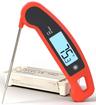
The pick for almost everyone. Lavatools publishes a 2–3 second response, ±0.9°F accuracy across the band you actually cook in, a −40 to 482°F range, a 2-inch auto-rotating backlit display and a 3-year limited warranty — a year longer than the ThermoPop and the longest coverage on this page. In the hand it reads like a tool rather than a gadget: the display flips to stay upright, the magnet on the back means it lives on the smoker door, and the number stops moving before you have finished opening the lid.
Two honest costs. IP65 is splash resistance, not submersion — wipe it, do not run it under the tap, which is exactly what you can do with the ThermoPop. And the retail listing advertises a 2-second reading where Lavatools’ own page says 2–3; we use the maker’s figure and so should you. Neither changes the verdict: on published specs this is the most thermometer per dollar here.
Best documented accuracy: ThermoWorks ThermoPop 2
The pick if paperwork matters to you. ThermoWorks publishes a 2–3 second reading on the 4.5-inch probe, ±1.0°F accuracy from 14 to 208°F, a −58 to 572°F range, IP67 water resistance, a defeatable 10-minute auto-off, NSF certification for food equipment, and a NIST-traceable calibration certificate in the box — the same certificate that ships with the Thermapen. If you cook for other people in any setting where someone might ask what your thermometer is certified to, this is the answer at this price.
Two things to know. On paper it is a tenth of a degree looser than the Lavatools and carries a 2-year warranty rather than three, so you are buying the certification and the IP67 rating rather than better numbers. And a buyer-first note we will keep repeating: ThermoWorks sells this directly, and its own store listed it at $39.00 on the date we read it — below the retail listing we earn a commission on. Check both, and if the maker is cheaper, buy from the maker.
Budget pick: Alpha Grillers instant-read
The cheapest thermometer we would actually hand a beginner, and the gap between owning this and owning nothing is far bigger than the gap between this and the Lavatools. The listing states a 1–2 second response, a bright backlit display, IP67 waterproofing and that it arrives pre-calibrated. Cheap enough to own two — one clipped by the smoker, one in the kitchen drawer — which is a real advantage when the alternative is walking back indoors mid-cook.
The honest gap is documentation: no accuracy figure, no temperature range, no calibration certificate and no warranty term published anywhere we could read. Check it yourself when it arrives — the ice-water test takes two minutes and is described below — and if it reads 32°F in slush, it will read your chicken correctly too. Our budget meat thermometer roundup covers the rest of this end of the shelf.
Most widely stocked: Weber Instant-Read
We include it because it is the thermometer most people already own or will be handed with a grill, and because being straight about it is more useful than leaving it off. Weber’s own listing states a 15-second readout with auto shutoff and a Fahrenheit/Celsius switch. It works, it is cheap, it is sold everywhere, and nothing about it is dishonest.
Fifteen seconds is the problem. Standing with the lid open for a quarter of a minute per probe costs real heat on a charcoal cooker, and it discourages the thing a thermometer is for — checking several spots. If you already own one, keep it as the kitchen spare and put a faster one by the smoker. If you are buying your first, the budget pick above reads in a second or two for similar money.
Check any thermometer before you trust it
Two minutes, no equipment. Fill a glass with crushed ice, top it with cold water, stir it and let it sit for a minute: a correct thermometer reads 32°F in that slush. Boiling water works as a second check but shifts with altitude, so ice water is the more reliable home test. Do it the day the thermometer arrives, and again any time a reading looks wrong — a probe that has been dropped or cooked at 500°F can drift.
Then place the probe properly, because a perfect thermometer in the wrong spot is a wrong number: thickest part of the meat, away from bone and away from any fat seam, and push through until the reading stops falling. USDA recommends two thermometers for smoking — one watching the cooker, one for the food — which is why most people who smoke regularly end up owning an instant-read and a leave-in. If the leave-in is the half you are missing, our MEATER alternatives page covers the cordless and multi-probe units, and best wireless meat thermometers ranks the whole category.
How to choose between the four
- “Just tell me which one.” Lavatools Javelin PRO Classic. Fastest published reading, tightest published tolerance, longest warranty.
- “I want certification and an IP67 rating.” ThermoWorks ThermoPop 2 — and price it on ThermoWorks’ own store first.
- “I want to spend as little as possible.” Alpha Grillers, with the ice-water test on arrival.
- “I already have the Weber one.” Keep it indoors and buy something faster for the smoker.
- “I need to watch a cook, not check it.” None of these. Buy a leave-in probe and read best meat thermometers for smoking instead.
Whichever you buy, the number you are chasing matters more than the tool. Our smoke times and temperatures chart is the reference you will actually hold it against, and how to choose a meat thermometer walks through the leave-in half of the decision in plain English.