What $1,000 actually buys in an offset
An offset smoker is the simplest cooker in barbecue and the hardest to run. Fire burns in a box bolted to one end; heat and smoke travel sideways through a long chamber and out a stack at the other end. Nothing regulates it but you, a vent and a shovel of coals. That is the whole appeal — it is also why the price band matters more here than in any other category.
Three things separate a thousand-dollar offset from a two-hundred-dollar one, and only the first two change how the food comes out.
- Steel thickness and seal. Heavy steel evens out temperature swings and holds heat when the lid opens; a tight seal means the air you feed the fire is the air that reaches the chamber. Thin steel with a loose lid cannot be throttled, so the cooker runs at whatever temperature the weather allows. Worth knowing before you shop: noneof the makers on this page publish a steel gauge for these cookers. Oklahoma Joe’s spec table for the Laredo 1100 lists cooking area, weight, dimensions, grate material, fuel type and warranty, and no steel thickness and no temperature range at all. Assembled weight is the only honest proxy you get.
- Heat distribution. In a plain offset the end nearest the firebox runs much hotter than the far end, which is why experienced cooks rotate racks mid-cook. Reverse flow fixes it structurally with baffles that force the heat down the length of the chamber and back. That design is the single biggest difference between the top of this band and the bottom of it.
- Capacity and fit. More money buys bigger chambers, firebox grates you can grill on, better wheels and more usable shelves. Pleasant, and not a reason on its own to double your budget.
One thing no offset in this band buys you is automation. There is no thermostat, no fan and no app on any of the three offsets here, so a leave-in thermometer is not optional — it is the difference between cooking and guessing. USDA recommends a food thermometer for doneness rather than color, and on an offset you also want to know the real grate temperature, because the dome thermometer on the lid is reading air several inches above and often several feet away from your meat. Our meat thermometer roundup covers the two-probe setup this cooker type needs, and Thermapen alternatives is the page to read if you want the fast spot-check thermometer without paying premium money for it.
The five cookers side by side
| Cooker | Type | Cooking area | Weight | Hot spot handled by | Warranty |
|---|
| Oklahoma Joe’s Highland Reverse Flow | Offset, reverse flow | 1,093 sq in (619 + 474, plus 281 firebox) | 156 lb assembled | Four removable baffles | Not published on the listing we read |
| Oklahoma Joe’s Laredo 1100 | Offset, traditional | 1,100 sq in total (558 primary, 542 warming) | 94.97 lb (maker) | You, by rotating racks | 2 years (maker) |
| Royal Gourmet CC1830S | Offset, traditional | Maker publishes none; 824 sq in on the retail listing | 50.3 lb net (maker) | You, plus an adjustable charcoal pan | 1 year; excludes rust and paint (maker) |
| Pit Barrel Cooker 18.5" | Drum, not an offset | Hanging rods plus a grate | Not published | Fixed vent; nothing to manage | Not published on the listing we read |
| Masterbuilt Gravity Series 600 | Gravity-fed charcoal, not an offset | 600 sq in (maker) | Not published | A fan and a controller | 1 year; excludes rust and paint (maker) |
The pattern in that table is the argument of this page. Spend at the top of the band and the cooker solves the hot spot for you. Spend at the bottom and you solve it yourself, every cook, by rotating racks and learning where your chamber runs hot. Both are legitimate; they are different hobbies.
Best under $1,000: Oklahoma Joe’s Highland Reverse Flow
If you know you want an offset, this is where the money should go. Reverse flow is the only feature in this band that makes an offset measurably easier for a beginner, because it attacks the problem that actually ruins cooks: one end of the chamber running 50°F hotter than the other. The listing publishes four removable baffles, adjustable smokestack positions, 619 sq in of primary grate, 474 sq in secondary and a 281 sq in firebox grate for searing.
Three honest costs. It is the most expensive way into offset cooking here, so you are paying for the baffles. Reverse flow means a longer warm-up, because you are heating the plate and the chamber before the chamber settles. And at 156 lb assembled you want a second pair of hands for the build and a permanent spot in the yard. Oklahoma Joe’s does not publish a steel gauge or a temperature range for it, and the listing publishes no warranty term, so the weight is your best evidence of what you are getting. Budget for a gasket kit either way — factory offsets in this band all leak somewhere, and a proper first seasoning burn is the right time to find out where.
Best value: Oklahoma Joe’s Laredo 1100
The most cooking area per dollar on this page and the pick we steer most first offset buyers toward. Oklahoma Joe’s publishes 1,100 square inches in total — 558 sq in of primary grate and a 542 sq in warming rack — 94.97 lb assembled, porcelain-coated steel grates, a painted steel lid and a 2-year warranty covering the grates, emitter, lid and firebox. For a cooker at this price, a published warranty term at all is a mark in its favor.
What you give up against the reverse-flow pick is heat distribution: this is a traditional offset, so the firebox end runs hot and racks get rotated. You are also 60 lb lighter in steel, which shows up as faster temperature swings when the wind picks up or the lid comes off. Our Oklahoma Joe’s Laredo 1100 review goes through it in detail, and the best offset smokers for beginners roundup is the fuel-type view of the same shelf.
Budget pick: Royal Gourmet CC1830S
About a fifth of the price of the reverse-flow pick, and still a genuine barrel-with-a-side-firebox offset — which at this money is not a given. Royal Gourmet publishes a 50.3 lb net weight, a 53.4 x 27.9 x 48.8 inch product size, a steel side table with three integrated hooks, two wheels, an adjustable charcoal pan and a lid-mounted thermometer that “helps check and monitor the cooking temperature”. Note what is missing: the maker’s own page publishes no cooking area in square inches at all, and the 824 sq in figure you see quoted everywhere comes from the retail listing rather than from Royal Gourmet.
Two costs you should price in before buying. At 50 lb this is thin steel, and thin steel means the cooker tracks the weather — you will work harder to hold 225°F on a cold, breezy day than on either Oklahoma Joe’s. And Royal Gourmet’s warranty is 1 year with two exclusions published outright: the paint finish is not covered because “it may burn off during normal use”, and rust is explicitly not considered a defect. That is the real cost of the cheapest offset: a cover, a gasket and the expectation that this is a five-year cooker, not a twenty-year one. Our CC1830S review covers the whole picture, and are cheap smokers worth it is the honest version of this trade.
If an offset is more work than you want: Pit Barrel Cooker
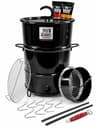
Read this section even if you came here certain. An offset asks you to tend a fire for the length of the cook; a drum asks you to light charcoal, hang the meat and close the lid. Pit Barrel states 275 to 310°F as the expected range when the cooker is properly lit, and roughly 10 to 12 lb of charcoal for the 18.5-inch barrel — so the temperature is a property of the design rather than something you chase with a vent.
The trade is control. You cannot dial a drum down to 225°F for a long brisket hold the way you can throttle an offset, and the fixed vent that makes it easy also makes it inflexible. If what attracted you to an offset was the wood fire and the ritual, a drum will not scratch that itch. If what attracted you was charcoal flavor without babysitting, it is the better cooker at the money. Our Pit Barrel Cooker review and best drum smokers for beginners cover it properly.
If you want charcoal with a thermostat: Masterbuilt Gravity 600
The other honest alternative at this money. A gravity-fed cabinet burns real charcoal and wood chunks while a fan and a controller do the airflow work, which means you set a number the way you would on a pellet grill and the fuel is still charcoal. Masterbuilt publishes 225 to 700°F, 600 sq in of cooking area, a hopper holding up to 12 lb of lump or 18 lb of briquettes, up to 18 hours at 225°F from one fill, support for up to four meat probes and app connectivity.
What you take on is complexity and maintenance. There is a fan, a controller and an auger-free but still mechanical hopper to fail, where an offset has nothing that can break except the welds. Masterbuilt’s published warranty is 1 year and explicitly excludes both paint finish and rust, and ash and grease management is a real chore. Our Gravity 600 review and gravity versus pellet are the detail, and offset versus pellet is the honest argument most first-time offset buyers should read before they spend.
How to choose
- “I want an offset and I want it to be easy.” Highland Reverse Flow. The baffles are what you are paying for.
- “I want the most cooker for the money.” Laredo 1100 — 1,100 sq in and a published 2-year warranty.
- “I want to try an offset cheaply.” Royal Gourmet CC1830S, with a cover and realistic expectations about rust.
- “I want charcoal flavor, not a fire-tending hobby.” Pit Barrel Cooker.
- “I want to set a temperature and walk away.” Masterbuilt Gravity 600.
If you are still deciding between cooker types rather than between offsets, start with how to choose your first smoker, which works through fuel before brand. If the budget is the thing you are testing, our best smokers under $1,000 roundup is the fuel-agnostic version of this page and leads somewhere different on purpose. And whichever offset you buy, the fire is the skill: how to control temperature in a smoker and which charcoal to burn will do more for your barbecue than another $300 of steel.