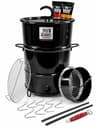
Why $500 is the band to shop in
Charcoal is the one fuel where the expensive cookers are not meaningfully better at making barbecue. A bullet smoker, a drum and a steel kamado all work by the same physics as a $2,000 cabinet: a small fire, a throttled air supply, and a body that holds heat. What more money buys you above this band is insulation, steel thickness, capacity and fit and finish — and only the first two change the cook, and then only in cold weather or on very long sessions.
Below roughly $200 the picture does change, and not in your favor. Thin steel with a loose-fitting lid cannot be throttled, so the cooker runs at whatever temperature the weather allows. That is the real argument of our are cheap smokers worth it page: the cheap cooker is not bad value because it is cheap, it is bad value because you cannot control it, and control is the entire skill.
So this band — call it $200 to $500 — is where a charcoal smoker stops fighting you and starts being a tool. Four of the six cookers below sit in the top half of it, and the two that sit lower are honest about what they trade.
The six cookers side by side
| Cooker | Type | Published cooking area | Published temperature | How much fire management |
|---|
| Weber Smokey Mountain 18" | Bullet / water smoker | 481 sq in over two grates (Weber) | Not published | Moderate — four dampers to learn |
| Pit Barrel Cooker 18.5" | Hanging drum | Not published as a square-inch figure | 275–310°F expected (Pit Barrel) | Least — one vent, set once |
| Char-Griller AKORN | Insulated steel kamado | 445 sq in total, 325 primary (Char-Griller) | 200–700°F (Char-Griller) | Low — insulation does the work |
| Oklahoma Joe’s Bronco 18" | Adjustable drum | 284 sq in on the grate (Oklahoma Joe’s) | Not published | Moderate — real intake control |
| Weber Smokey Mountain 14" | Bullet / water smoker | Not published | Not published | Moderate — same dampers, smaller fire |
| Dyna-Glo vertical offset | Offset cabinet | Not published | Not published | High — thin steel swings with the weather |
That column of “Not published” is not us being lazy. Weber publishes no temperature range for any Smokey Mountain and no cooking area for the 14-inch; Pit Barrel publishes an expected 275–310°F range but no square inches at all. We print what the maker states and nothing else, which is why this site will never show you a spec table that looks complete when the underlying data is not.
Pick on how much fire you want to manage
Everything in this band makes good barbecue. What separates them is how much of your Saturday the cooker asks for, and that is the axis to choose on.
Least effort: the Pit Barrel
A hanging drum with one vent you set according to your altitude and then leave alone. Pit Barrel states an expected 275 to 310°F when properly lit, around 10 to 12 lb of charcoal for the 18.5-inch, and a lighting routine of a quarter basket in a chimney for 11 to 12 minutes below 2,000 ft. Meat hangs on hooks rather than sitting on a grate, which cooks faster and self-bastes.
The thing to accept is that it is not a 225°F cooker and does not pretend to be. If the plan is a fourteen-hour overnight brisket at 225, this is the wrong barrel; if the plan is ribs and pork shoulders on a weekend afternoon, it is the most forgiving cooker here. Our Pit Barrel review is specific about where that line falls, and Pit Barrel versus Smokey Mountain is the head-to-head most people in this band actually want.
Least fuel: the AKORN
Char-Griller states triple-walled insulation for maximum heat retention and fuel efficiency, a 200 to 700°F range and 445 sq in total. In practice that means one load of lump charcoal covers a long cook and the weather matters far less — which is why it is the cooker on this page we would pick for a December brisket. Budget for the Smokin’ Stone heat deflector, though: Char-Griller sells it separately and describes it as what turns the kamado into a smoker by shielding food from direct heat. Without it, long indirect cooks are compromised.
Most capacity for the money: the Bronco and the Dyna-Glo
Oklahoma Joe’s publishes 284 sq in on the Bronco’s grate plus nine meat hooks and three hangers, and states 8 lb of charcoal and wood gives 14+ hours of uninterrupted smoking. It is the drum for someone who wants the Barrel’s hanging trick and a damper to adjust — see our Bronco review. The Dyna-Glo is the other route to volume: a tall cabinet that swallows ribs and sausage for the least money on the page, at the cost of real attention on windy days.
Most cooker for your grandchildren: the Smokey Mountain
Our top pick, and the reason is the warranty combined with the design. Weber states 10 years no rust-through or burn-through on the bowl, lid and center ring of the 22-inch, and the same bullet construction runs through the 14 and 18. Nothing on it is electronic. Nothing on it is proprietary. It holds temperature beautifully once you understand the dampers, and the resale market for a used one is a standing testament to how long they last. Our full review covers the learning curve, and the 14 against the 18 settles the size question — which, on this page, is also a real-money question, so compare the two buttons above before you decide.
Budget for the two things that are not the cooker
Every price on this page is for a cooker and nothing else, and two purchases are not optional.
The first is a leave-in thermometer. None of these cookers has a thermostat, and the lid thermometers on the ones that have them read the air at the dome, not the temperature at the grate where your food is. USDA’s guidance is explicit about using two thermometers, one for the cooker and one for the food, and on a charcoal smoker that is not pedantry — it is the only feedback you get.
The second is a chimney starter. Lighter fluid taints food, and every cooker here is lit by pouring a measured amount of ashed-over coals onto unlit fuel. Add wood chunks and a bag of charcoalyou can get consistently, and you are set up for the first dozen cooks. The running cost is lower than people expect — our cost to run a smoker page does the arithmetic.
What to do if your budget is tighter
If $500 is a stretch rather than a target, the honest advice is to go down a band rather than down a tier of build quality. Our best smokers under $300 roundup covers that properly, and the 14-inch Smokey Mountain on this page sits close enough to be a candidate. What we would not do is buy an unbranded offset at the bottom of the market because the square-inch figure looks generous. Thin steel plus a large body is the worst combination in barbecue: the cooker has a lot of surface to lose heat through and not enough mass to ride out a gust of wind.
And if charcoal itself is the part you are unsure about, read electric versus charcoal before you buy. Charcoal gives you the best flavor of any fuel and asks for your attention in exchange. Plenty of people would rather have the attention back, and there is nothing wrong with that.
If your ceiling is higher than this page’s, the next rung is worth a look for one reason only: it is where a thermostat on a charcoal fire, a ceramic kamado and a reverse-flow offset become affordable. Best charcoal smokers under $1,000 lays out what the extra money buys — and says plainly that most people should still buy from this page.