What the Smokey Mountain is actually known for
Three things, and an alternative only counts if it covers the ones you care about.
- It holds a low temperature for a very long time. The water pan is the mechanism: water absorbs heat and buffers swings, which is what lets a bullet smoker sit at 225°F through an overnight brisket. The four dampers are how you set it, and learning them is the whole learning curve.
- It will outlive you. No electronics, no proprietary parts, porcelain-enamelled steel, and the per-component warranty above. Used ones hold their value in a way almost nothing else in barbecue does.
- It is a known quantity. Twenty-odd years of other people documenting exactly what it does in every weather and with every cut. When a cook goes wrong, somebody has written down why.
Two things it is not: insulated, and hands-off. Weber publishes no temperature range for the cooker at all — which on an open-vented charcoal smoker is an honest admission rather than an omission, because the range is whatever your airflow and fuel load make it. And a thin steel body loses heat to the air, which is why the WSM is the cooker most affected by a cold windy day. Both of those gaps are where the alternatives below earn their place.
The four alternatives against the published Weber specs
| Cooker | Design | Published cooking area | Published temperature | Fire management |
|---|
| Weber Smokey Mountain 18" (the original) | Bullet, water pan, four dampers | 481 sq in over two grates (Weber) | Not published | Moderate — four dampers to learn |
| Pit Barrel Cooker 18.5" | Sealed hanging drum, one fixed vent | Not published as square inches; 8 racks of ribs or 2–3 butts (Pit Barrel) | 275–310°F expected (Pit Barrel) | Least— set the vent once |
| Oklahoma Joe’s Bronco 18" | Drum with adjustable intake; hang or grate | 284 sq in on the grate (Oklahoma Joe’s) | Not published | Moderate — real intake control |
| Char-Griller AKORN | Insulated steel kamado | 445 sq in total, 325 primary (Char-Griller) | 200–700°F (Char-Griller) | Low — insulation does the work |
| Dyna-Glo vertical offset | Tall cabinet, side firebox | Not published | Not published | High — thin steel swings with the weather |
Capacity on that table is genuinely hard to compare, and we would rather say so than invent a figure. Pit Barrel publishes no square-inch number at all — it describes the 18.5-inch as holding 8 racks of ribs, 2 to 3 pork butts or briskets, or 2 turkeys of 13 to 16 lb on turkey hangers — because hanging capacity does not convert to grate area. Oklahoma Joe’s is explicit that the Bronco’s 284 sq in is grate only and does not count the hanging room from its nine meat hooks and three hangers. On hanging cookers, racks of ribs is the honest unit.
If the dampers are what put you off: Pit Barrel
This is the alternative for the largest group of people, because the most common complaint about a bullet smoker is not the price — it is that four dampers and a water pan sound like a skill you have to acquire before dinner.
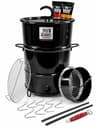
A Pit Barrel removes the choice. There is one vent, which you set according to your altitude and then leave. Pit Barrel’s own lighting instruction is a quarter basket of charcoal in a chimney for 11 to 12 minutes below 2,000 ft, or 12 to 15 above it. Meat hangs on hooks, which cooks faster than grate cooking and self-bastes as the fat runs down the cut. The Premier package Pit Barrel publishes includes the hook tool, an ash pan, eight stainless hooks, two hanging rods, the charcoal basket, a grate, a heat shield, a stand and two rubs — so there is less to buy afterwards than with most cookers on this site.
The thing to accept is the temperature. Pit Barrel states 275 to 310°F as the expected range, so this is not a 225°F overnight cooker, and if a fourteen-hour low-and-slow brisket is the whole reason you are shopping, the WSM genuinely does that better. For ribs, pork shoulders, chicken and a weekend-afternoon brisket, it is the most forgiving charcoal cooker we know of. Our Pit Barrel review is the detail, and Pit Barrel versus Weber Smokey Mountain is the direct head-to-head.
If you want control but not four dampers: the Bronco
The Bronco is the middle ground, and the closest cooker here to the WSM’s actual behaviour. It is a drum, so you get the hanging trick — nine meat hooks and three hangers, per Oklahoma Joe’s — but it also has an adjustable air-intake channel, which means you can genuinely dial a temperature rather than accept the one the cooker prefers.
Oklahoma Joe’s publishes 284 sq in on the grate, 136.5 lb of cooker, a removable ash pan, a temperature gauge, a two-year warranty, and states that 8 lb of charcoal and wood gives 14+ hours of uninterrupted smoking. It publishes no numeric temperature range, so we do not claim one. The trade against the Pit Barrel is that there is more to learn; the trade against the WSM is less documented history and a shorter warranty. Our Bronco review covers it, and our drum smoker roundup compares the two barrels directly.
If your winter is real: the AKORN
This is the one specification the Smokey Mountain genuinely does not have, and it is the reason to consider a kamado instead. Char-Griller states triple-walled insulation for maximum heat retention and fuel efficiency, a 200 to 700°F range, 445 sq in total cooking area and a five-year warranty. An insulated body means one load of lump charcoal runs a long cook and a cold windy day costs you far less heat — where a thin-walled bullet smoker is working against the weather the whole time.
You also get a cooker that sears at the top of its range, which no WSM does. Two things to know before you buy: the Smokin’ Stone heat deflector is sold separately, and Char-Griller describes it as what turns the kamado into a smoker by circulating air round the meat while shielding food from direct heat — so budget for it if indirect smoking is the plan. And the bottom vent needs ash clearing to keep airflow honest. Our AKORN review is the detail; smoking in cold weather explains why insulation matters more than any other spec once the temperature drops.
If the price is the problem: Dyna-Glo
Roughly half the money, and genuinely a charcoal smoker rather than a compromise: a tall cabinet with the firebox off to one side, so the fire is never under the food. It holds a lot of ribs and sausage for what it costs, which is why it appears in our best smokers under $300 roundup and our vertical smoker roundup.
What you are buying is thin steel, and that is the whole trade. It leaks smoke around the door and loses heat through the body until you gasket it yourself, and holding a steady temperature takes real attention on a breezy day. It is a starter cooker rather than a lifer. We would still rather see somebody buy this and cook on it than save for a year and cook nothing — but if you can stretch, the gap in build quality between this and anything else on the page is the largest gap here. Our are cheap smokers worth it page is honest about where that line sits.
Which one, in a sentence each
- “The WSM is sold out.” The Bronco. Closest behaviour, real damper control, hanging as a bonus.
- “It looks like too much work.” Pit Barrel. One vent, set once, hang the meat.
- “I smoke in winter.” AKORN. Insulated, efficient, and it sears too — buy the heat deflector with it.
- “It costs too much.” Dyna-Glo, with clear eyes about the steel.
- “I want the one that lasts twenty years.” Then buy the Weber. Our WSM review is there, and the 14 against the 18 is how to buy it for less.
Whichever you choose, the same two purchases follow: a leave-in thermometer, because USDA’s smoking guidance is to run two thermometers and none of these cookers has a thermostat, and a chimney starter, because all four are lit by pouring measured ashed-over coals onto unlit fuel. Our best charcoal smokers under $500 roundup is the price-band view of this same shelf.