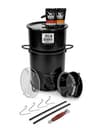
The three published limitations people shop away from
- One temperature, by design. Pit Barrel’s own published expected range for the 18.5-inch is 275–310°F, with vent position set by altitude rather than by what you are cooking. That band is excellent for ribs, chicken and pork butt and awkward for anything that wants a long 225°F cook or a hot sear.
- No published cooking area. Capacity is expressed in hanging rods and hooks rather than square inches, and neither the Amazon listing nor Pit Barrel publishes a grate figure — which is why our product card for it prints “Not published” rather than a number we made up. Every alternative here except the smaller drum publishes one.
- Hanging means opening the lid to look. You cannot see or probe hanging meat without lifting the barrel lid, and lifting the lid on a fixed-vent cooker is the one real way to disturb it. Cookers with grates and doors let you check without that.
What is not on that list: flavor, durability or ease. A drum hanging meat directly over coals gives you drippings on the fire and self-basting meat, and almost nothing else is this forgiving for a beginner. If none of the three points above is your complaint, buy the Pit Barrel.
The five, and the one thing each fixes
| Cooker | What it fixes | Published cooking area | Published range | What it costs you |
|---|
| Oklahoma Joe’s Bronco 18" | Adjustable intake — you choose the temperature | 284 sq in grate, plus hanging rods | Not published | Smallest published grate here; more to learn |
| Weber Smokey Mountain 18" | Published capacity, dampers, long warranty | 481 sq in over two grates | Not published | No hanging; you learn to run the vents |
| Char-Griller AKORN | Range — 225°F cooks and searing heat | 445 sq in | 200–700°F (maker) | Heat deflector for indirect cooking is a separate buy |
| Weber Smokey Mountain 14" | Price and footprint | Not published | Not published | Cooks for two or three, not a crowd |
| Pit Barrel Junior 14" | Footprint, keeping the hanging method | Not published | Not published | Same fixed-vent design, less room |
Three “Not published” entries in one table is unusual, and it is honest: drum and bullet makers describe capacity in racks of ribs and chickens rather than square inches, and Weber publishes no temperature range for a cooker whose temperature is whatever fire you build. We would rather show you the gaps than fill them with estimates.
Every cooker above carried a live Amazon price when we last read the feed, as of November 23, 2026. Drums and bullets discount at different times, so compare the buttons on the day rather than trusting a number in prose.
Hanging versus grates, honestly
Hanging is genuinely better for ribs and chicken. A rack hung vertically takes up almost no horizontal space, fat renders down the length of it, and the drippings hit the coals and come back as smoke. It is worse for anything floppy or delicate, anything you want to probe frequently, and anything that will not survive being pierced by a hook — brisket in particular tends to end up on a grate in the end.
That is why the Bronco is the top pick rather than a bullet: it does both, with hanging rods above a 284 square inch grate. If you want the full comparison of the two philosophies, we have Pit Barrel vs Weber Smokey Mountain and the drum smoker roundup.
Which alternative, for whom
- “I like the drum, I want a dial.” Oklahoma Joe’s Bronco.
- “I want the most proven charcoal smoker.” Weber Smokey Mountain 18-inch — 481 published square inches and ten years limited on the bowl, lid and center ring, by component.
- “I need one cooker that also sears.” Char-Griller AKORN, published 200–700°F.
- “Cheapest real charcoal smoker.” Weber Smokey Mountain 14-inch.
- “I want a Pit Barrel, just smaller.” The Junior — same hanging method, same fixed vent, less space.
Whichever way you go, a drum or bullet lives or dies on fuel and airflow: buy briquettes for the long burn, light them with a chimney starter, and keep a leave-in thermometer in the meat rather than trusting a lid gauge.