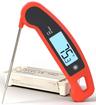
What the Thermapen is actually known for
Four things, and it is worth being precise about them, because an alternative is only an alternative if it covers the ones that matter to you.
- Speed. ThermoWorks publishes a 1-second reading. That matters more than it sounds: every second the lid is open is heat leaving your cooker, and on a hot grill it is also a second your hand is over the fire. Faster readings also mean you take more of them, which is how you find the cold spot in a pork butt instead of trusting one poke.
- Documented accuracy. ±0.5°F through the middle of the range, with a NIST-traceable calibration certificate in the box. Most thermometers under $20 publish no accuracy figure anywhere — which does not mean they are wrong, it means nobody has told you how wrong they are allowed to be.
- Build and warranty. IP67 water resistance and a 5-year warranty. For a tool that lives outdoors, gets grease on it and occasionally gets rinsed, both are real.
- It is a spot-check tool, not a monitor. This is the point most buyers miss. A Thermapen tells you the temperature of the meat the second you touch it. It cannot watch a brisket overnight, and it will not alarm at 203°F. If what you actually need is to know when to wrap and when to pull without standing at the cooker, no instant-read of any price solves that — a leave-in probe does.
That last distinction decides which part of this page you should read. If you need a fast spot check, the first three picks are your shortlist. If you need to monitor a cook, skip to the fourth, and our instant-read versus leave-in comparison explains why most serious cooks end up owning one of each.
The four alternatives against the published Thermapen specs
| Thermometer | Type | Published response | Published accuracy | Water resistance | Warranty |
|---|
| ThermoWorks Thermapen ONE (the original) | Instant-read | 1 second | ±0.5°F mid-range; NIST certificate | IP67 | 5 years |
| Lavatools Javelin PRO Classic | Instant-read | 2–3 seconds | ±0.9°F, −4 to 302°F | IP65 (splash only) | 3 years limited |
| ThermoWorks ThermoPop 2 | Instant-read | 2–3 seconds (4.5" probe) | ±1.0°F, 14 to 208°F; NIST certificate | IP67 | 2 years |
| Alpha Grillers instant-read | Instant-read | 1–2 seconds (listing) | Not published | IP67 (listing) | Not published |
| Typhur Sync Gold Gen2 | Leave-in cordless probe | Continuous — not a spot-check tool | Not published | Not published | Not published |
Read the accuracy column honestly and the Thermapen wins it outright, with the ThermoPop second because it ships with the same calibration paperwork. The gap that matters for barbecue, though, is smaller than the gap in price. USDA’s safe-temperature guidance works in whole degrees — 165°F for poultry, 145°F for whole cuts of pork and beef with a rest — and the done-and-tender window for a brisket or a pork butt is a band of ten or fifteen degrees, not a tenth of one. A thermometer accurate to a degree is accurate enough to cook safe, good barbecue. Where a half-degree starts to earn its money is candy, custard, frying oil and sous vide.
If you want the Thermapen experience for less: Lavatools Javelin PRO Classic
This is the pick for most people searching for a cheaper Thermapen, because it is the same kind of instrument rather than a cheap imitation of one. Lavatools publishes a 2–3 second response, ±0.9°F accuracy across the band you cook in, a −40 to 482°F range, a 2-inch auto-rotating backlit display so the reading is upright whichever way you hold it, and a 3-year limited warranty — longer coverage than the ThermoPop from the same budget.
Two honest costs. IP65 is splash resistance, not submersion: wipe it, do not rinse it under the tap, where both ThermoWorks units are rated IP67. And the retail listing advertises a 2-second reading where Lavatools’ own page says 2–3 — we use the maker’s number, and you should treat the faster claim as marketing. Neither of those changes the verdict: for barbecue this is as much thermometer as you need, and it feels like a tool in the hand.
If you want it from ThermoWorks: ThermoPop 2
The interesting answer to this search is that ThermoWorks makes the cheaper thermometer you are looking for. The ThermoPop 2 publishes a 2–3 second reading on the 4.5-inch probe, ±1.0°F accuracy from 14 to 208°F, a −58 to 572°F range, IP67 water resistance, a defeatable 10-minute auto-off, NSF certification for food equipment and the same NIST-traceable calibration certificate the Thermapen ships with — under a 2-year warranty instead of five.
Two things to know. The speed difference against the Thermapen is real but small; the accuracy difference is a half degree on paper. And a buyer-first note: when we read ThermoWorks’ own store it listed this thermometer at $39.00, below the retail listing we link to. We would rather tell you that than earn the commission quietly — check both before you buy, and if the maker is cheaper, buy from the maker. Our meat thermometer roundup covers how it fits against the leave-in units most smokers end up wanting.
If price is the whole question: Alpha Grillers instant-read
The cheapest fast thermometer we would hand a beginner. The listing states a 1–2 second response, a bright backlit display, IP67 waterproofing and that it arrives pre-calibrated. That is most of the functional difference between owning a thermometer and guessing, for roughly a quarter of what the Javelin costs.
The honest gap is documentation. No accuracy figure is published anywhere for this thermometer, there is no calibration certificate, and no warranty term is stated on the listing we read. That is not evidence it reads badly; it is the absence of evidence either way, and at this price that is the trade. If you want to check one yourself, the ice-water test takes two minutes: a slushy glass of ice and water should read 32°F. Our budget meat thermometer roundup is the wider view of this end of the shelf.
If you actually need a leave-in: Typhur Sync Gold Gen2
Worth saying plainly, because it is the most common mistake in this category: a lot of people shopping for a Thermapen alternative do not need an instant-read at all. If your problem is “I do not know when my brisket is done and I do not want to stand outside for twelve hours”, no handheld thermometer solves it. A cordless leave-in does: the probe stays in the meat, and the base or your phone tells you when to wrap and when to pull.
The Typhur publishes six sensors per probe — five internal and one ambient at the tip, so you read grate temperature and meat temperature from the same probe — and talks to its own LCD base over a Sub-1 GHz radio that Typhur states is ten times stronger than the Bluetooth other cordless probes use, so the reading survives a closed smoker door. What you give up is the spot check: a leave-in is clumsy for checking three chicken thighs in a hurry, which is why most cooks who smoke regularly end up owning one of each. Our wireless meat thermometer roundup ranks it against the other cordless units, and MEATER alternatives is the page to read if that is the cordless probe you were comparing it against. For the spot-check field on its own, including the two picks above, see best instant-read thermometers.
How to choose between the four
- “I want a Thermapen but cheaper.” Lavatools Javelin PRO Classic. 2–3 seconds, ±0.9°F, 3-year warranty.
- “I trust ThermoWorks and nobody else.” ThermoPop 2 — same maker, same calibration certificate, a third of the money.
- “I want the cheapest thing that works.” Alpha Grillers, and run the ice-water test when it arrives.
- “I need to know when the brisket is done.” Typhur Sync Gold Gen2, or any leave-in — not an instant-read.
- “I cook candy, oil or sous vide as well as barbecue.” Then the Thermapen’s published ±0.5°F and 5-year warranty are worth the money, and buying the original is a legitimate answer.
Whichever you buy, the reason to own one is not precision for its own sake. USDA recommends a food thermometer rather than color or time to judge doneness, and on a smoker the number in the meat is the only thing that tells you whether a cook is safe and whether it is finished. If you have not bought any thermometer yet, start with how to choose a meat thermometer and the smoke times and temperatures reference, which is the chart you will actually use it against.