Why mild woods win on cheese
Three things make dairy the fussiest thing in the smoker, and all three push the same way.
- Fat absorbs smoke fast. Smoke compounds dissolve readily in fat, and cheese is mostly fat and water. Two hours of apple smoke on a block of cheddar is roughly as assertive as a whole afternoon of it on a pork butt — which is why the woods we recommend for beef ribs are the wrong starting point here.
- There is no bark to hide behind. On meat, a heavy wood concentrates in a crust that gets sliced through. Cheese has no crust: the smoke flavor sits on the surface you eat directly, so harshness has nowhere to go.
- Nothing cooks off. A long hot cook burns off volatile compounds and mellows smoke over time. A two-hour cold smoke does none of that — what goes on stays on, which is also why smoked cheese improves after a week in the fridge rather than straight off the grate.
Practically, that means apple first, cherry second, and nothing heavier until you know what you like. Hickory and mesquite are not forbidden — some people smoke cheddar with hickory on purpose — but they are a second or third project, not a first one.
Chips, pellets or chunks
With the cooker off, the format decides whether you get smoke at all:
- Pellets— the easiest thing to light in a maze tray or tube and the most reliable at smoldering for hours unattended. A mild blend rather than straight hickory is what you want.
- Chips— work in a maze tray and in tubes whose listings name chips as a fuel, and give you single-species control that most pellet blends do not. This is why the apple chips are the top pick: one wood, no hickory hiding in the mix.
- Chunks— need a fire, so they are not a cold-smoking fuel on their own. The exception is a kettle run deliberately cool with a tiny handful of coals, where one cherry chunk gives color and a softer smoke. It is more work and less controllable than a tray.
The five side by side
| Pick | What it is | Format | Published figure that matters | Role on a cheese day |
|---|
| Weber apple chips | Apple — mild fruit wood | Chips | 2 lb pack (listing); chip size not published | The wood. Mildest common species, single wood |
| Kaduf pellet smoker tray | Stainless maze tray | Burns pellets or chips | Up to 12 hours per fill; listing names hot and cold smoking | The device. Longest unattended run here |
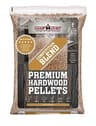
| Camp Chef Competition Blend | Maple, hickory, cherry blend | Pellets, 20 lb | Hardwood pellets (listing) | Easiest fuel to light and keep smoldering |
| Weber cherry chunks | Cherry — mild fruit wood | Chunks | 4 lb (listing) | For a kettle run cool; adds color |
| Realcook 12" hexagonal tube | 304 stainless tube | Burns pellets or chips | Up to 5 hours per fill (listing) | Cheapest device that makes cold smoke |
One number in that table deserves the weight we are giving it: the Kaduf listing states both hot andcold smoking and up to twelve hours from one fill, which is longer than any tube here claims. Neither maker publishes a warranty term, and we print “Not published” on the cards rather than guessing.
Every pick above carried a live Amazon price when we last read the feed, as of November 23, 2026. These are cheap items whose prices move constantly, so the button on each card is the number that counts.
How a cheese smoke actually runs
The method matters as much as the wood, and it is short. Cut the cheese into blocks no more than an inch or two thick and let them dry uncovered in the fridge for a few hours, so the surface takes smoke instead of beading water. Light the tray or tube, let it settle into a thin smoke rather than a flame, and put it at the far side of a cold cooker with the cheese on a rack above the other end. The cooker itself stays off.
Then keep it cold. Pick a cold day or work early in the morning, add a pan of ice under the rack if your cooker or the weather is warm, and pull everything back into the fridge once the smoke is done. FDA’s consumer storage guidance is the authority worth following around all of this: keep the refrigerator at or below 40°F, and do not leave perishable food in the danger zone for more than two hours. Smoking cheese is not a preservation method — it is a flavor method on a food that still has to be treated like dairy.
Two hours of smoke is plenty for a first attempt, and one hour is enough for something delicate like mozzarella. Then wrap it and wait: smoked cheese tastes harsh on the day and settles into itself after a week in the fridge. If the smoke was too much for your taste, use less wood next time rather than a shorter run — a fine, thin smoke over two hours is nicer than a thick one over thirty minutes, which is the same thin blue smoke principle the rest of this site is built on.
What we would buy
- “First time, keep it simple.” Weber apple chips plus the Realcook tube. It is the cheapest complete setup on this page.
- “I want to smoke a lot of cheese at once.” The Kaduf maze tray, whose listing claims up to twelve hours from one fill.
- “I already own a tube.” Then you only need wood — apple chips, or the Camp Chef blend if your tube prefers pellets.
- “I want a deeper color on the rind.” Cherry, as chunks in a cool kettle or chips in the tray.
A tube or tray is useful well beyond cheese: it is the cheapest way to add real wood smoke to a pellet or electric cooker, which is what our smoke tube roundup is about. And if you want the species-by-species version of the wood decision for meat, best wood for smoking covers all eight bags in our registry.